
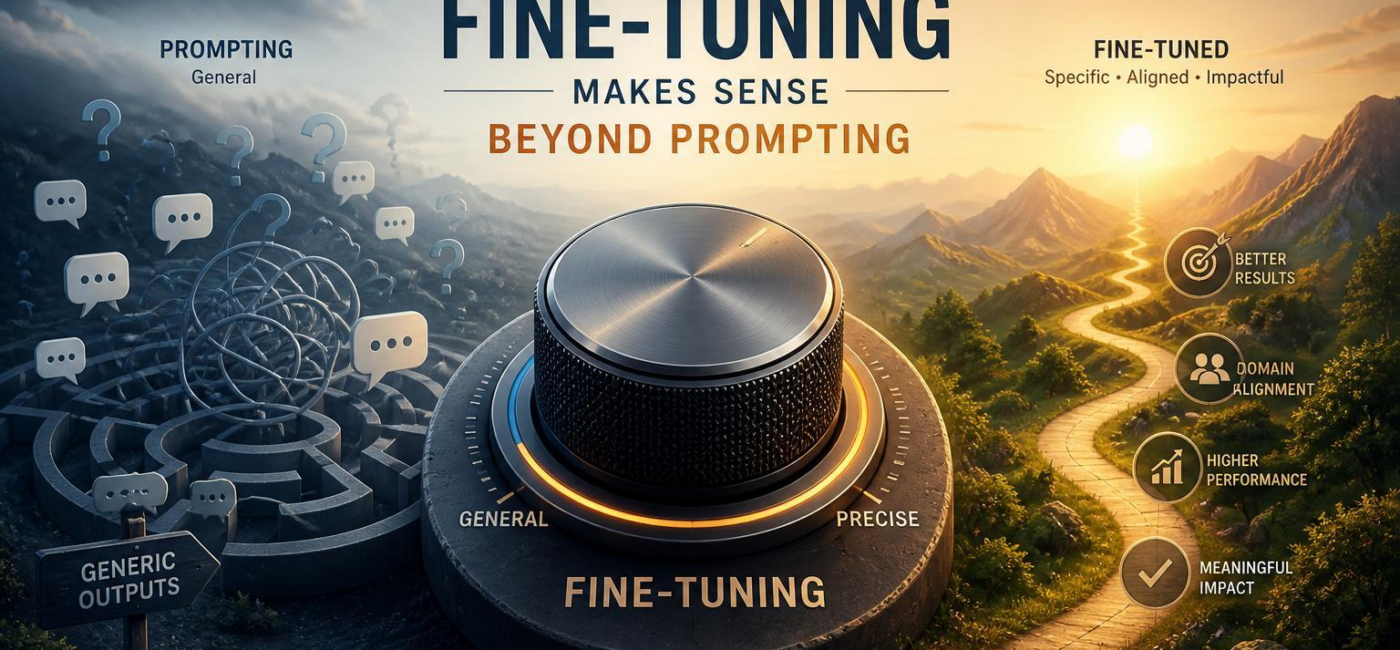
Prompting should usually be the frist move. It is flexible, fast to test, and easy to update when the task or source material changes. But there are cases where prompt engineering reaches a point of diminishing returns. The question is not whether fine-tuning is more advanced; it is whether it solves a recurring problem that careful prompting, examples, and retrieval have failed to solve.
So, when does fine-tuning make sense? It makes sense when you need consistent domain behavior, styleor performance that prompting alone cannot reliably deliver. the best use cases tend to be stable, repeatable workflows wiht clear expectations-not constantly changing work that depends on fresh information or open-ended judgment.
When prompting keeps falling short
A prompt can handle many one-off tasks well. The warning sign comes when the same mistakes continue after you have revised the instructions, added examples, improved the contextand tested the output on realistic inputs.
Maybe the model keeps misreading internal terminology. Maybe it produces the right information but ignores a required structure, slips into the wrong tone, or treats an established business rule as optional. If those problems appear again and again in familiar situations, the issue might potentially be less about finding better wording for the prompt and more about teaching a stable pattern of behavior.
This is especially relevant when a team relies on long, fragile prompts just to get a standard response. A support assistant, for instance, should not need a lengthy explanation of the company’s internal request taxonomy every time it categorizes a ticket. Fine-tuning can help a model learn that recurring pattern from carefully selected examples, so the prompt can focus on the details of the current case.
That does not make prompts needless. Clear instructions, reliable reference material, and human review still matter. Fine-tuning is better understood as a targeted option for situations where the model broadly understands the task but does not consistently follow an organization’s established way of doing it.

Choose work that repeats and matters
Fine-tuning is most useful when the same valuable task shows up frequently enough and there is a reasonably clear definition of a good result. A claims team may need to turn intake notes into a consistent coverage summary. A legal operations group may classify clauses using an internal taxonomy. A catalog team may need product attributes written in a specific format and house style.
In each case, a prompt can explain the goal. But it may need repeated examples, lengthy instructionsand ongoing reminders about labels, exclusions, tone, or formatting. A fine-tuned model can carry more of that recurring pattern into its default behavior, leaving the prompt to provide the facts that are unique to each request.
The strongest candidates are tasks where consistency has a practical payoff and experienced reviewers can generally agree on what the correct output should be. Stable formats, recurring classifications, controlled writing stylesand company-specific terminology are often good fits. Work based on changing policies,current external information,one-off research,or highly ambiguous judgment usually remains better suited to prompting,retrieval,and human oversight.
Train on the actual production decision-not a polished, simplified version of it. the examples should include difficult cases, approved outputsand situations where the right response is to ask for clarification, flag uncertainty, declineor hand the work to a person. Fine-tuning solely to make responses sound smoother is rarely a strong reason on its own.The more compelling case is operational: less repeated instruction, better adherence to a defined pattern, and behavior that is easier to evaluate consistently.
Build a training set people trust
The quality of the training examples sets the ceiling for a fine-tuned model. For domain-specific work, the dataset should resemble the decisions, language, edge casesand output formats the model will encounter in production. A smaller collection of carefully reviewed examples is often more useful than a large archive of loosely related material.
Remove duplicates, outdated guidance, incomplete recordsand examples that conflict with the behavior you want. Every input should have an answer that a educated person in the domain would consider accurate, safeand appropriately limited. If the examples disagree with one another, the model is likely to learn that inconsistency too.
Before preparing the data, agree on the rules: what the model should answer, when it should ask questions, when it should refuse or escalate, how much explanation it should giveand wich terms and formatting conventions it must use. Include realistic hard cases rather than filling the dataset with only clean,obvious examples. the goal is not simply to reproduce preferred phrasing. It is to teach the distinctions that matter in the work.
Decide how you will measure advancement
Before training begins, define what “better” means. A fine-tuned model should not be considered triumphant just because it sounds more confident or matches a preferred tone. The evaluation should reflect the job it is meant to do: accuracy, completeness, instruction-following, consistent formatting, appropriate treatment of uncertaintyand the amount of human correction still required.
For customer-facing tasks, brand voice and escalation behavior might potentially be central.For internal workflows, correctness, completenessand fit with the existing process may matter more. In either setting, test whether the model behaves sensibly with routine requests, incomplete information, ambiguous cases, and requests that fall outside its role.
Compare the fine-tuned version with a strong prompt-only baseline using the same held-out evaluation set.That comparison is essential. Fine-tuning should earn its place through repeatable gains,not a handful of notable-looking examples. If it improves formatting but causes more factual errors, that trade-off should be clear before deployment.
Fine-tuning is not the default answer to every model problem. It is indeed worth considering when a high-value task repeats, the desired behavior is stable, good examples are availableand prompt engineering has already shown its limits. In those situations, it can make model behavior more consistent-and make the overall workflow easier to manage.
AI tools built by Emerald Force
Built and supported by Emerald Force.


You might also like
- How AI Clusters Customer Feedback and Detects Sentiment
- AI Center of Excellence: Standards and Adoption
- Where AI Coding Excels: Tests, Refactors, Scaffolds
- AI Can Fake Documents-Why Verification Is Essential
- Can AI Identify You From a Photo? Key Risks
AI Models Explained: From Inputs to Outputs
- Synthetic Data: Purpose, Uses, and Limitations
- Preparing Students for Success in AI-Driven Work
- How AI Improves Test Prep With Plans and Practice
- Content Provenance: How Media Origins Are Verified