
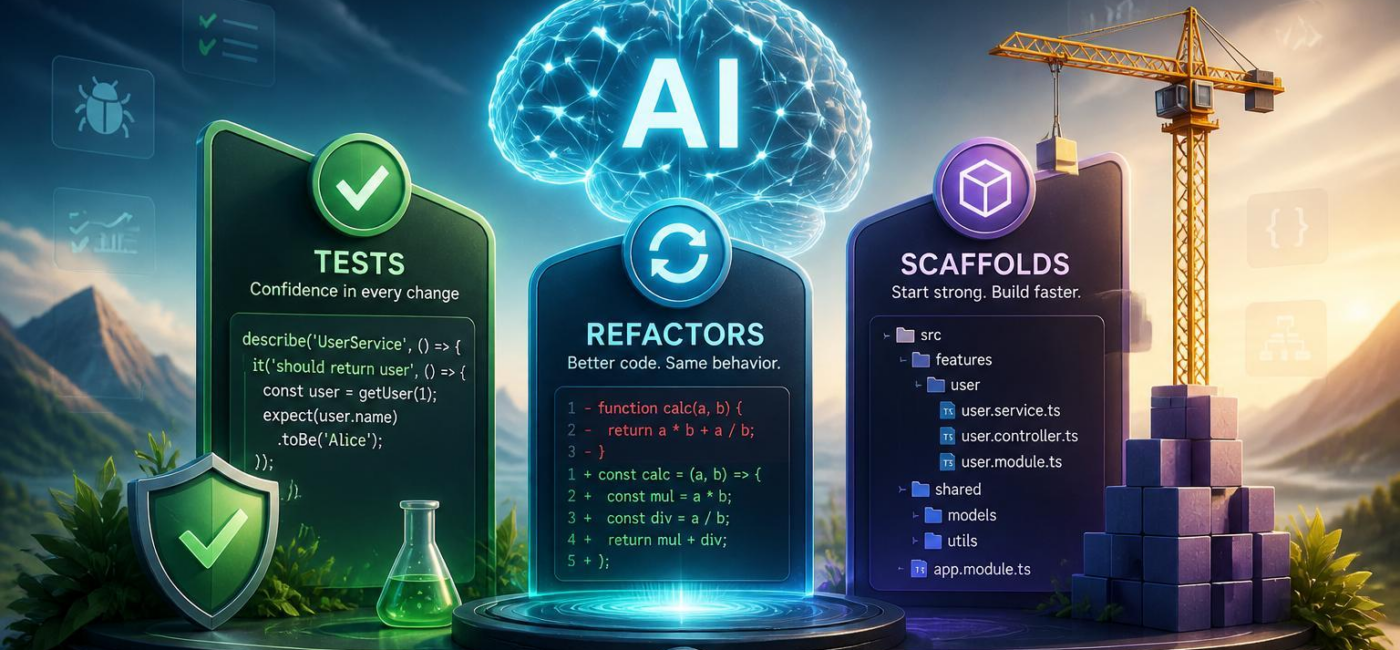
AI coding tools are most useful when the task is narrow, repetitiveand easy to verify. They can produce a strong frist pass for tests, routine refactorsand feature scaffolding, but they still need direction and review. The question is not whether AI can write code; it is which coding tasks dose AI do best. In practice, boilerplate, test generation, straightforward transformationsand small feature scaffolds tend to be the safest places to start.
drafting better tests
AI coding tools can be helpful when you need to turn an existing function, routeor component into a sensible set of test cases. They are often good at spotting the obvious path, boundary values, invalid input, empty statesand error handling that may be easy to miss when you are deep in the implementation.
the crucial word is draft. Generated tests are only useful if they reflect the real contract of the code.A test that merely follows the current implementation can create false confidence; a good test checks what the user or calling code should actually observe. that might mean confirming returned values, error responses, validation messagesor a change in visible UI behaviour.
The same applies to coverage. An assistant may point out untested branches or suggest cases for a conditional path, but coverage numbers alone do not tell you whether the suite is meaningful. code can be executed without any useful assertion being made. AI is useful for finding places worth a closer look, while developers decide which behaviors matter and whether the proposed tests prove them.

handling routine refactors
Refactoring is another area where AI can save time, especially when the change is mechanical. Renaming symbols,updating deprecated APIs,cleaning up imports,extracting repeated code,or applying a consistent pattern across several files are all tasks a coding assistant can usually tackle well.
The safest approach is to give the tool a clear, limited instruction and keep the resulting change small enough to review.Existing tests, type checksand linters provide useful guardrails here. Instead of requesting a sweeping rewrite, ask for one change at a time and verify that behavior has not changed.
That boundary matters. A tool can make code look cleaner while accidentally changing error handling, timing, ownershipor data flow. The closer a refactor gets to authorization, payments, concurrency, public APIs, or other business-critical logic, the more it needs a developer who understands the surrounding system. Let AI handle the repetitive edits; keep human attention on the places where the rules are harder to see in the code alone.
Getting a feature started
New features often begin with predictable setup work: folders, routes, types, configuration, components, service filesand test placeholders. This is where scaffolding can be especially practical. If a repository already has clear conventions, an AI assistant can produce a reasonable starting structure that follows its file names, import styleand organization.
That does not make the generated code a finished feature. It simply removes some of the repetitive setup so the developer can focus sooner on product behavior and edge cases. The best prompts describe the constraints: the existing pattern to follow, the files to create, the validation or test placeholders requiredand the parts that should be left for manual implementation.
For example, asking for a small endpoint scaffold with validation placeholders and a corresponding test file is usually more reliable than asking for an entire feature. Review the structure before building on it. AI can help establish the frame, but people should still decide the domain model, permissions, error behaviorand long-term module boundaries.
Keep review in the loop
AI-generated code earns trust through review, not automatic acceptance. Treat a generated test, refactor, or scaffold as a proposed change with a person responsible for checking it. The reviewer should confirm that it matches the intended behavior, fits the project’s conventions, handles failure cases sensiblyand does not introduce needless dependencies or broader permissions.
Review should be stricter when code touches authentication, personal facts, payments, database migrations, destructive operationsor production configuration. Passing tests and a tidy diff are helpful signals, but they do not guarantee that the requirement was understood correctly.
- Keep generated changes small and easy to trace.
- Require tests for expected behavior as well as rejected or failing cases.
- inspect new dependencies and generated configuration before merging.
For routine scaffolds and straightforward refactors, a normal peer review may be enough. For sensitive code paths, bring in someone who understands the domain and verify the logic manually. AI can speed up the first pass, but the decision to ship remains a human one.
Use AI where the work is easy to check
Tests, mechanical transformationsand small scaffolds are good fits because the output can usually be compared against clear expectations. That is the common thread: AI works best when the task is bounded and the result is easy to verify. Use it to reduce repetitive work, not to replace judgment about the behavior your software should have.
AI tools built by Emerald Force
Built and supported by Emerald Force.
You might also like
- How AI Clusters Customer Feedback and Detects Sentiment
- AI Center of Excellence: Standards and Adoption
- Where AI Coding Excels: Tests, Refactors, Scaffolds
- AI Can Fake Documents-Why Verification Is Essential
- Can AI Identify You From a Photo? Key Risks
AI Models Explained: From Inputs to Outputs
- Synthetic Data: Purpose, Uses, and Limitations
- Preparing Students for Success in AI-Driven Work
- How AI Improves Test Prep With Plans and Practice
- Content Provenance: How Media Origins Are Verified