

AI is most helpful in coding when the work is structured, repeatable, adn easy to verify. That includes generating boilerplate tests, explaining or transforming existing code, cleaning up small sectionsand scaffolding modest features. It is less reliable when the task depends on product judgment, unfamiliar business rules, or a deep understanding of the wider system.
For day-to-day growth, the best approach is simple: let AI produce a useful first draft, then review it like any other code change. Here are the coding tasks AI tends to do best-and where a developer still needs to make the final call.
Tests and edge cases
AI is particularly good at taking a happy-path test and asking, “What happens when this goes wrong?” Given a function, API endpointor UI component, it can quickly suggest cases for empty input, missing fields, malformed values, boundary conditions, duplicate requestsand dependency failures.
That does not mean every suggested test belongs in the suite. Some will repeat existing coverage or test implementation details rather than behavior. But it can be a useful way to surface gaps that are easy to miss during a rushed review. Such as, a function may work perfectly with valid input but behave unpredictably when configuration is absent, an external service times outor a dependency returns an unexpected shape.
The quality of the result depends heavily on the prompt. Tell the tool what the code is supposed to do, what inputs are validand which constraints matter. Then review the generated tests for clarity and relevance. A smaller set of readable tests is far more valuable than a large pile of near-duplicates.
- Worth checking: zero and maximum values, blank or malformed input, unavailable services, partial responsesand failed operations that should leave state unchanged.
Used this way, AI-generated tests are not a replacement for test design.They are a fast way to build a better review queue.
Small refactors and code cleanup
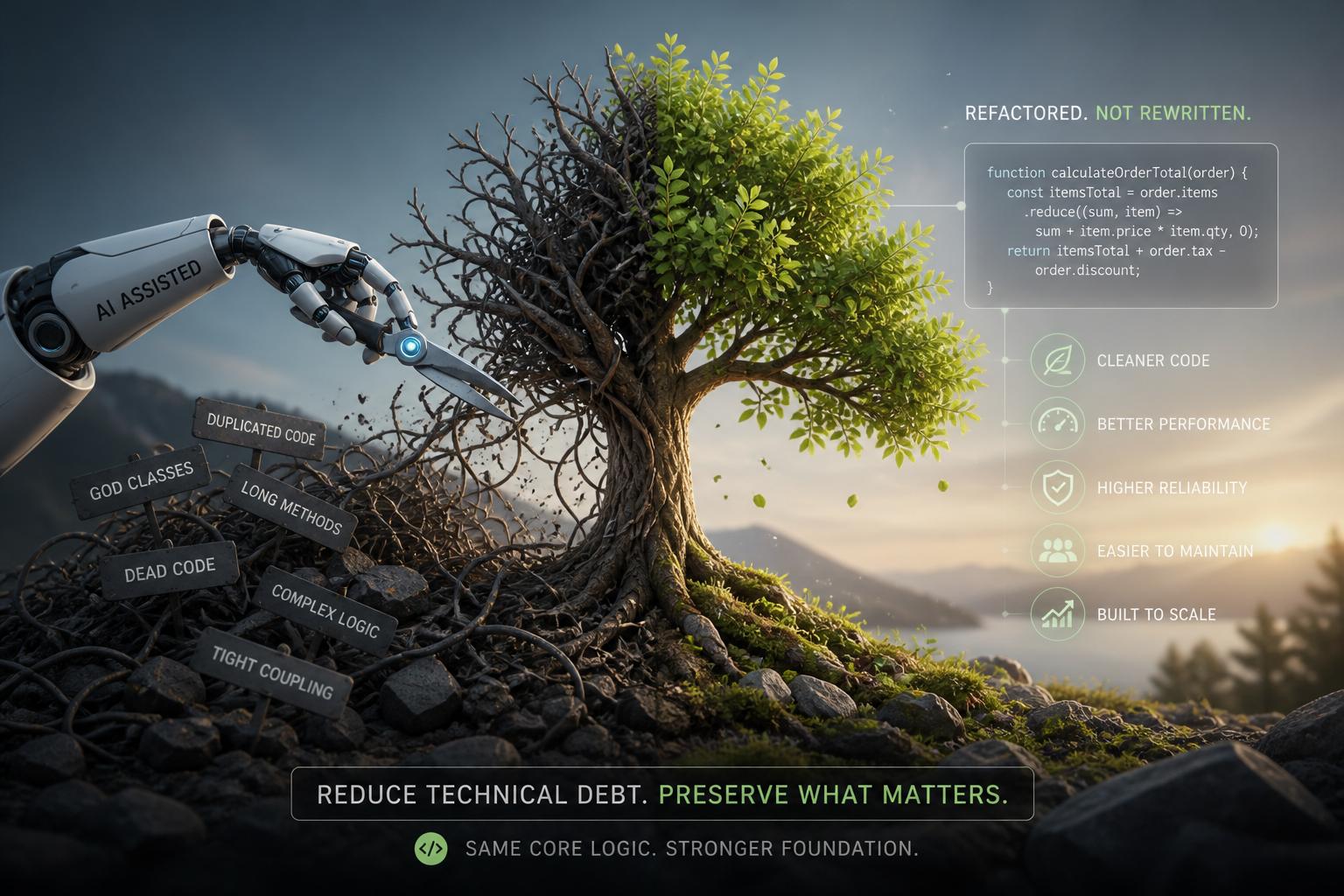
Most technical debt is not dramatic. It shows up as repeated blocks, vague names, long methods, tangled conditionalsand old helper functions that no longer fit the code around them. These are often good candidates for AI-assisted refactoring because the goal is narrow: make the code easier to understand without changing what it does.
AI can propose a first pass at extracting duplicated logic, renaming unclear variables, simplifying a conditionalor separating parsing from validation. That can save time, especially when the advancement is obvious but tedious to write by hand. the useful part is not that the tool makes the decision for you. It gives you a concrete diff to inspect.
Keep these changes small. Ask for one focused refactor, read the result, run the relevant tests, and commit it before moving on. That matters most in older or sensitive parts of a codebase. A payment flow, as an example, may not be a safe place for a broad rewrite, but its formatting helpers or repeated guard clauses may still be straightforward to improve.
Human review remains essential around public APIs, security checks, performance-sensitive code, and business rules.A refactor can look cleaner while subtly changing error handling, data flowor the assumptions another part of the system relies on.
feature scaffolds and routine setup
new features often start with predictable work: creating folders, wiring up routes, adding starter components, writing configuration templates, and setting up matching test files.AI handles this kind of scaffolding well as the work usually follows patterns that already exist in the repository.
Give it the stack, naming conventions, file layoutand a nearby example to follow. It can then draft a feature folder, route skeleton, test fileand configuration stub that fit the project more closely than generic boilerplate would. This is one of the places where explanation, transformationand small feature scaffolding tend to work well: the desired shape is usually clearand the output is easy to compare with existing code.
Still, generated scaffolds should be treated as a starting point. Check imports, dependencies, environment settings, authentication assumptionsand error handling before the new structure becomes the model for future work.A clean-looking folder structure is not useful if it introduces an unnecessary package or carries unsafe defaults into production.
Review is still the final step
AI can draft tests, suggest a refactor, explain unfamiliar codeand assemble the first version of a small feature. What it cannot reliably do is decide whether a change fits the real rules of your system. That requires context: who can access a field, what happens if a request is retried, which failures must be visible to usersand which conventions the team has agreed to follow.
Review is where plausible code becomes dependable code. Read the diff in context, run the relevant tests, inspect error paths and permission checksand make sure the change will still make sense to the next person who works on it. AI is at its best when it removes routine effort and gives engineers more time for that judgment.
The practical takeaway is not to hand over coding tasks wholesale. Use AI for the bounded work: expanding test coverage, cleaning up contained sections of code, translating or explaining existing logicand creating predictable starting structures. then let human judgment decide what actually belongs in the codebase.
AI tools built by Emerald Force
Built and supported by Emerald Force.
You might also like
- AI Can Build Websites: From HTML to Backend Scaffolds
- AI Voice Scams Are Rising: Why Verification Matters
- Letting AI Run Terminal Commands: Essential Safeguards
- AI Lowers Routine Costs, but Expertise Still Decides
- AI Agents Today: Useful but Still Need Oversight
- How AI Enables Robots to Perceive, Plan, and Interact
- Retrieval-Augmented Generation: A Clear Guide
- Why Smaller Tuned Models Win Focused AI Tasks
- Protect Family From AI Scams: Verify Before Paying
- Will AI Become Conscious? No Evidence So Far