
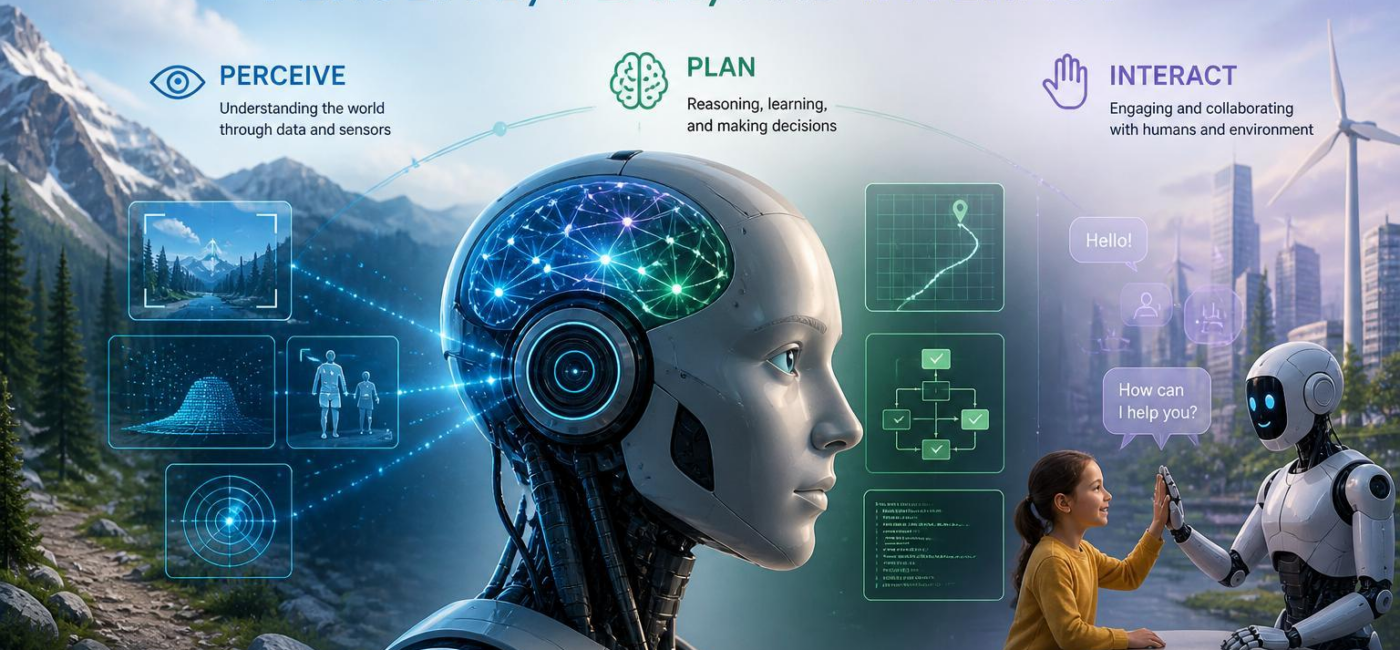
Can robots use AI? Yes. Robotics increasingly relies on AI to help machines make sense of their surroundings, choose sensible actions, control their movementsand communicate with people. That does not mean every robot thinks like a person. Most are built for specific jobs, in specific environments. But AI gives them more flexibility then traditional systems that simply repeat a fixed sequence.
Seeing the world through sensors
Robots do not experience a room the way people do. they work from fragments of data: camera images, depth readings from lidar or stereo vision, pressure from force sensors, sounds from microphonesand position data from their own joints. AI helps turn those signals into something useful. It can help a robot identify objects, estimate where they are, distinguish a person from a chair, and recognize whether a route is clear.
The critically important part is context. A box on a warehouse floor might be an obstacle,a package waiting to be moved,or something that has fallen from a shelf. The right response depends on the task and the situation around it. By comparing sensor data over time, a robot can track movement, notice changes in its surroundingsand update its view when conditions are uncertain.
That matters in ordinary situations: moving around people, finding a safe point to grasp an itemor recognizing that a delicate object shoudl not be handled with the same force as a heavy container. Good perception is not just about labeling what is in front of the robot. It gives the robot enough situational awareness to act with care.
Turning information into action
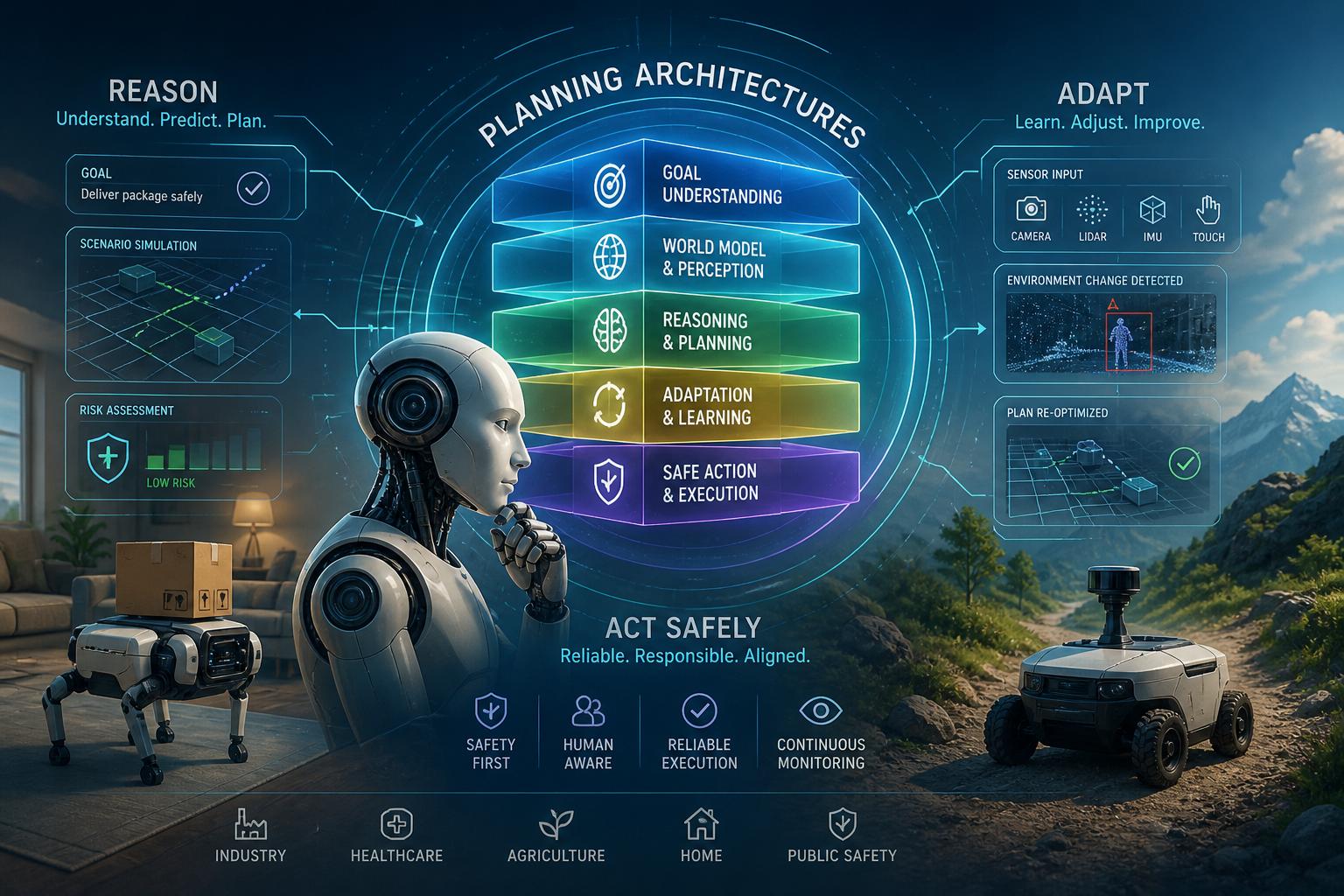
Once a robot has a picture of its surroundings, it needs to decide what to do next. Planning connects what the robot perceives with the job it has been assigned. Instead of reacting to every camera frame on its own, the robot weighs its goal, the space available, physical limitsand what could happen if it takes a particular route or makes a particular movement.
Take a warehouse robot approaching a busy aisle. It may need to wait for someone to pass, take a longer but clearer routeor stop altogether if it cannot see enough to proceed safely. When the situation is uncertain, a cautious response is frequently enough the right one.
Planning usually happens at more than one level. A task-level system may break a job into steps such as finding an item, picking it up, carrying itand placing it in the right location. At the same time, motion control handles the immediate details: avoiding obstacles, staying within reach limitsand moving without losing balance or applying too much force.
Those layers allow the robot to adapt without becoming erratic. If an aisle is blocked or an object is not where it should be, the overall plan can change while the lower-level controls keep the machine steady.Clear limits on speed,force,workspace access,and proximity to people remain essential. AI can make a robot more adaptable, but safe operation still depends on carefully defined boundaries.
Working with people
A robot working around people has to do more than recognize a voice command. It may need to account for timing, gesture, gaze, the immediate taskand whether the request is clear. Simply put, human-robot interaction is as much about understanding intent as it is indeed about processing words.
In a warehouse, a robot might need to recognize a worker’s hand signal before moving a load. In a care setting, it may be better to pause and ask for confirmation when a person seems hesitant than to act on an uncertain instruction. Combining speech, movementand visual cues can make those exchanges clearer, provided the robot is designed to handle ambiguity rather than guess its way through it.
People also need to know what the robot is doing. A useful system gives clear feedback about what it understood, what it plans to doand when it needs help. Its behavior should be consistent enough that workers can anticipate its movements. just as importantly, people should be able to correct it, pause it, or take over when necessary.
Trust does not come from a pleasant voice or a humanlike face alone. it comes from repeated interactions that are understandable and reliable. A robot that admits it needs another instruction is usually safer-and more credible-than one that confidently acts on the wrong assumption.
Putting intelligent robots to work
Reliable deployment starts with a clearly defined job, not a broad promise of general intelligence. Before introducing a robot, teams should be specific about where it will operate, which objects it needs to recognize, what decisions it can make on its ownand when it must stop or ask for help.
Testing should reflect real working conditions, not just a tidy demonstration area. Poor lighting,clutter,reflective surfaces,unreliable network connections,unexpected people,and misplaced objects can all expose gaps that are easy to miss in a controlled setting. A robot that works only when everything goes according to plan is not ready for everyday use.
- Build in clear stop states, manual controlsand a straightforward way for staff to take over.
- Track more than speed: completion rates, exceptions, near misses, downtimeand operator feedback all matter.
- Introduce changes gradually, test them in the real environmentand keep a proven rollback option.
AI for robotics also needs ongoing care. Cameras, sensors, maps, batteries, modelsand software updates all need attention, with clear ownership for each part of the system. When unusual situations arise, teams should document them and turn them into repeatable tests before changing the robot’s behavior.
Ultimately, AI helps robots perceive, planand interact more effectively, but it does not remove the need for careful design and human oversight. The strongest deployments pair capable software with practical operating rules, thoughtful testingand people who know when the robot should proceed-and when it should stop.
AI tools built by Emerald Force
Built and supported by Emerald Force.
You might also like
- AI Agents Today: Useful but Still Need Oversight
- How AI Enables Robots to Perceive, Plan, and Interact
- Retrieval-Augmented Generation: A Clear Guide
- Why Smaller Tuned Models Win Focused AI Tasks
- Protect Family From AI Scams: Verify Before Paying
- Will AI Become Conscious? No Evidence So Far
- Where AI Agents Excel: Structured Digital Workflows
- How AI Strengthens Finance Teams and Reporting
- Can AI Fake Photos? How Synthetic Images Look Real
- AI Handles Routine Service; Humans Handle the Rest