
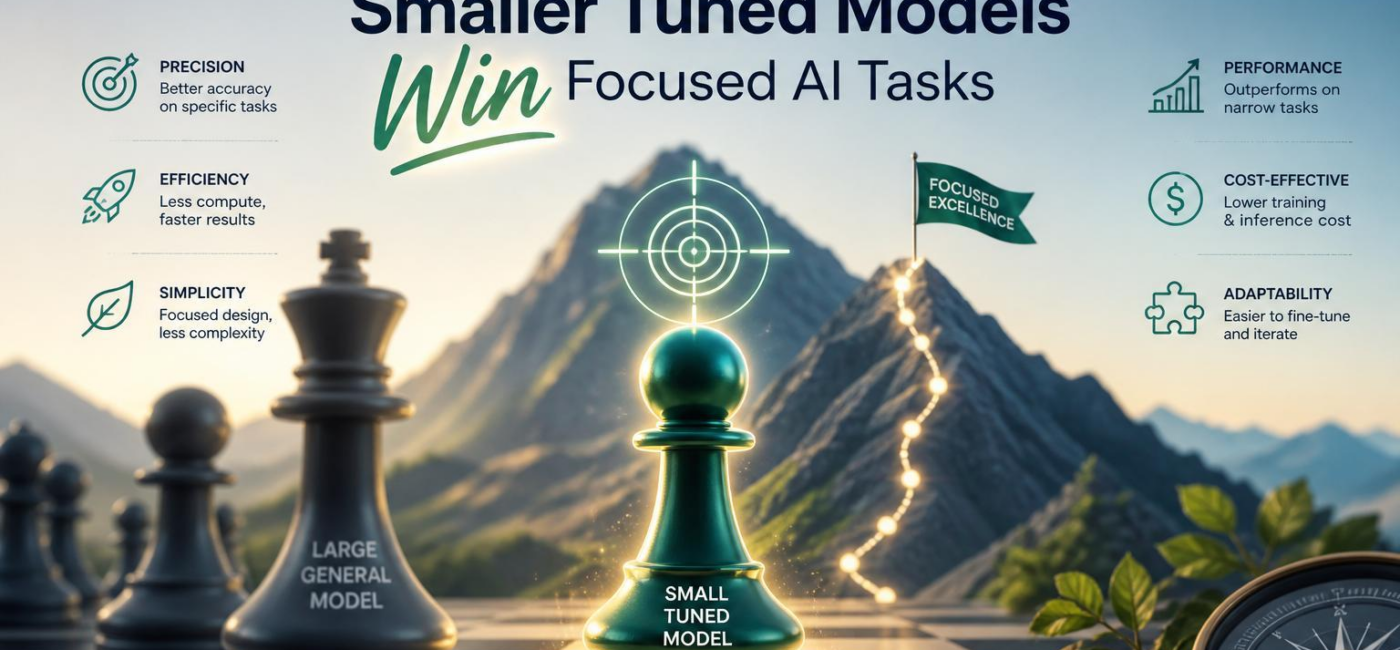
Can smaller models be better? Often, yes. For focused AI tasks, a smaller model that has been tuned on the right examples can be cheaper, fasterand more than capable of meeting the quality bar. The key is matching the model to the work. A general-purpose model might potentially be useful when a request is broad or unpredictable, but many day-to-day jobs have clear inputs, familiar patternsand a well-defined outcome.
Better at the Work It Was Trained to Do
A smaller model trained on the language, decisionsand edge cases of a specific domain can be more dependable than a larger general model for that particular job. Consider compliance reviews, support-ticket triageor product categorization. Each depends on vocabulary, policiesand judgment calls that may not be obvious from a broad prompt alone.
Fine-tuning helps the model recognize the distinctions that matter in that habitat: the wording of a policy clause, the difference between two similar support issuesor the category rules used by a product team. It is indeed not about making a smaller model universally smarter. It is about giving it a narrower assignment and enough well-chosen examples to handle that assignment consistently.
This also makes evaluation easier. A team can test the model against realistic requests, identify where it failsand improve the examples or instructions behind those failures. A focused model works best when the task has clear boundaries, repeatable standards, and domain knowledge that can be captured in training data. For many production tasks, relevance matters more than raw model size.

lower Cost, Faster Responses
Once an AI feature moves beyond a prototype, the cost of each request starts to matter.Smaller models generally need less compute to produce an answer, which can make them a practical choice for high-volume work such as ticket classification, invoice field extraction, request routingor short responses written in an approved brand voice.
They can also feel quicker in real workflows. When someone is waiting for a result-or when a system is handling a steady stream of requests-response time affects whether the feature is genuinely useful. A tuned model can often return a specific, structured answer without carrying the overhead of a much broader model.
The goal is not to pick the smallest model available. It is to choose the smallest model that reliably does the job. That approach can keep operating costs more predictable, reduce infrastructure demandsand reserve larger models for the cases that truly need broader context or more open-ended reasoning.
Good Training Data Makes the Difference
small models benefit most from training material that is clean, currentand closely tied to the work they will handle. A billing support assistant, for example, needs realistic customer questions, approved resolutions, current policiesand examples of exceptions. It does not need a large collection of only loosely related text.
Start by removing duplicates, outdated guidance, contradictory answersand examples where the desired outcome is unclear. Then make sure the remaining data reflects real variation. Include common requests, but do not leave out the incomplete, ambiguousor unusual cases that cause trouble in production.
- Use current policies and terminology.
- Include edge cases and realistic incomplete requests.
- Keep separate examples for evaluation so performance can be checked honestly.
Annotation deserves careful attention as well.If two reviewers would respond differently to the same request, that is usually a sign that the underlying instruction or policy needs to be clarified before the example is used for training. Clear, direct target responses help establish the right level of detail, while examples that ask for clarification can teach the model not to guess when crucial context is missing.
It also helps to preserve the details that can change an answer,such as a user’s role,region,product tier,or the date a policy took effect. A smaller tuned model does not need to know everything. It needs reliable guidance on what belongs inside its assignment-and what does not.
When a Smaller Model Is the Right Choice
A smaller tuned model is often a strong fit for narrow, repeatable work wiht a stable definition of a good answer. Classification, extraction, routing, structured responses, short-form draftingand defined support flows are all common examples. What matters is not whether the model can discuss every related subject.What matters is whether it can handle the approved inputs, outputsand policies of the request consistently.
This kind of model is also easier to review.Teams can build a useful test set around known failure modes rather of trying to predict how a general-purpose system might behave across an unlimited range of topics.That makes it easier to set quality thresholds, monitor resultsand decide when a request should be handed off.
Clear handoff rules are essential. Requests that fall outside the tuned model’s domain should be redirected, escalatedor declined rather than answered with unwarranted confidence. A larger model may still be the better option for ambiguous requests, unusual exceptionsor work that depends on broad context.
The Best Model Is the One That Fits the Job
Smaller tuned models are not a replacement for large general-purpose models in every situation. They are a practical choice when the work is focused,the quality standard is clear,and the training data reflects what happens in the real world.
For the right task, specialization can deliver dependable output without paying for capabilities the application does not need. Define the job carefully, curate the examples with care, test against realistic casesand give the model a clear path to hand off anything outside its scope. That is often where a smaller model does its best work.
AI tools built by Emerald Force
Built and supported by Emerald Force.

You might also like
- AI Agents Today: Useful but Still Need Oversight
- How AI Enables Robots to Perceive, Plan, and Interact
- Retrieval-Augmented Generation: A Clear Guide
- Why Smaller Tuned Models Win Focused AI Tasks
- Protect Family From AI Scams: Verify Before Paying
- Will AI Become Conscious? No Evidence So Far
- Where AI Agents Excel: Structured Digital Workflows
- How AI Strengthens Finance Teams and Reporting
- Can AI Fake Photos? How Synthetic Images Look Real
- AI Handles Routine Service; Humans Handle the Rest