

Can AI write books? It can certainly help draft them. It can generate scenes, outlines, summariesand pages of usable prose at remarkable speed. But a finished book-whether it is nonfiction or fiction-still depends on human expertise, tasteand revision. The difference is not just grammar or polish.It is knowing what matters, what feels trueand what a reader will carry with them after the last page.
What AI prose Can’t Do on Its Own
AI-generated prose can sound polished even when it has little to say. It is indeed frequently enough good at clear sentences, familiar story beatsand the emotional signals readers expect. But a lasting voice is more than a certain rythm or word choice. It comes from a writer’s judgment: what thay notice, what they leave out, where they let a moment stay uncomfortableand which details they refuse to smooth over.
A machine can mimic the surface of a style, but it does not have private memories, stubborn beliefs, embarrassing mistakesor a point of view formed through experience. Those things give a book pressure and personality. Smooth writing is not the same as insight.
original work also requires choices that are not obvious. Strong books can be strange, inconvenient, funny in unexpected placesor willing to sit with uncertainty. A writer may cut a beautiful paragraph because it makes a chapter too tidy. They may let a character make a bad decision rather than protecting them from consequence. That kind of revision is discernment, not cleanup. AI can offer alternatives and help a writer keep moving, but it cannot decide what is worth saying-or why.
A Book Needs a Human Editor’s Eye
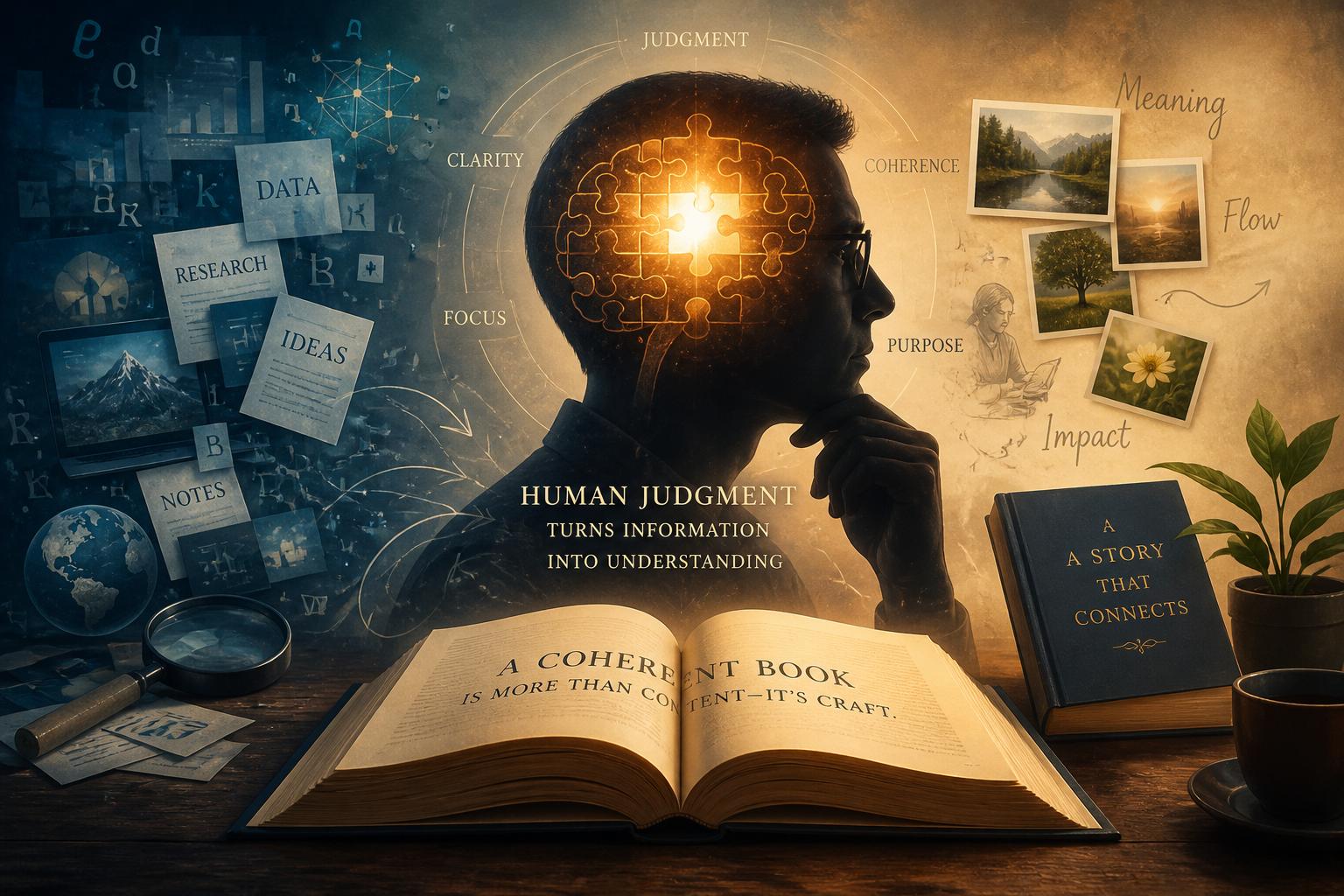
A book is not simply a stack of competent paragraphs.It needs someone to see the whole shape of it: which idea deserves room to develop, which anecdote is doing too much work, and where the reader needs a pause before the argument changes direction.
That is where editorial judgment matters. A human writer or editor can tell the difference between repetition that builds a theme and repetition that merely takes up space. They can hear when a chapter has drifted into a different tone, even if every sentence works on its own. They can recognize when a passage is technically clear but emotionally wrong for the book.
Coherence often comes from decisions that are hard to turn into a prompt.Sometimes the right move is to save a strong passage for later. Sometimes it is to combine two chapters, cut a favorite section, or rewrite an explanation that sounds polished but does not sound like the author. A good editor also asks harder questions: Is this claim fair? Is the source being represented honestly? Does this chapter earn the reader’s attention?
Using AI Without Handing Over the Book
AI is most helpful when it supports the work rather than replaces the writer’s judgment. During research, it can help turn a broad subject into a working set of questions. It may suggest opposing viewpoints to investigate, possible gaps in a timelineor areas that need more reporting. Those suggestions are starting points, not evidence. Facts, quotations, studiesand cultural details still need to be checked against reliable sources.
It can also be useful during outlining and revision. An author might ask AI to flag repeated ideas,summarize the movement of a subplot,identify sections that seem disconnected from the central argument,or suggest a few transitions when a draft has stalled. That can save time and reveal options the writer had not considered.
But the writer must remain in charge. Can AI write books? It can draft parts of one. The author still decides what belongs, what gets cut, what the book meansand how it should sound. The final responsibility for every claim,scene,rhythm,and moral choice stays with the person whose name is on the cover.
Turning a Draft Into a Real Book
An AI-assisted draft should be treated as raw material, not a manuscript ready for publication. Before anyone worries about sentence-level polish, the book needs a clear promise: who it is indeed for, what it offers, and why this author is the right person to make the case or tell the story.
From there, people do the work that turns pages into a book. A developmental editor can test the structure, audience fit, missing perspectives, and weak spots in the argument. A line editor can help replace generic language with prose that sounds specific and credible. Fact-checking, sensitivity review, copyediting, proofreadingand design each protect the reader in different ways.
The process works best when everyone is working from the same brief and someone has the authority to make final decisions. Without that structure, an AI-assisted manuscript can end up technically complete but flat, loosely sourcedor interchangeable with dozens of others.
AI can make drafting faster. it cannot make a book meaningful by itself. The books readers remember are shaped by people who question the easy answer,make tough cuts,and respect the reader’s time. That human attention is not an extra layer added at the end. It is the work.
AI tools built by Emerald Force
Built and supported by Emerald Force.
You might also like
- System Prompts: Rules That Govern AI Behavior
- AI Can Draft Books, but Humans Still Make Them Great
- How AI Reviews Code: Bugs, Tests, Style, and Security
- How AI Is Regulated: From Privacy to AI-Specific Laws
- AI Agent Memory: Goals, Preferences, and Past Steps
Value Lock-In: How AI Can Entrench Narrow Values
- Trust AI for Speed-Verify High-Stakes Facts
Can AI Write Essays? Risks, Accuracy, and School Rules
- How Generative AI Creates Art From Prompts and References
- How Privacy Laws Shape AI Data and Decisions