

Can AI Write Essays? Risks,Accuracy,and School Rules
Can AI write essays? Yes. It can produce a readable draft in secondsorganize ideasand help with wording. But a smooth, well-structured essay is not necessarily a good or trustworthy one. AI-written work can be generic, inaccurateor against school policy, depending on how it is used and what the assignment requires.
Used carefully, AI can be helpful for brainstorming or revising. Used as a shortcut for submitting work you did not actually write or understand,it can create academic and practical problems.
How AI essay tools can get things wrong
AI essay writers generate responses by predicting what language is likely to come next based on patterns in the information they were trained on and the prompt they receive. They can produce a thesis, an outlineand polished paragraphs that sound convincing. What they cannot do reliably is guarantee that every detail is correct.
That is where students can get caught out. An AI tool may mix up dates, names, statisticsor past events. It may oversimplify a elaborate debate or confidently connect facts that do not belong together. It can also misunderstand a vague prompt and fill in missing details with assumptions rather than asking the right question.
the biggest problems often appear when an assignment involves recent events, specialized research, disputed interpretations, or close reading of a particular source. A sentence can sound authoritative and still be incomplete or false. Fluency is not proof of accuracy.
If you use AI during the writing process,treat its output as a starting point to question,not material to accept automatically. Check quotations against the original text, verify factual claims with reliable sources, and make sure the argument reflects what you actually understand.
The academic risks of submitting AI-written work
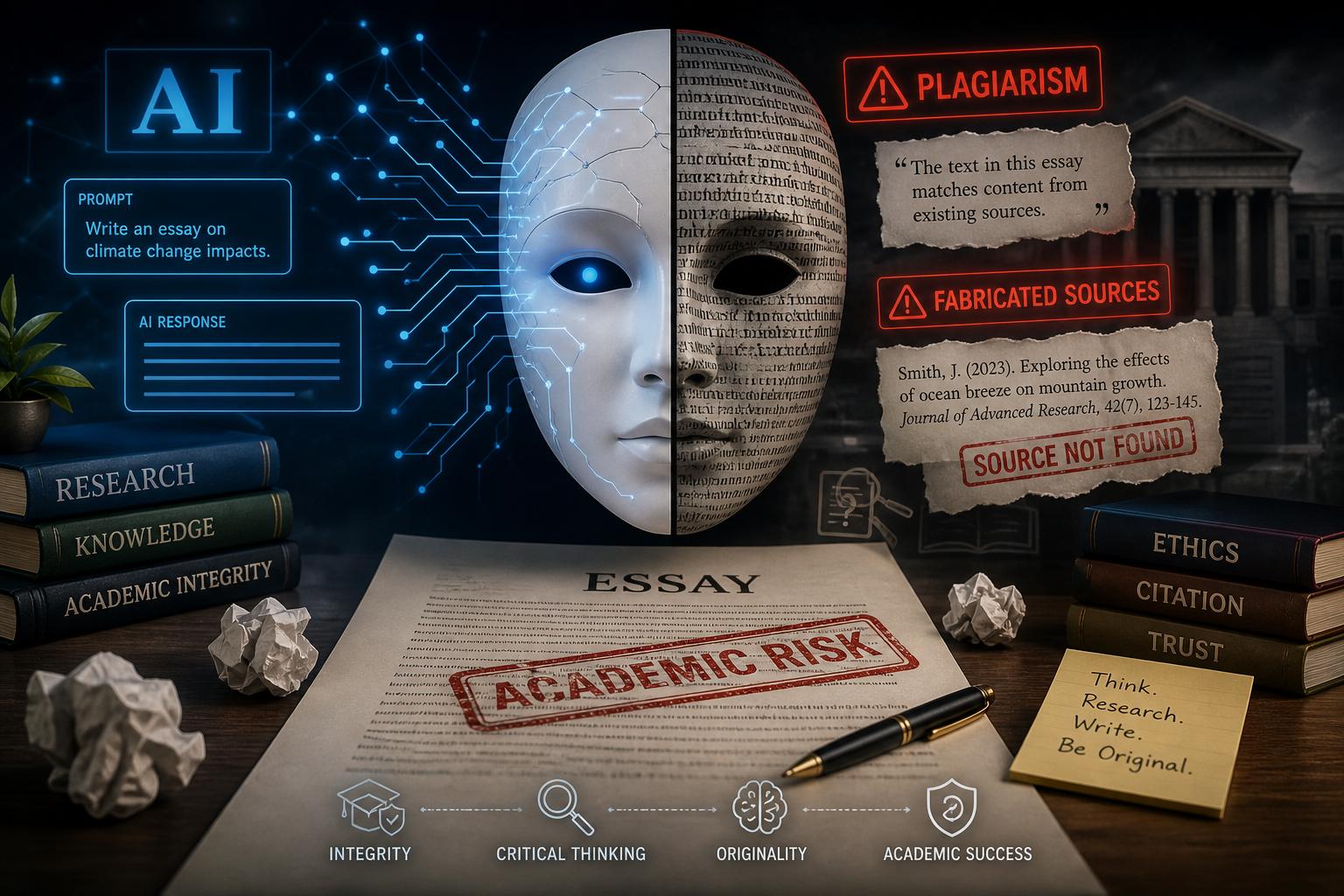
Handing in an AI-generated essay can raise more issues than simply sounding unlike your usual writing. Some tools may produce wording that closely resembles existing material without showing where it came from. Even if you did not copy and paste from a website yourself, submitting uncredited material can still create a plagiarism concern.
There is also the question of authorship. Many assignments are designed to show what a student can read, research, argueand explain independently. Passing off machine-generated analysis as your own may violate an academic-integrity policy, even when the writing itself is original in the narrow sense.
Fabricated citations are another common risk. AI can generate authors, article titles, quotations, publication details, and links that look believable but do not exist. A polished bibliography does not prove that the research is real. Before using a source, find it yourself, read it, and confirm that it supports the point you are making.
A simple rule helps: if you cannot locate the source, explain the claimor defend the sentence in a conversation with your teacher, it should not be in your paper.
What school rules usually mean
School policies on AI are not all the same. One teacher may allow a tool for brainstorming, grammar feedbackor practice questions, while another may prohibit AI-generated writing altogether. A course may permit help with proofreading but not with drafting an argument or writing a final response.
The safest move is to read the assignment directions and your school’s academic-integrity policy before using an AI tool.If the rule is unclear, ask the instructor. Permission to use AI for one part of the process does not automatically mean it is acceptable for every part.
When AI use is allowed, be honest about it if your teacher asks for disclosure. Keep your notes, draftsand research materials as you work. They can show how your thinking developed and make it easier to explain your choices if questions come up later.
Using AI without giving up your own work
AI can be useful as an essay-writing assistant when it supports your process rather than replaces it. Such as, it can definitely help you turn a broad topic into research questions, point out where a paragraph is unclear, suggest ways to improve an outlineor flag awkward wording in a draft you have already written.
The vital parts should still come from you: the argument, the evidence you choose, your interpretation of the sourcesand the final voice of the paper. Rewrite any useful suggestions in your own wordsand remove anything you do not fully understand or cannot support.
- Use AI for feedback or brainstorming only when your instructor allows it.
- verify every fact, quotation, dateand citation independently.
- Keep control of the argument and be prepared to explain every part of the final essay.
AI can make writing feel easier, but it cannot take responsibility for the work. The best use of it is limited and obvious: let it help you think, reviseor spot gaps, then do the research and reasoning yourself. That approach protects your credibility, keeps you within school rulesand leaves you with an essay you can stand behind.
AI tools built by Emerald Force
Built and supported by Emerald Force.
You might also like
- AI Agent Memory: Goals, Preferences, and Past Steps
Value Lock-In: How AI Can Entrench Narrow Values
- Trust AI for Speed-Verify High-Stakes Facts
Can AI Write Essays? Risks, Accuracy, and School Rules
- How Generative AI Creates Art From Prompts and References
- How Privacy Laws Shape AI Data and Decisions
- How to Write AI Prompts That Deliver Results
- AI’s Social Response: Education, Safety, Shared Gains
- Renewable Energy Helps, but Can’t Erase AI’s Footprint
- How AI Models Meaning Without Human Understanding