

Can AI make art? Yes-generative models can create images, music, video, and other media from written prompts or reference material. the result is not usually a perfect translation of what you had in mind, but a new interpretation shaped by the instructions you give, the reference material you provideand the patterns the model learned during training.
How prompts and references guide the result
A prompt is closer to creative direction than a set of exact drawing instructions. It gives the model ideas to work with: subject, setting, mood, color, perspectiveand medium. “A small cabin beneath a violet sky, painted in loose watercolor” tells it something about scale, atmosphere, paletteand style. The clearer those priorities are, the easier it is indeed for the model to produce an image that feels close to your intention.
That does not mean every detail will appear exactly as written. Generative systems make judgments about what matters most,and they may interpret vague or competing instructions in unexpected ways. A focused prompt generally works better than a long string of loosely related descriptors.
Reference images offer a different kind of guidance.They can communicate things that are hard to explain in words: the angle of a face, a muted palette, the open space in a compositionor the texture of a garment. The model uses those cues alongside the written request. For example, “keep the warm dusk colors and wide framing, but replace the city with a coastal village” gives it a clear reason to preserve some qualities while changing the scene.
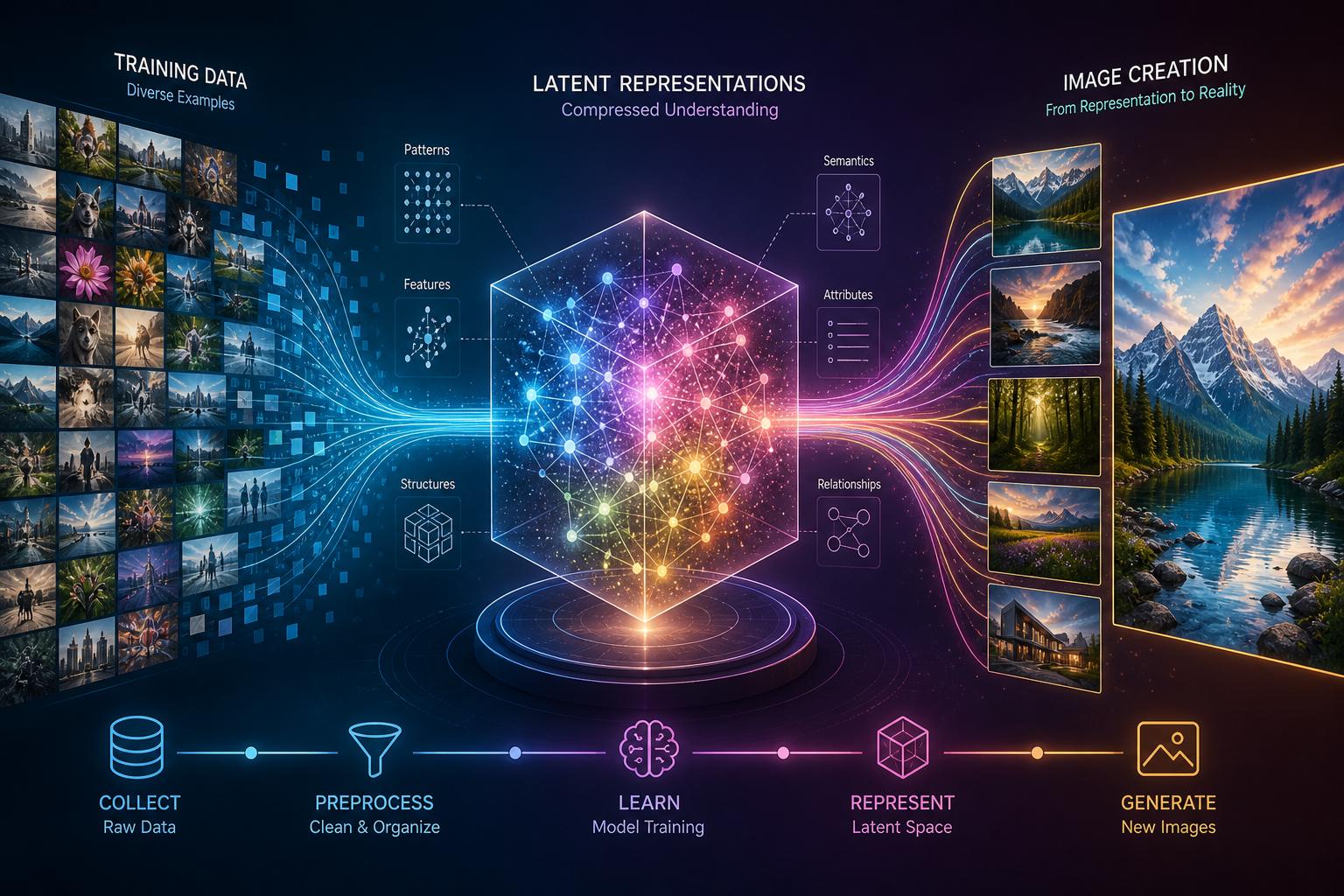
What the model has learned
Generative image systems are trained on large collections of images and,in many cases,the text associated with them. Thru that process,they learn broad visual relationships: what frequently enough makes an object read as a bicycle,how light may behave on metal,or how a watercolor illustration tends to differ from a photograph.
The model does not work like a search engine pulling a finished image from a catalog. It processes learned visual patterns in a compressed internal form, often called a latent depiction, then turns those patterns into a new image. A prompt can steer the result toward ideas such as “foggy harbor,” “ink outline,” or “golden evening light.” A reference image can give the system stronger cues about layout, color, pose, or texture.
As the image takes shape, the system fills in visible details such as edges, shadows, materials, and spatial relationships. that is why results can feel inventive, but also why small changes in wording or reference material can produce noticeably different outputs.
Writing prompts that are easier to follow
A good prompt does not need to be elaborate. It needs to make the important choices clear. Start with the main subject, then add the details that shape the image: composition, lighting, medium, settingand mood. “A red fox” leaves plenty of room for interpretation. “A red fox standing on a snow-covered ridge in side profile, with pale morning light and a distant pine forest, painted in watercolor” gives the model a much more useful brief.
It also helps to state what should stay in the background. If you care most about the fox and the ridge, there is no need to overdescribe every tree. If something is unwelcome,say so plainly: “no text,” “no extra people,” or “no modern buildings.”
Specificity is not the same as length. The goal is to remove confusion, not to bury the main idea under a pile of style labels. Avoid combinations that clash unless the tension is intentional. A request for a minimalist, baroque, cyberpunk watercolor photograph might potentially be captivating, but it asks the model to resolve several competing directions at once.
Using reference images thoughtfully
Reference images are especially helpful when you need to communicate a visual quality that is difficult to name.You might wont the soft late-afternoon light in one image, the camera angle from anotherand the restrained colors of a third.Explain which parts matter. That gives the model room to create something new rather than simply trying to make a close variation of one source.
It is also worth thinking about where those references came from. Do not use another artist’s finished work as a guide for near-duplication,and do not upload private photographs without permission from the people shown. Your own sketches, licensed stock images, public-domain materialsand images you are authorized to use are safer starting points.
The most useful references usually establish a direction, not a template. Pair them with a clear prompt, identify what should changeand leave enough room for the result to develop its own character.
Generative AI is a tool for direction and experimentation
Generative AI can make art from prompts and references, but it works best when you treat it as a creative tool rather than a mind reader. Give it a strong central idea, make your priorities clearand revise the prompt or reference material when the output misses the mark.
That back-and-forth is part of the process. A good result often comes from refining the direction: keeping what works, changing what does notand gradually moving the image closer to the one you imagined.
AI tools built by Emerald Force
Built and supported by Emerald Force.
You might also like
- How Generative AI Creates Art From Prompts and References
- How Privacy Laws Shape AI Data and Decisions
- How to Write AI Prompts That Deliver Results
- AI’s Social Response: Education, Safety, Shared Gains
- Renewable Energy Helps, but Can’t Erase AI’s Footprint
- How AI Models Meaning Without Human Understanding
- AI Can Fake Documents-Why Verification Matters
AI Can Feel Like a Friend, but It Is Not One
- Can AI Take Meeting Notes? It Captures Decisions
- How Platforms Detect AI-Generated Abuse Online