
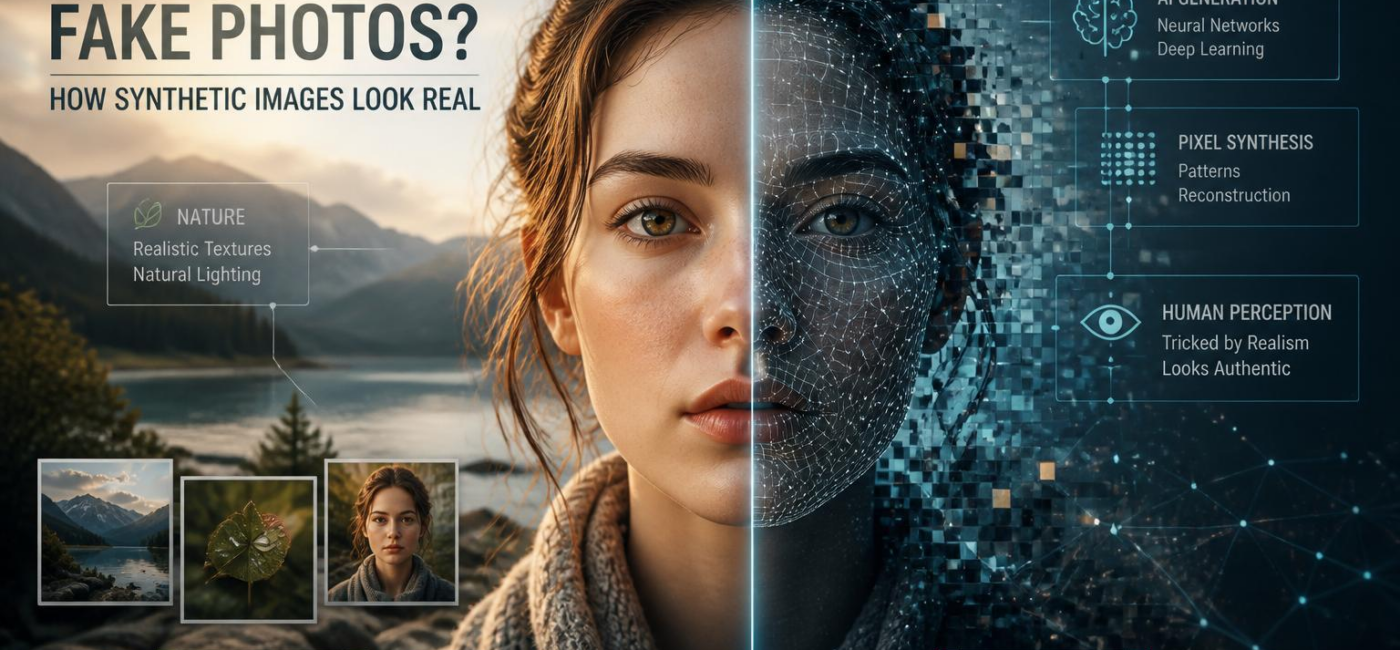
Can AI fake photos? Yes. Image-generation and editing tools can now create scenes,people,and events that look surprisingly real. Some are clearly stylized, but others are designed to resemble ordinary camera photos: a person at a café, a crowded street, a breaking-news imageor a casual selfie. That makes it harder to rely on appearance alone.
Realistic does not automatically mean authentic. The best way to judge a suspicious image is to look beyond the pixels: consider who posted it, where it frist appearedand whether reliable sources can confirm what it claims to show.
Why AI images can look like photographs
AI image tools have learned common visual patterns found in photographs, including lighting, shadows, skin texture, reflections, camera blurand the way backgrounds soften behind a subject. They can recreate the small visual details people tend to associate with a real photo, from a wrinkled shirt to an awkward crop or uneven indoor lighting.
Frequently enough, it is indeed the ordinary details that make an image convincing. A crooked horizon,a passerby out of focus,or a slightly unflattering camera angle can make a synthetic image feel candid rather than carefully made. But a believable look is not the same as evidence. AI can produce a scene that seems physically possible without documenting anything that actually happened.

What to look for in a suspicious image
Many AI-generated photos hold up during a speedy scroll. The problems tend to appear when you slow down and inspect the relationships between small details.Hands, teeth, ears, jewelry, eyeglass frames, buttonsand lettering are still worth a close look. You may notice a finger with an odd shape,an earring that seems to disappear into hair,or a sign that resembles writing without actually saying anything.
lighting can also tell a story. Check whether shadows point in the same direction and whether reflections match the angle of the scene. A window, mirror, polished tableor pair of sunglasses may reveal a different arrangement of people or objects than the image itself. Backgrounds can be another weak point: furniture may blend into a wall, faces in a crowd may repeator objects near the edges may lose their clear purpose.
None of these details proves an image is fake on its own. Real photos can look strange as of compression, editing, motion blur, unusual lensesor a poorly timed shot. What matters is the overall pattern. if several parts of the image seem inconsistent, it deserves more scrutiny.
How to check whether a photo is AI-generated
Start by enlarging the image and looking at the details that need to remain consistent: hands, hairlines, text, reflections, clothing seamsand the edges between a person and the background. A single warped feature may be a harmless editing issue,but multiple mismatched details should raise questions.
- Read signs, labels, book covers, and other visible text closely.
- Check whether paired details, such as eyes, earringsand hands, look consistent.
- Compare shadows and reflections with the apparent light source.
- Search for the original image and review the date, caption, and source.
Source checking is usually more useful than trying to spot a visual flaw. Run a reverse-image search and look for the earliest credible version of the image. If it is connected to a news event, see whether trusted outlets, official organizationsor the photographer have published matching information.An old image reused with a false caption can be just as misleading as a fully synthetic one.
Metadata may offer useful clues, but it is easy to remove or change, so it should not be treated as proof. AI-detection tools can be helpful as a starting point, too, but they are not final judges. Use them as one signal among several, not as the entire case.
Think before you share
take extra care with images that could damage someone’s reputation, cause panicor shape public understanding of an event. Political posts, celebrity images, disasters, conflict footage, and alleged crime photos often spread quickly because they trigger a strong reaction. That is exactly when a pause matters most.
Look for the earliest post rather than the version with the most shares. Read the caption carefully, check the claimed date and locationand see whether other reliable reporting supports the same story. If the image is still unverified, say so plainly instead of presenting it as fact. And avoid reposting a suspected fake just to mock or debunk it; repeating the image can still help the false claim travel.
AI-generated images will continue to get harder to identify by sight alone. The safest habit is simple: treat a photo as one piece of evidence, not the whole story. A realistic image may be real, edited, old, mislabeled, or entirely synthetic. When the stakes are high, waiting for confirmation is usually wiser than sharing first and correcting later.
AI tools built by Emerald Force
Built and supported by Emerald Force.
You might also like
- Can AI Fake Photos? How Synthetic Images Look Real
- AI Handles Routine Service; Humans Handle the Rest
- How AI Can Scale and Tailor Misinformation
- AI Helps Both Sides: Security Choices Decide
- Few-Shot Prompting: Learning from a Few Examples
- Inference Cost: The Compute Behind Model Outputs
- How to Benchmark Tools Before Buying: A Practical Guide
- Can AI Remove Backgrounds? A Proven Vision Use Case
- How AI Clusters Customer Feedback and Detects Sentiment
- AI Center of Excellence: Standards and Adoption