
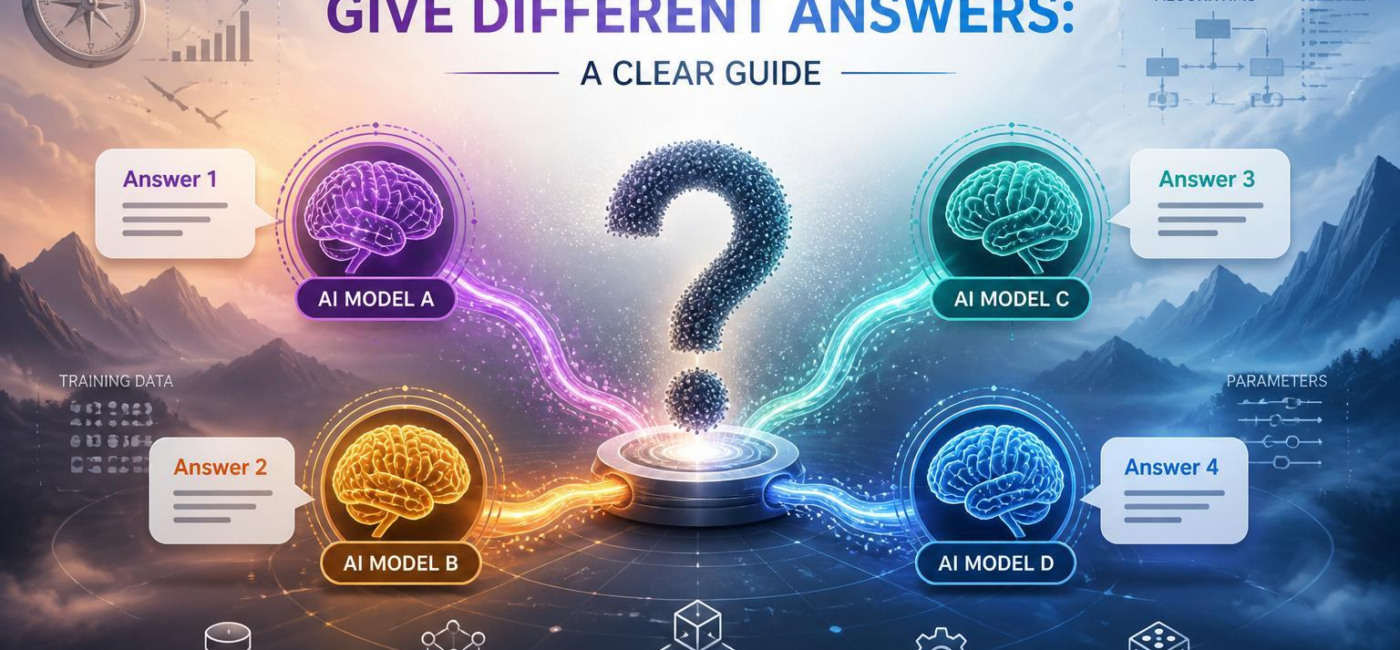
Ask the same question to two AI models and you may get two answers that are both reasonable-but noticeably different. That can be confusing, especially when the question seems straightforward. the short answer is that AI systems are not identical reference books. They are built, trained, tunedand used in different ways.
So, why do different AI models give different answers? They may differ in their training data, design, tuning, safety rules, ability to use contextand access to tools. Even the same model can respond differently when a prompt is phrased another way or run more than once.
Why answers can change
An AI model does not usually pull a single prewritten answer from a database. It generates a response one piece at a time, choosing among many plausible ways to continue. That means there can be more than one sensible path to an answer.
Some systems are set up to be highly consistent,while others allow more variation in wording and examples. A lower-variation setting tends to produce similar responses each time. A higher-variation setting may make the answer feel less repetitive, but it can also shift the emphasis or introduce a different example.
The surrounding conversation matters, too. Earlier messages, platform instructions, available toolsand changes to the model itself can all affect what it says. Different answers do not automatically meen one model is wrong. Sometimes the question leaves room for interpretation, and each model chooses a different angle.
If consistency matters, be specific. say who the answer is for, what format you want, which details to includeand what assumptions the model should avoid making.

Training and design make a difference
Training data shapes a model’s starting point. One model may have learned from more technical material, while another may be better at conversational explanations or creative writing. Models can also be trained to place different weight on caution, directness, helpfulness, or following detailed instructions.
That does not mean one model simply has more knowledge than another. It frequently enough means they have learned different patterns for deciding what belongs in an answer.Ask about nutrition, for exampleand one model may focus on general health guidance while another offers meal ideas.Both may be trying to help, but they are approaching the question differently.
Design choices matter after the initial training as well. Developers decide how much conversation history a model can consider, when it should ask a follow-up question, how it handles uncertaintyand how firmly it should refuse certain requests. Further tuning can shape its style. One model may give a brief answer first; another may explain its thinking at greater length.
Different answers are often the result of different priorities. The prompt matters, but so do the habits the model has developed through training and tuning.
Prompts, contextand variation
Small wording changes can produce surprisingly different results.“Explain this simply” calls for a different response than “Explain this to a software engineer.” add a goal, audience, exampleor constraintand the model has a clearer idea of what you need.
Context works the same way. A model may use details from earlier in the conversation to decide what to explain,what to skip,and what tone to use. If that earlier context is incomplete, misleadingor inconsistent, the response may reflect that.
Then there is variation in generation itself. When several words or phrases coudl reasonably come next, the model may choose differently from one attempt to the next. The main point may stay the same, while the phrasing, examplesand order of ideas change. Lower-variation settings generally make answers more repeatable; higher settings allow more range, sometimes at the expense of focus.
How to get better results
Rather than treating the first response as final,read it the way you would read a draft from a colleague. Check whether it answered the actual question, included the right level of detailand made claims it can support. If you run the same prompt again, look for what stays consistent. Those recurring points are frequently enough more useful than any one turn of phrase.
A few habits help: give the model the audience and purpose, ask for a defined formatand request a second pass for factual gaps, contradictions, or unsupported claims. You can also ask it to separate established facts from suggestions or assumptions. That is especially useful when the topic is technical, sensitiveor likely to change.
Better prompts do not have to be longer. “Make this better” leaves too much open to interpretation. “Rewrite this for a general audience in plain English, keep it under 200 wordsand flag uncertain claims” gives the model a real editorial brief.
Use AI answers as drafts, not verdicts
Different AI models will continue to give different answers as they are different systems working from different instructions, trainingand constraints. That is not necessarily a flaw.It is a reminder to judge the response itself rather than trusting it simply because it sounds confident.
Be clear about what you need, compare answers when the stakes are highand verify important claims with reliable sources. Used that way,AI becomes more useful: not a final authority,but a tool that can definitely help you think,draft,and refine.
AI tools built by Emerald Force
Built and supported by Emerald Force.


You might also like
- Can AI Fake Photos? How Synthetic Images Look Real
- AI Handles Routine Service; Humans Handle the Rest
- How AI Can Scale and Tailor Misinformation
- AI Helps Both Sides: Security Choices Decide
- Few-Shot Prompting: Learning from a Few Examples
- Inference Cost: The Compute Behind Model Outputs
- How to Benchmark Tools Before Buying: A Practical Guide
- Can AI Remove Backgrounds? A Proven Vision Use Case
- How AI Clusters Customer Feedback and Detects Sentiment
- AI Center of Excellence: Standards and Adoption