
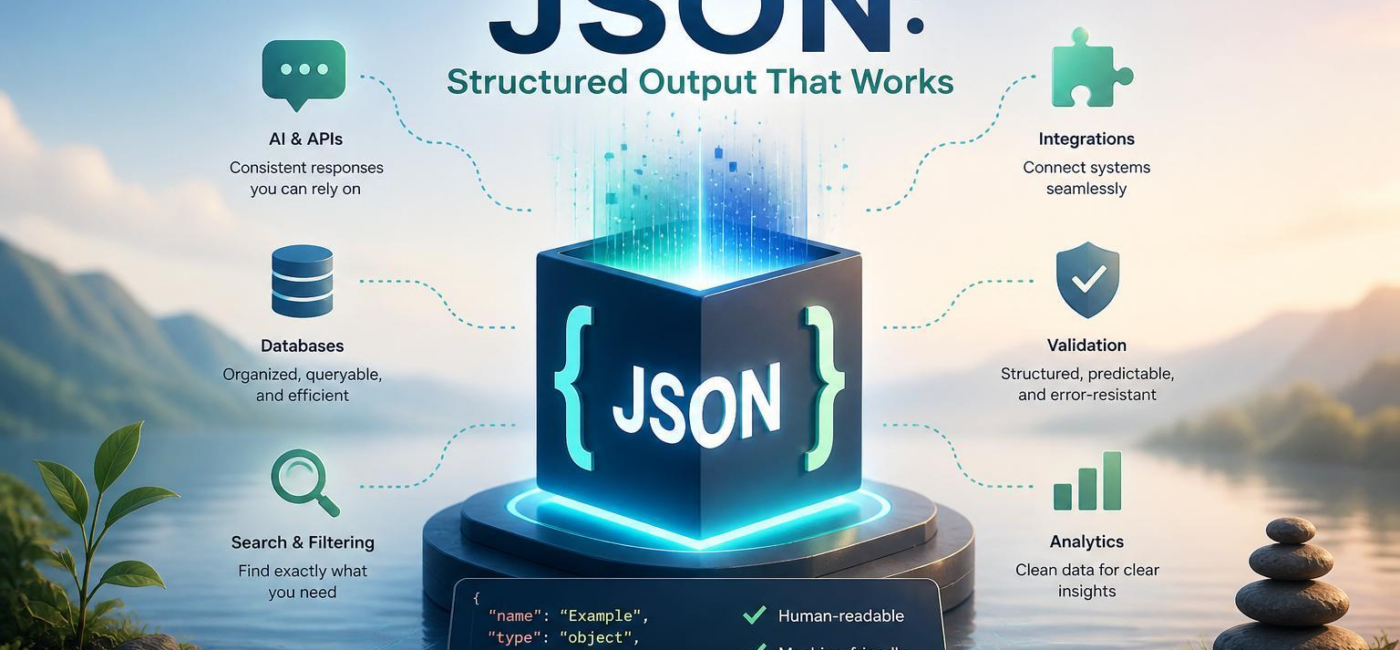
Should I ask for JSON? Yes-when you need structured output that can feed other tools or software. JSON is useful when an answer needs to do more than inform a person; it needs to become a record, trigger a workflow, populate a spreadsheetor pass cleanly into an submission. If the response will be checked field by field, a clear structure is usually better than a paragraph.
When JSON is the right fit
Ask for JSON when consistency matters more than presentation. It works especially well for repeatable jobs were you expect the same pieces of information every time: pulling contact details from emails, turning support messages into ticket fields, classifying feedback, creating product recordsor preparing event details.
A simple test can help: will another system read this response, or will someone need to compare the same fields across many results? If the answer is yes, JSON can reduce ambiguity. Instead of getting a different label or format in every response, you can ask for predictable keys such as name, priority, due_dateor next_step.
That does not mean every prompt needs JSON. Explanations, creative writing, sensitive recommendationsand anything that depends on nuance usually work better in ordinary prose. Use structure when it supports the next step, not as it looks more technical.
before you ask for JSON, decide what should happen when the source does not provide an answer. A null value, an empty arrayor a field that clearly says information is unavailable is much more useful than a confident guess.

Give the response a clear shape
JSON becomes more reliable when you describe exactly what you expect. Name the fields, say which ones are required, and explain the kind of value each field should contain. If a status field can only be draft, publishedor archived, say so. Leaving it as open-ended text invites inconsistent answers that are harder to validate later.
Think of the schema as an agreement between the prompt and the software that receives the result. The model knows what it needs to return, while your application knows what it can safely expect. Required fields should always appear. Optional fields should have clear rules: can they be null, should they be omittedor should they contain an empty array?
Keep the structure as small as the task allows. A product summary might need a name, category, short descriptionand a list of features. It probably does not need a full catalogue model with dozens of unused fields. Likewise, nested objects should reflect real relationships. An address belongs inside a customer record; it should not be scattered across unrelated parts of the response.
Be precise without making it brittle
There is a balance to strike. To little structure leaves downstream code trying to interpret prose. Too much structure can make a simple task unnecessarily rigid. The practical approach is to require the fields that drive an action and leave room for plain-language context where it helps.
such as, an extraction task might need a fixed status value and a facts array, while reason can remain open-ended. That gives software enough consistency to work with while preserving the detail a person may need to review later.
Be explicit about missing information. Decide weather it should be represented as null, an empty arrayor an omitted field, then use that rule consistently. Small decisions like this prevent a lot of cleanup once the output reaches a database, automation, or reporting workflow.
Plan for incomplete or invalid results
A useful JSON response should handle failure as clearly as success. Rather than allowing a stray explanation or half-finished object, ask for a predictable error format. One simple pattern includes an ok field, a machine-readable error_codeand a short message for people.
{"ok":true,"data":{"status":"approved"}}{"ok":false,"error_code":"MISSING_ACCOUNT_ID","message":"account_id is required"}
Your software can then check ok instead of trying to infer meaning from a sentence.If partial results are acceptable, make that clear with fields such as warnings or missing_fields. If they are not acceptable, return a consistent failure object instead of guessing.
It is also worth validating the response before sending it to the next step. Invalid JSON, missing required fieldsand unsupported values should be treated as errors that need a retry or review. JSON is not valuable simply because it is formatted data; it is valuable when the structure is clear enough for people and software to handle it with confidence.
Use JSON when the next step needs it
JSON is a practical choice when an answer needs to become usable data. Start with a small schema, define how missing information should appearand include a clear path for errors. When the output is meant for human reading, keep it human. when it needs to move through software, give it a structure that holds up.
AI tools built by Emerald Force
Built and supported by Emerald Force.

You might also like
- Can AI Fake Photos? How Synthetic Images Look Real
- AI Handles Routine Service; Humans Handle the Rest
- How AI Can Scale and Tailor Misinformation
- AI Helps Both Sides: Security Choices Decide
- Few-Shot Prompting: Learning from a Few Examples
- Inference Cost: The Compute Behind Model Outputs
- How to Benchmark Tools Before Buying: A Practical Guide
- Can AI Remove Backgrounds? A Proven Vision Use Case
- How AI Clusters Customer Feedback and Detects Sentiment
- AI Center of Excellence: Standards and Adoption