

Do you need permission to clone a voice? in many cases, yes. Consent,publicity rights,contracts,privacy rules,and laws aimed at fraud or deceptive impersonation can all come into play. The answer depends on where you are, whose voice is involved, how the clone will be used, and what rights you have to the original recordings.
The safest starting point is straightforward: do not assume that access to someone’s audio gives you the right to create or use a synthetic version of their voice. Get clear permission before you train a model,generate speech,or release anything that could be recognized as that person.
Get clear, informed consent
Permission to “use my voice” is frequently enough too vague for voice cloning. The person should know what they are agreeing to before recordings are collected or a voice model is made. Explain the intended use in plain language: narration, customer support, advertising, entertainment, internal testingor another specific purpose.
It also helps to spell out where the cloned voice may appear, who can use it, whether it may be edited or combined with other materialand how long the permission will last.Consent only means something when the person can reasonably understand the use they are approving.
Give people meaningful choices where possible. They might potentially be comfortable with a voice clone for one training course but not for advertisements, political messages, public-facing callsor material that appears to endorse a product. For sensitive or high-risk uses,written consent should be detailed and separate from broad terms of service.
Keep dated records of the agreement, the source recordingsand any changes to the approved scope. That documentation can prevent misunderstandings later and gives everyone a clearer reference point if questions arise.
Define ownership and allowed uses
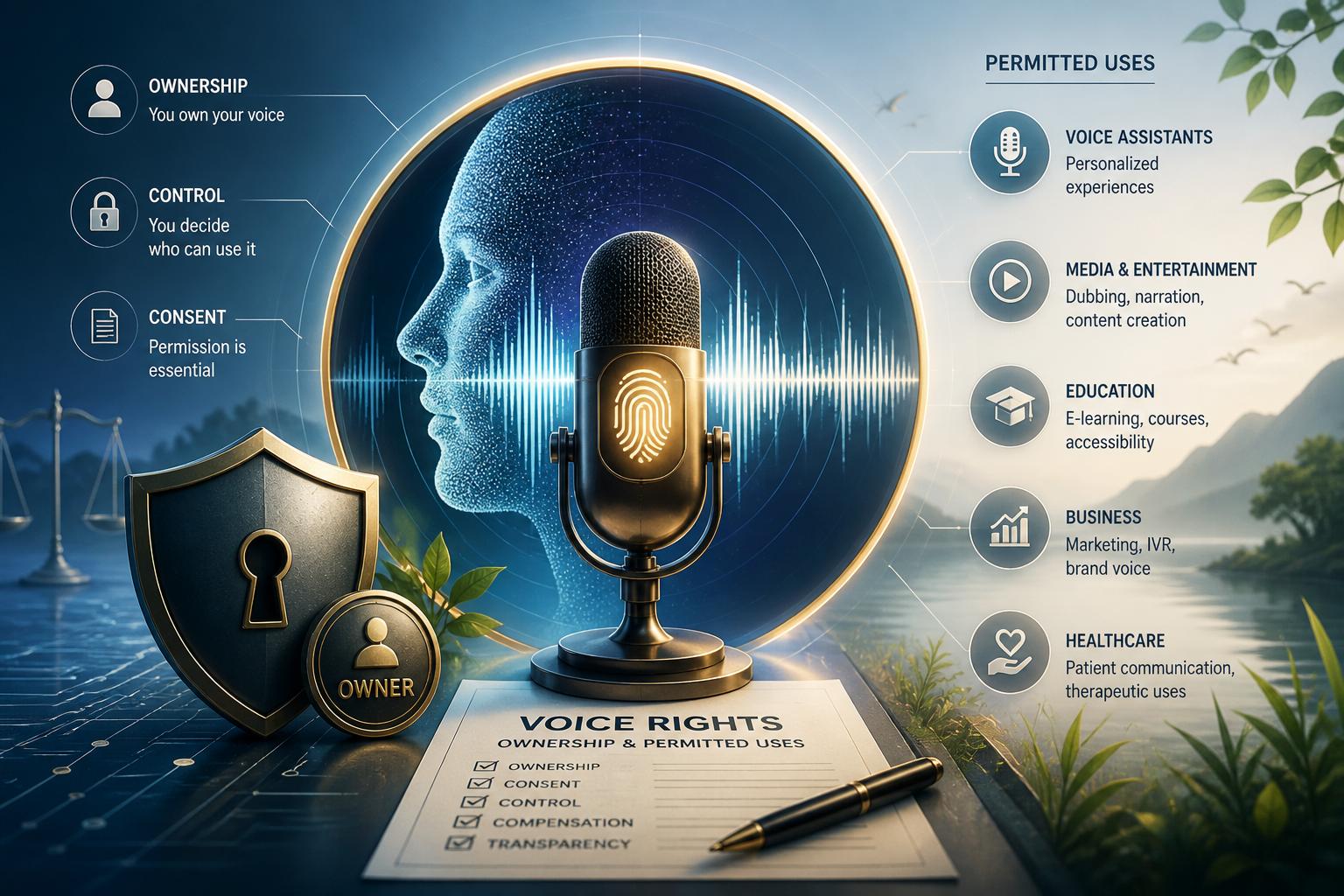
A cloned voice is not a blank asset just because a recording exists. an agreement should address who controls the recordings,the resulting voice model,and any generated audio. It should also say who can access the model, whether it can be copied or adaptedand whether it may be licensed, transferredor shared with another company.
in many situations, the speaker may retain rights tied to their identity and vocal likeness while a client, producer, or platform receives a limited license for a defined project. The agreement should make that division clear rather then leaving it to assumption.
The permitted-use section deserves the same attention. A voice actor might approve narration for a course but not synthetic dialog, customer-service calls, advertisingor content that suggests a personal endorsement. Approval for one use is not approval for every future use.
Be specific about formats, platforms, territories, duration, editing rightsand prohibited uses.If a possible future use is still unclear, it is usually better to seek fresh written permission when the project is defined than to rely on an open-ended clause. The agreement should also cover what happens when the relationship ends, including whether the model must be deleted, archivedor retained only for already approved material.
Understand the legal layers
Voice-cloning projects can involve several different legal questions at once. Permission to record someone does not necessarily include permission to build a synthetic voice.Likewise,approval for an internal demonstration may not cover a public advertisement,podcast,political message,or commercial release.
Publicity and privacy rights often concern the individual behind a recognizable voice. Copyright may apply to the recordings, scripts, performances, musicand other material used in the project. Owning a recording can give you rights in that recording, but it may not resolve claims based on the speaker’s identity or the use of protected content.
A practical agreement identifies the speaker, source recordings, approved uses, distribution channels, territories, durationand whether editing or further model training is allowed. It should also explain how future permission can be withdrawn, subject to the terms of the agreement and applicable law.
- Get written approval before cloning or publishing a recognizable voice.
- Confirm that you have rights to use every recording supplied for training.
- Consider labeling synthetic speech when listeners might otherwise be misled.
- Maintain consent records and a workable process for removal requests.
Laws vary by jurisdiction and are still evolving around digital replicas. Projects involving celebrities,employees,minors,deceased people,financial communications,political content,or broad commercial distribution may need legal review before release. This is especially true when the voice could be mistaken for a real person speaking in real time.
Plan for changes, withdrawaland misuse
A good voice-cloning agreement should not stop at initial permission. It should explain what happens if the speaker later wants to limit or withdraw consent. That may mean stopping future training and new uses, taking down material that has not yet been widely distributed, deleting stored voice dataor notifying partners who received access to the model.
There can be real limits. Material already published, content held for legal complianceor work covered by a fixed-term agreement may not disappear immediately. Still, those limits should be clearly stated. They should not become a blanket reason to keep or reuse a voice indefinitely.
Access controls matter, too. Limit voice files and models to people who need them for the approved workand keep a record of signed terms, approved samplesand later revisions. Those safeguards protect the speaker’s control over a recognizable part of their identity while giving the producer a clear process for handling disputes or unauthorized use.
Use permission as the starting point
Voice cloning can be useful, but it carries more duty than ordinary audio editing. Clear written consent, narrow and well-defined usage rightsand a practical plan for revocation are the foundation of a responsible project.
When in doubt, ask for permission again rather than stretching an old agreement to cover a new use.It is the safer legal approachand it is usually the more respectful one.
AI tools built by Emerald Force
Built and supported by Emerald Force.
You might also like
- AI in Healthcare: Support, Not Autonomous Care
- The Best Prompt Format: Clear, Contextual, Specific
- The Total Cost of Enterprise AI Adoption
- AI Can Scaffold Apps-But Real Products Need Engineers
- Can AI Grasp Causality Beyond Scientific Correlation?
- Voice Cloning Permission: Consent, Rights, and Law
- How Ordinary People Should Use AI Wisely
- AI Sustainability: Scaling Benefits Beyond Costs
- Can AI Upscale Old Photos Without Inventing Details?
- Human-in-the-Loop: Oversight of AI Actions