
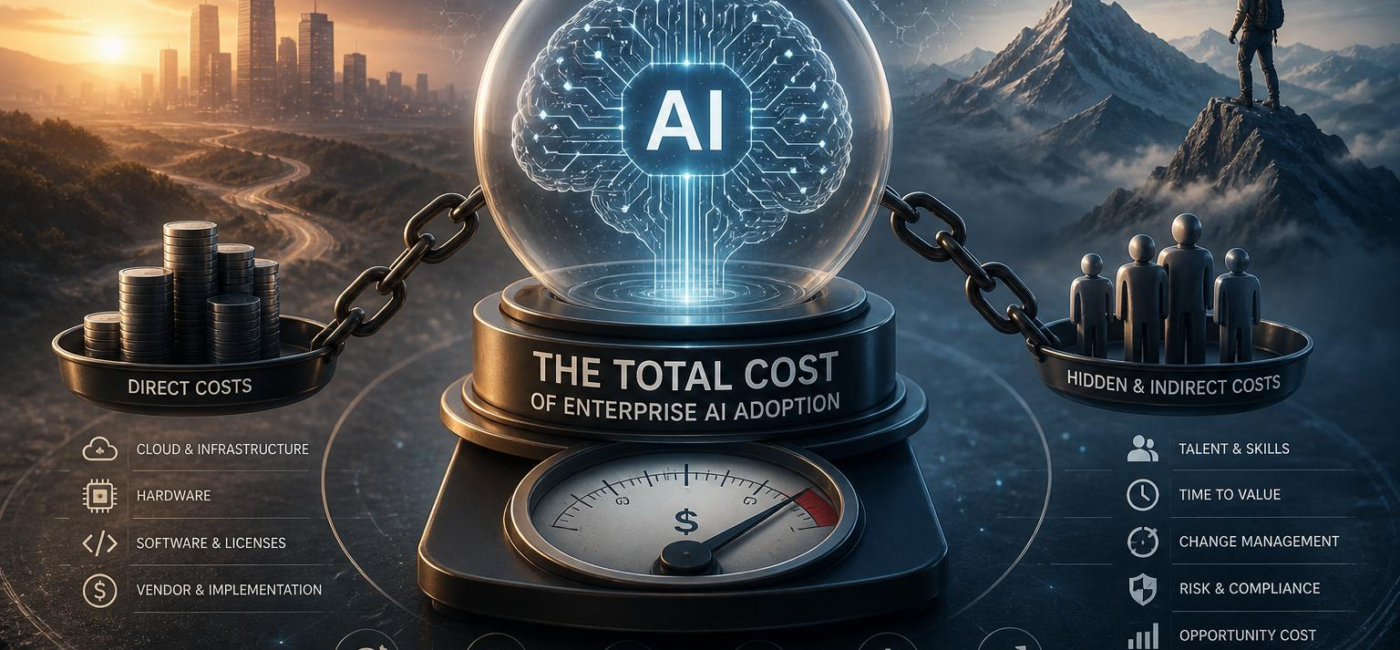
When leaders ask, “What is the total cost of AI adoption?” the answer is much broader than a model subscription or a pilot project. The real budget includes model usage, integration, monitoring, governance, training, change managementand ongoing support. In many organizations, the largest expenses emerge after the first demo-when the work begins to make AI dependable, secureand useful in day-to-day operations.
Data, Infrastructure, and integration
Enterprise AI budgets are often shaped long before anyone chooses a model. Crucial data might potentially be scattered across finance systems, customer platforms, operational databases, shared drivesand department-specific tools. Definitions may differ from one team to another, records may be outdated or incomplete, and access rules may not be clear.
Getting that details ready for AI use takes work. Teams may need to clean and classify data, review retention requirements, clarify ownership, update permissions, and decide which sources are reliable enough to support automated outputs. That effort is not limited to IT.Data owners, security teams, legal reviewers, architectsand business specialists all have a role in deciding what the system can safely use.
Integration is another ongoing cost. An AI tool has limited value if it sits outside the systems where employees already work. Connecting it to approved applications and data sources can require identity management,access controls,logging,audit trails,and processes for handling inaccurate or sensitive results.Those connections also need attention over time as source systems, policiesand business needs change.

People, Governanceand Risk Management
Responsible AI starts with people, not software. Someone needs to own the decisions around how a tool is used, what data it can access, and what happens when it produces a poor result. That obligation is usually shared across IT, security, privacy, legal, procurement, data teams, and the business groups using the system.
Most companies do not need a large, separate AI department on day one. they do need time and accountability from people who can set policies, review higher-risk use cases, challenge assumptionsand respond when something goes wrong. Employees also need practical training: what belongs in approved tools, what information should stay out, when human review is requiredand how to spot an answer that sounds plausible but is incorrect.
Governance and compliance are recurring operating costs, not paperwork to complete at launch. A workable program needs a way to assess vendors, manage access, retain records appropriately, document meaningful decisions, investigate incidentsand review performance over time. The details will vary by industry and jurisdiction,but the basic goal is the same: the association should be able to explain how a use case was approved,monitored,and corrected when necessary.
Responsible adoption has a cost, but so does unmanaged risk.
Scaling and Ongoing Support
A pilot can be relatively contained. Broad deployment is diffrent. As more teams use AI, more employees need training, more workflows need reviewand more exceptions have to be handled. Managers may need to revise procedures, define approval stepsand make clear who is allowed to change prompts, workflows, data permissionsor model settings.
This is where change management matters. People need to understand how the tool fits into their work and where its limits are. Support teams need a clear path for questions, errorsand escalation. Without that structure, adoption can become uneven: some teams rely on the tool too heavily, while others avoid it as they do not trust it or do not know how to use it well.
Maintenance does not end at launch. Teams may need to monitor output quality, investigate failures, refresh knowledge sources, test changes before releaseand revisit workflows as usage evolves. Vendors may change their products or pricing,integrations may require updates,and a workflow that worked in a small pilot may need to be redesigned for wider use. These are core run costs, not side tasks for a project team that has already moved on.
Budgeting for Value, Not Hype
A useful ROI calculation starts with a baseline. Before expanding a use case, document the current cost and quality of the work: handling time, error rates, backlog volume, time spent finding information, manual reworkand the cost of outside support. Then compare those measures with the full cost of running the AI system-not just licenses, but data preparation, integration, security reviews, training, monitoringand ongoing support.
Some benefits are easy to measure, such as fewer manual steps or reduced rework. Others may be less direct but still meaningful, including better access to internal knowledge, more consistent customer responses, faster decisions, or less employee frustration.The important thing is to distinguish between expected value and demonstrated value, then review both regularly.
A sustainable enterprise AI budget treats AI as an operating capability rather than a one-time purchase.It funds the initial use cases while leaving room for evaluation, updates, governance, incident responseand the retirement of tools that do not deliver enough value. Where possible, business units should see the costs tied to the benefits they receive, while shared investments-such as identity management, data controlsand enterprise oversight-remain visible across the organization.
The total cost of AI adoption is not a single line item. It is the combined cost of building, operating, supportingand governing a capability over time. Companies that budget for that full picture are in a better position to decide where AI is worth expanding-and where it is not.
AI tools built by Emerald Force
Built and supported by Emerald Force.
You might also like
- AI in Healthcare: Support, Not Autonomous Care
- The Best Prompt Format: Clear, Contextual, Specific
- The Total Cost of Enterprise AI Adoption
- AI Can Scaffold Apps-But Real Products Need Engineers
- Can AI Grasp Causality Beyond Scientific Correlation?
- Voice Cloning Permission: Consent, Rights, and Law
- How Ordinary People Should Use AI Wisely
- AI Sustainability: Scaling Benefits Beyond Costs
- Can AI Upscale Old Photos Without Inventing Details?
- Human-in-the-Loop: Oversight of AI Actions