
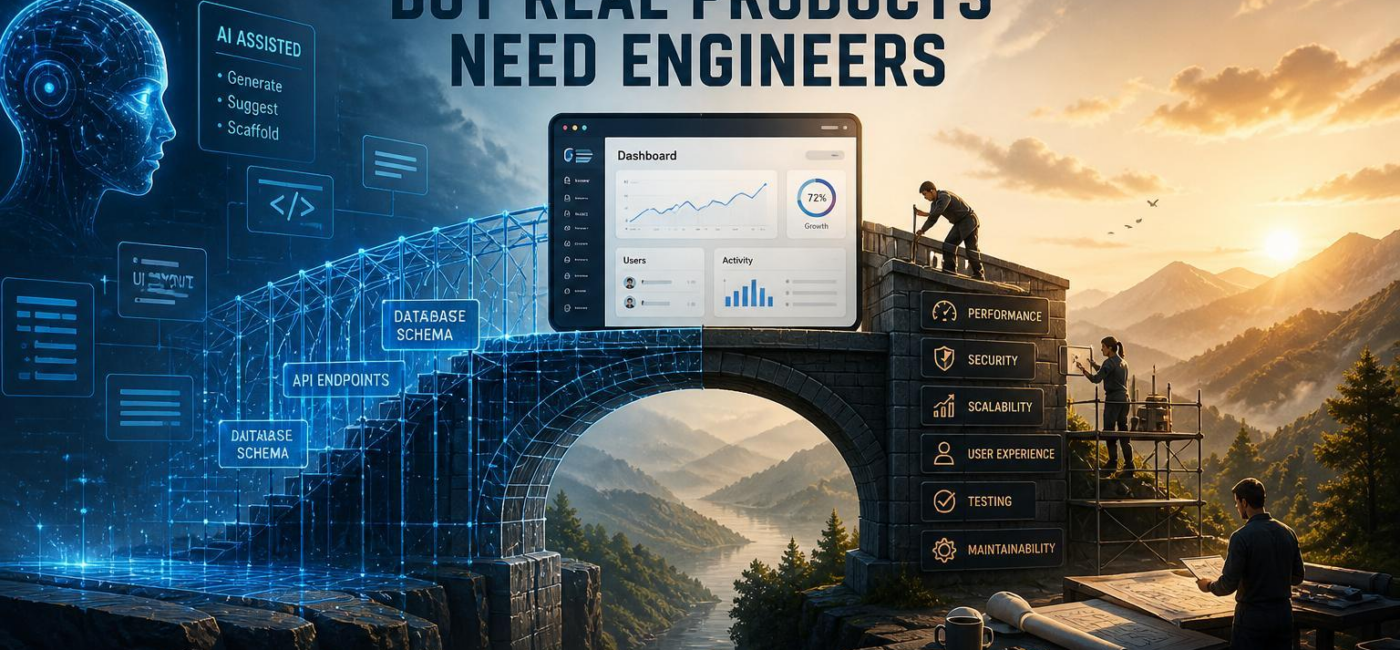
Can AI build an app from a prompt? Often, yes-at least far enough to make an idea tangible. It can generate screens, wire up common user flows, suggest a data modeland produce a prototype in a fraction of the time it once took.That makes it useful for exploring an idea, testing a workflowor giving a team something concrete to discuss.
But a convincing demo is not the same thing as a dependable product. Once real customers, sensitive data, payments, integrationsand day-to-day business operations enter the picture, the work changes. AI can scaffold many apps quickly, especially prototypes, but real products still need review and engineering discipline.
Prototypes Show Possibility. Products Carry Duty.
A generated prototype can answer an critically important early question: does this workflow make sense to people? It may let users sign in, fill out a form, view a dashboardor complete a basic task. That is valuable. It gives an idea shape before a team commits months of effort to it.
Production software has to answer tougher questions. What happens if a customer loses connection halfway through an update? What if two people edit the same record? What if an outside service is slow or unavailable? What if someone tries to access data they should never see?
Those details are rarely visible in a first demo, but they are where trust is won or lost. A prototype suggests that a product could work.A production system needs to keep working when people use it in unexpected ways, when services failand when the business changes its mind about how something should behave.

Security and Reliability Need Deliberate Choices
generated code can quickly create forms, database callsand familiar interface patterns. What it cannot reliably do on its own is make the right tradeoffs for a particular product. Engineers need to decide how users prove who they are, what each person is allowed to do, where sensitive information belongs, and how the system should respond when something goes wrong.
Those are not finishing touches. They shape the application from the beginning. A change to account permissions, a payment confirmationor an update to a customer record may need stronger safeguards than a public marketing page.The difference is not just technical complexity; it is indeed the cost of getting the behavior wrong.
Reliability works the same way. An app that behaves well for a small internal group can expose problems once it handles more requests, larger files, unreliable integrationsor background jobs that fail without anyone noticing. Engineers build in ways to spot issues, recover from themand understand what happened afterward. That can include useful logging, clear alerts, tested backups, safe retry behaviorand a practical plan for rolling back a bad release.
AI can help write parts of that code. engineers decide whether those parts fit together and whether they will hold up outside ideal conditions.
Code Still Needs a Structure People Can Live With
Generated code can look complete at first glance. The routes exist,the forms submit,and the demo does what it is indeed supposed to do. The harder question is whether the next engineer can understand it, change itand troubleshoot it without breaking something unrelated.
Maintainable software has clear boundaries.Business rules should not be scattered across interface components. Billing logic, permissions, customer data, and external-service calls need understandable ownership. When those responsibilities are blurred,even small changes can become risky because no one is quite sure what else they affect.
Good engineering does not mean building an elaborate system before the product has users. It means making sensible choices that leave room to change direction. Teams document important decisions, use consistent names, handle data migrations carefullyand keep temporary shortcuts from quietly becoming permanent foundations.
AI can provide a starting point.Engineers decide what is safe to keep.
Put AI output Through a Real Engineering Process
The best use of AI-generated code is not to skip engineering work, but to move through the early stages faster. Start with the prompt or prototype, then turn it into clear requirements: who is using the feature, what data it affects, what success looks likeand what should happen when something fails.
From there, engineers can review the generated structure, replace generic assumptions with actual business rulesand divide the work into small changes that can be tested. They should check the normal path, but also the awkward cases: missing information, duplicate submissions, expired sessions, failed integrations, and users with limited permissions.
- Set clear acceptance criteria before building.
- Review generated code for security, data handlingand clarity.
- Test real-world failure states, not just the happy path.
Clear ownership matters too. someone needs to decide whether a new dependency belongs in the codebase, whether a database change is safe, and whether the feature remains understandable after release. Code review, automated checks, monitoringand user feedback help turn an early scaffold into something the team can support over time.
AI Makes the First Draft Faster
AI can be remarkably good at getting an app idea off the blank page. It can help teams prototype,explore interfaces,draft code,and reduce the friction of early advancement. That is a meaningful advantage.
Still, software is more than a collection of screens and working demos. Real products need judgment about security, failure, maintenance, operationsand the people who will depend on them. Use AI to build momentum-but keep experienced engineers involved to turn that momentum into software worth trusting.
AI tools built by Emerald Force
Built and supported by Emerald Force.
You might also like
- AI in Healthcare: Support, Not Autonomous Care
- The Best Prompt Format: Clear, Contextual, Specific
- The Total Cost of Enterprise AI Adoption
- AI Can Scaffold Apps-But Real Products Need Engineers
- Can AI Grasp Causality Beyond Scientific Correlation?
- Voice Cloning Permission: Consent, Rights, and Law
- How Ordinary People Should Use AI Wisely
- AI Sustainability: Scaling Benefits Beyond Costs
- Can AI Upscale Old Photos Without Inventing Details?
- Human-in-the-Loop: Oversight of AI Actions