

Can prompting fix hallucinations? Not entirely. Better prompts can reduce hallucinations by narrowing the task, setting clear evidence boundariesand asking the model to acknowledge uncertainty. but prompting cannot replace retrieval, source checkingor human judgment when the answer needs to be accurate and current.
How better prompts keep answers grounded
Prompt design can make an answer more disciplined. Asking a model to summarize an attached report, rely only on named sources, state its assumptionsand avoid filling gaps with guesses usually produces a better result than asking for “the answer” with no context.
those instructions can help reduce familiar problems: made-up citations, overly certain languageand the tendency to blend similar facts together. That is especially useful when the model is organizing material a person has already collected.
Still, grounding and verification are different jobs. Grounding asks what details the response should rely on. Verification asks whether that information is accurate, current, complete, and interpreted correctly. A model can follow a prompt closely while relying on an outdated source, misunderstanding a passageor missing an important exception.
Prompting changes the conditions under wich an answer is written; it does not establish whether the answer is true. For medical, legal, financial, technicalor fast-moving news topics, the final check should rest on reliable evidence and an appropriate human reviewer.
Why verification still needs outside evidence
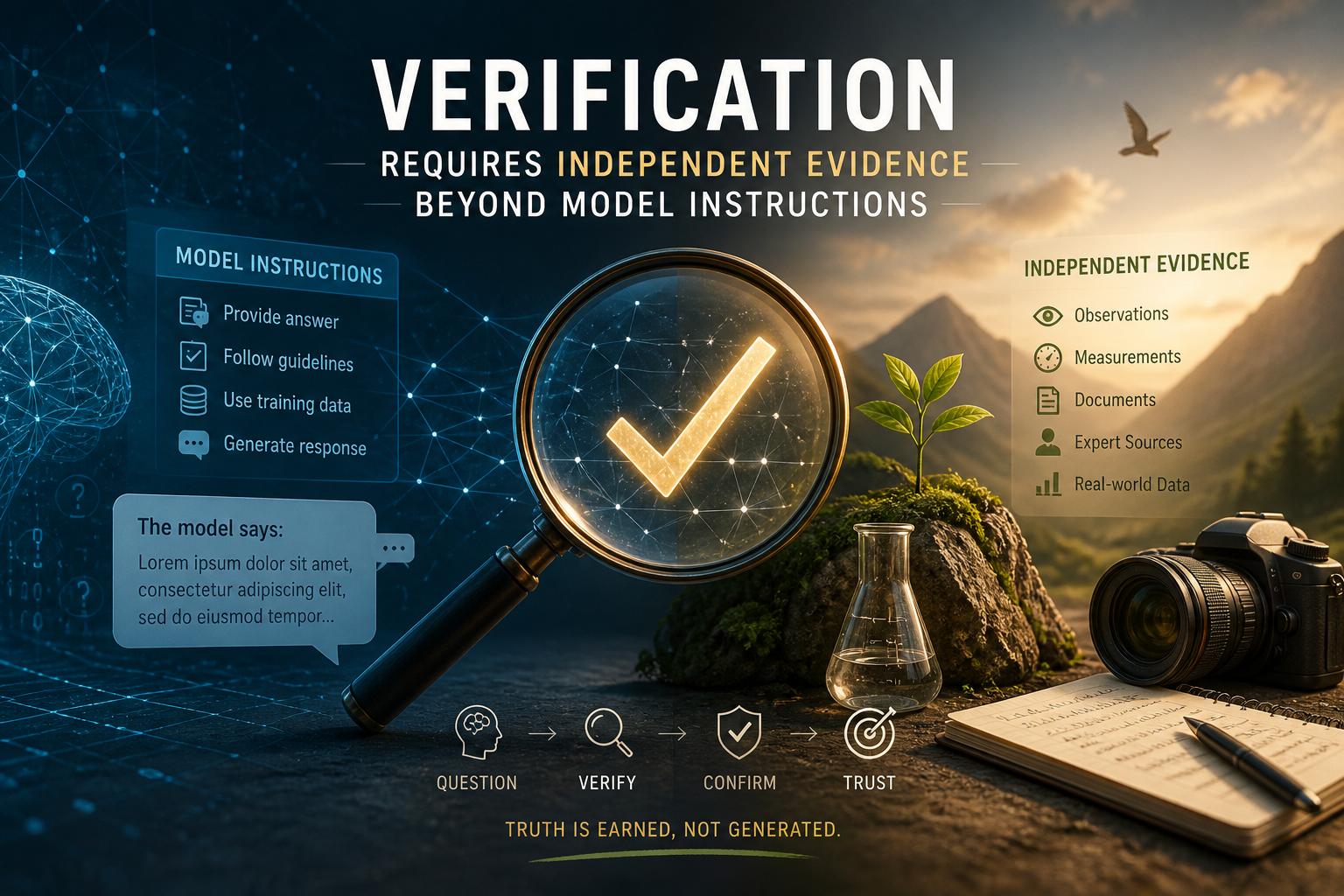
Clear instructions can prevent some avoidable errors.You can ask the model to name its sources, show its calculations, flag uncertainty, or leave out claims it cannot support. Those are worthwhile safeguards. They do not turn a generated response into proof.
A model does not independently confirm that a source exists, that a statistic is currentor that a cited page actually supports the conclusion being drawn. Verification starts where the model’s answer ends.
That means checking important claims against material outside the prompt and outside the model’s own response: a primary document, official filing, reliable database, direct measurementor source that can be reviewed in full context. The stakes are highest in areas where a polished mistake can cause real harm, including healthcare, legal interpretation, financial decisions, current eventsand technical implementation.
Good prompting makes a model more careful. independent evidence is what tells you whether that care led to the right answer.
Prompting habits that lower the risk
The most useful approach is to give the model a clear evidence boundary. Specify which documents,excerpts,dates,or sources it may use,and tell it to say when the available material does not support a conclusion. That reduces the temptation to invent a missing detail, even though it cannot guarantee accuracy.
It also helps to break the task into simple stages: first identify what the source actually says, then note gaps or conflictsand only then draft the answer. For research summaries or comparisons, ask the model to connect each material factual claim to a supporting passage. If the evidence is uncertain, request equally careful language: “the document indicates” is frequently enough more honest than a confident conclusion.
Useful instructions might include:
- Quote or identify the passage supporting each factual claim.
- Mark assumptions, conflictsand unknowns clearly.
- Do not infer names, dates, causesor figures that the source does not provide.
Thes practices can reduce hallucination risk and make problems easier to spot during review. They do not remove the need for someone to inspect the source material, test important claimsand decide whether the answer is fit for use.
Build verification into the workflow
For high-stakes work, verification should be a separate step, not a final sentence in the prompt. Treat the model’s response as a draft that must pass through review. Identify the claims that could cause harm, trace them to approved sources, confirm that those sources support the wordingand make clear who is responsible for approving the result.
The level of review should match the consequence of being wrong. Brainstorming, formattingand low-risk internal summaries may need only a swift check. A recommendation that affects a patient’s care,a legal decision,a payment,a safety procedure,or a public statement deserves much closer scrutiny.
It is also worth keeping a record of the prompt, source material, model output, reviewer edits, and final approval. If a claim cannot be verified, the right response is to flag it, remove it, or send it to someone qualified to resolve it. The answer should not become more confident simply because the evidence is thin.
Prompting can reduce hallucinations, but it cannot fully replace retrieval, verificationor tool use. The reliable approach is simple: use prompts to keep the model within bounds, then use trustworthy evidence and human judgment to determine what belongs in the final answer.
AI tools built by Emerald Force
Built and supported by Emerald Force.


You might also like
- Can AI Fake Photos? How Synthetic Images Look Real
- AI Handles Routine Service; Humans Handle the Rest
- How AI Can Scale and Tailor Misinformation
- AI Helps Both Sides: Security Choices Decide
- Few-Shot Prompting: Learning from a Few Examples
- Inference Cost: The Compute Behind Model Outputs
- How to Benchmark Tools Before Buying: A Practical Guide
- Can AI Remove Backgrounds? A Proven Vision Use Case
- How AI Clusters Customer Feedback and Detects Sentiment
- AI Center of Excellence: Standards and Adoption