

Can AI help with data science? Yes-especially with the practical work that takes up so much time before a model is ever trained.It can definitely help clean data, write notebook code, explain statistical concepts, and draft visualizations. Used well, it does not replace a data scientist’s judgment. It gives them a faster way to inspect information, test ideas, document their work, and spend more time on the questions that actually matter.
Collecting and cleaning data
Data rarely arrives in one neat, analysis-ready file. It may be spread across spreadsheets, forms, sensor feeds, logs, documentsand public records that were never meant to fit together. AI can help identify relevant sources, classify incoming files, extract fields from documentsand flag missing or contradictory values before the data reaches an analysis notebook.
That early work matters. A sophisticated model cannot make unreliable source data trustworthy. Teams still need to understand where their data came from, what it represents, and where its limits are.
AI can also make routine preparation less tedious. It may suggest column types, find duplicate records, standardize dates and names, identify inconsistent labelsand point out unusual values. Those suggestions need review. An outlier might be a typing mistake,but it could also be the most important observation in the dataset. The value of AI here is not automatic cleanup at any cost; it is reducing the repetitive checking so people can focus on context and quality.
Exploring patterns and building features
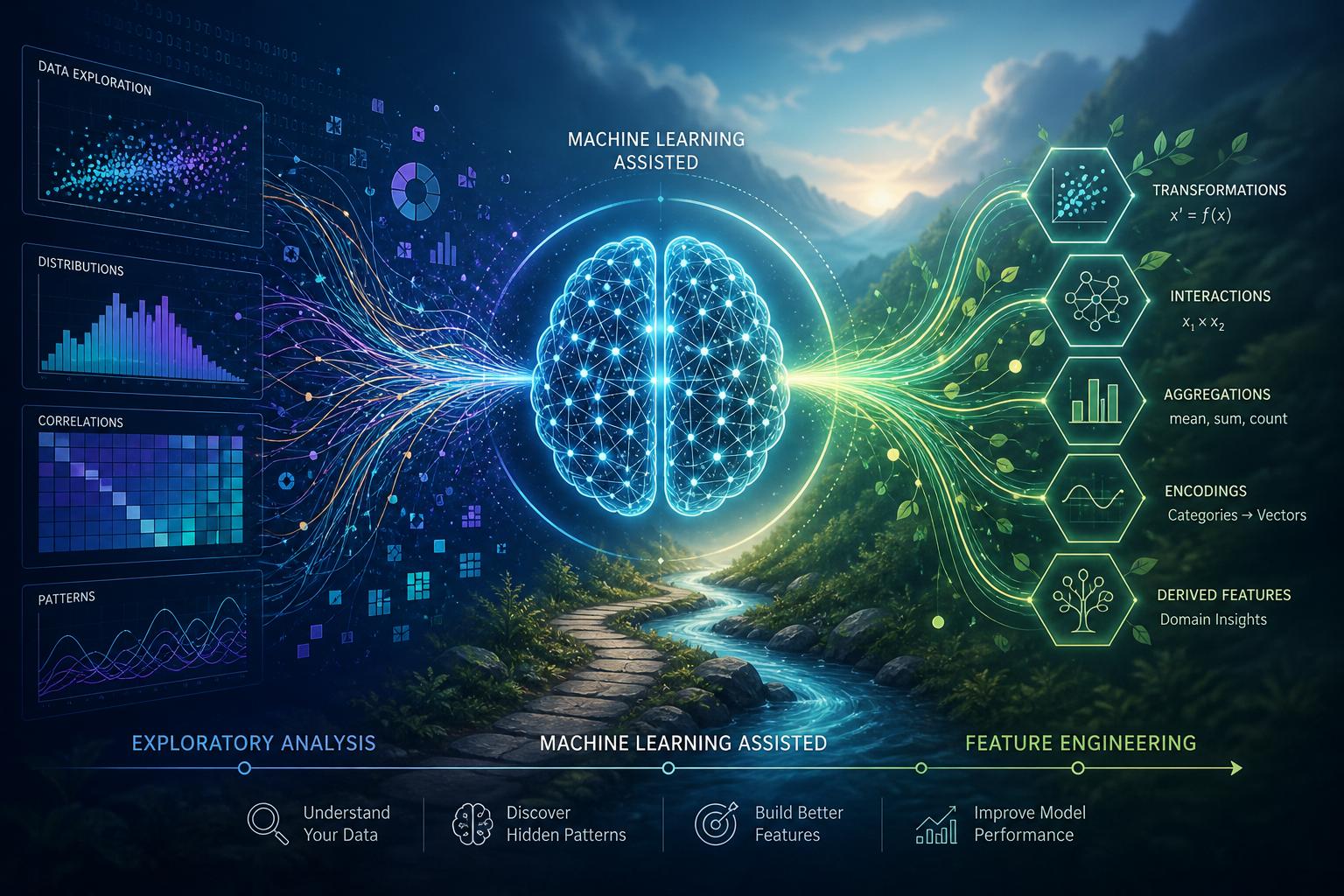
Exploratory analysis is often where a project finds its direction. AI-assisted tools can quickly scan distributions, missing values, outliers, correlationsand unexpected groups in the data. That does not make the findings final. It gives the analyst a useful starting point and a better set of questions to investigate.
For example, a tool may flag a sudden change in customer behavior, an unexpected relationship between two variablesor a field that looks suspiciously incomplete. The data scientist still has to decide whether the pattern reflects a real shift, a collection problemor something that matters to the business.
Feature engineering benefits from the same back-and-forth. AI can suggest transformations, surface related variablesand identify inputs that may not add much value.It can also help draft code for common tasks such as extracting date parts, creating ratios, grouping categoriesor aggregating records. Domain knowledge remains essential, though. A feature can look predictive in testing and still be misleading, hard to explain, or unusable in production.
One especially useful check is looking for possible data leakage: information that would not actually be available when a prediction is made. AI can help spot suspicious relationships or overly strong results, but the team must verify the timing and meaning of every input.
building and testing models
AI can support model development by helping teams organize experiments and catch common mistakes earlier. It can review notebook code, suggest validation approaches, compare model outputsand point out inconsistencies in how data was processed across training and test sets. It can also help explain evaluation metrics in plain language, which is useful when technical results need to be discussed with people outside the data team.
The goal is not simply to chase the highest score. A good model should perform consistently, use sensible inputsand be evaluated under conditions that resemble the real decision it will support. If results vary widely across time periods, customer groupsor validation folds, that instability deserves attention even when the overall metric looks strong.
AI can also help narrow down reasonable settings,feature combinations,and decision thresholds to test. That can save time,but it should not turn model selection into an unchecked automated search. Teams still need to weigh accuracy against speed, interpretability, maintenance effort, and operating cost. Clear records of assumptions, parametersand outcomes make that review much easier.
Monitoring models after launch
Deployment is where a model encounters real data, real usersand real consequences. Performance that looked solid during testing can weaken when customer behavior changes, source systems are updated, or new types of records begin appearing. Monitoring should thus be part of the plan from the start, not an afterthought.
Teams should watch for changes in input data, prediction patterns, error rates, and response time. Where appropriate, they should also review whether outcomes differ in concerning ways across relevant groups. Alerts only help if someone owns the follow-up, so responsibilities and review thresholds need to be clear.
Improvement should be deliberate rather than automatic. New feedback may reveal gaps in the training data or assumptions that no longer hold,but an updated model still needs to be tested before it goes live. Reviewing edge cases, user reportsand verified outcomes can help teams decide whether to retrain, revise the workflow, limit use of the model, or retire it altogether.
Where AI fits in data science
AI is most useful in data science when it acts as a capable assistant: it handles repetitive tasks, offers a fast first passand helps people communicate their work more clearly. It can clean data,write notebooks,explain statistics,and draft visualizations,but it cannot supply missing context or take responsibility for a decision.
The strongest results come from combining AI’s speed with human skepticism, subject-matter knowledgeand careful validation. That combination makes the work faster without making it careless.
AI tools built by Emerald Force
Built and supported by Emerald Force.
You might also like
- Can AI Fake Photos? How Synthetic Images Look Real
- AI Handles Routine Service; Humans Handle the Rest
- How AI Can Scale and Tailor Misinformation
- AI Helps Both Sides: Security Choices Decide
- Few-Shot Prompting: Learning from a Few Examples
- Inference Cost: The Compute Behind Model Outputs
- How to Benchmark Tools Before Buying: A Practical Guide
- Can AI Remove Backgrounds? A Proven Vision Use Case
- How AI Clusters Customer Feedback and Detects Sentiment
- AI Center of Excellence: Standards and Adoption