

Enterprise AI: Secure, Governed Intelligence at Scale
Enterprise AI is AI deployed inside organizations with the security, governance, integrationand reliability requirements that real business use demands. It is not simply a chatbot connected to company data. It is a set of systems that must handle sensitive details carefully, fit into established workflowsand produce results people can review and trust.
Protecting Data, Modelsand AI Interactions
Enterprise AI security starts by recognizing that not every asset carries the same risk. Customer records, internal documents, prompts, model weights, and generated responses may all require different protections.Before data enters a training, retrievalor inference workfloworganizations should know what it contains, who owns itand who is allowed to use it.
Access should be narrowly scoped. A finance analyst, such as, may need to query approved forecasting data without seeing raw customer records or gaining access to the model repository. The same principle applies to employees, servicesand automated agents: give each one only the access it needs to do its job. That reduces the impact of compromised accounts, overly broad integrations, and accidental exposure thru prompts or outputs.
It also helps to separate progress from production. Model registries, vector databases, API gatewaysand monitoring tools should have clear identities, permissionsand audit trails. Input controls, sensible rate limits, output review rulesand logging can reduce the risk of prompt injection, data leakageand misuse without forcing every request through manual approval.
When something goes wrong,teams need to be able to answer basic questions quickly: who used the system,what data informed the response,what model version was involved,and whether a policy changed the result. Those records support incident response, compliance reviewsand day-to-day oversight as the system evolves.
Making AI Decisions Accountable
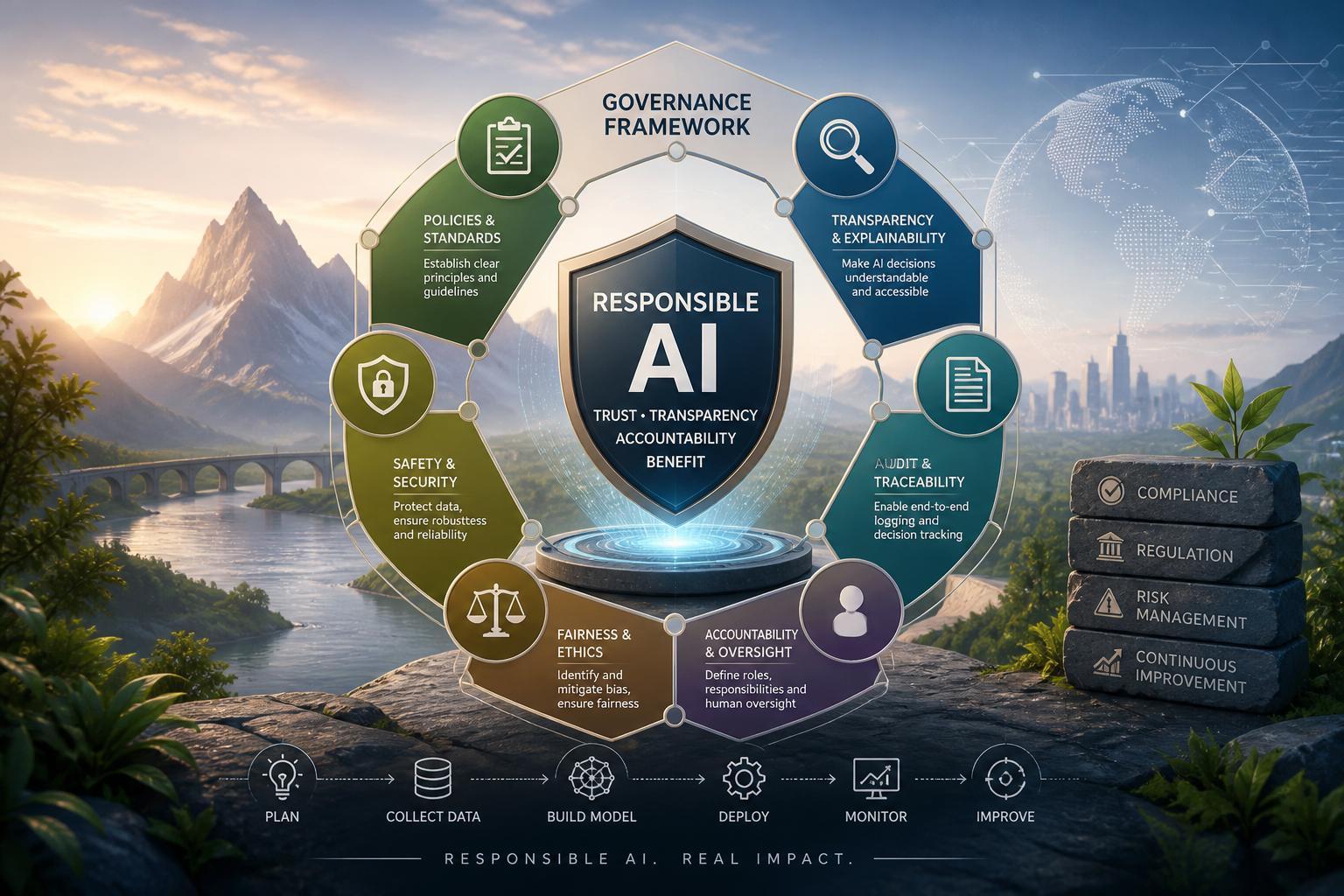
Responsible AI needs clear ownership. every production system should have a business owner who is accountable for the outcome, a technical owner who understands how it operatesand a risk, legalor compliance contact where the use case calls for one. Together, they should be able to explain why the system is being used, what it is allowed to doand where human judgment remains necessary.
Good governance begins before launch. Teams should document the intended use,the users,the data involved,known limitations,and the kinds of errors that would be unacceptable. Prompts, model versions, connected tools, training dataand policy settings should not be treated as informal details. They are part of the system’s operating record and may be essential when reviewing an output later.
Governance does not end at deployment. Organizations need a practical way to monitor exceptions,investigate incidents,approve meaningful changes,and decide when a system should be paused or retired. The level of oversight should match the consequences.An internal writing assistant does not need the same controls as a system that influences hiring, credit, healthcare, securityor customer eligibility.
Auditability is about useful evidence, not endless logs. Keep records that help people understand what was approved, how access was granted, what testing was performed, when a person overrode an outputand how an issue was addressed. A documented exception process matters too. Without one, urgent requests can quietly turn into permanent gaps in policy.
Building a Data Foundation People Can Trust
AI can only be as reliable as the information it draws from. A strong data foundation connects operational systems, documents, customer interactionsand approved outside sources without losing context, ownership, or lineage. More data is not automatically better. What matters is whether people can understand where it came from, how current it isand whether it is appropriate for the task.
Shared definitions and quality checks are especially important. If finance, operationsand sales all use different meanings for the same metric, an AI system may repeat that confusion at scale. Clear ownership, retention rulesand access controls help teams work from a common version of the business rather than competing interpretations.
As the organization grows, it should preserve source-level detail while maintaining curated datasets that can be reused across reporting, analyticsand AI applications. In practice, that means documenting data owners and business definitions, restricting access to sensitive records and derived insights, tracking lineage from source to outputand monitoring completeness, freshness, and accuracy over time.
turning AI Into an Ongoing Capability
Enterprise AI creates value after the pilot only when duty remains clear. Business leaders should own the outcomes, while technology, data, security, legaland compliance teams establish the guardrails for safe use. The most useful operating model treats an AI submission as a living service: it is indeed monitored,reviewed,improved,and sometimes retired when it no longer meets the organization’s needs.
Employees also need practical guidance, not vague encouragement to use AI. They should know where the technology can help them work faster or explore ideas,where they must verify results,and when a human decision-maker must remain involved. That is particularly critically important when work affects customers, employees, financesor regulatory obligations.
Training works best when it is tied to real tasks. Help people learn how to ask better questions, check outputs against trusted sources, handle sensitive informationand report results that appear inaccurate, unsafeor biased. Teams should also have a clear process for approving data access, model changesand external sharing.
Over time, the organizations that get the most from AI are usually not the ones chasing every new feature. they are the ones that learn from early use cases, share what works, correct problems quicklyand build reusable practices across the business.
Conclusion
Enterprise AI is not defined by a single model or platform. It is the disciplined use of AI within an organization: secure data handling, clear accountability, reliable informationand people who know when to trust the system and when to question it. When those pieces are in place, AI can become a useful part of everyday work rather than a promising experiment that never scales.
AI tools built by Emerald Force
Built and supported by Emerald Force.

You might also like
- Protect Family From AI Scams: Verify Before Paying
- Will AI Become Conscious? No Evidence So Far
- Where AI Agents Excel: Structured Digital Workflows
- How AI Strengthens Finance Teams and Reporting
- Can AI Fake Photos? How Synthetic Images Look Real
- AI Handles Routine Service; Humans Handle the Rest
- How AI Can Scale and Tailor Misinformation
- AI Helps Both Sides: Security Choices Decide
- Few-Shot Prompting: Learning from a Few Examples
- Inference Cost: The Compute Behind Model Outputs