

Can AI make podcasts? Yes-but it effectively works best as part of a human-led production process. AI can help with research, episode structure, script drafts, audio cleanupand synthetic narration. It cannot replace editorial judgment, fact-checkingor the sense of timing that makes someone want to keep listening. The strongest AI-assisted podcasts still sound like they were made by people who know their subject and their audience.
Research before you write
good podcast research begins with a clear question. Before opening an AI tool, decide what the episode is trying to explain, argueor uncover. Think about what listeners may already believe, what they may questionand which facts need to be current.
AI can help turn a broad idea into a practical research plan. it may suggest subtopics, interview questions, useful search terms, a rough timelineor perspectives that deserve a place in the episode. That can save time at the planning stage, but it is indeed not the same as reporting. Treat AI-generated research notes as prompts for further checking, not proof.
Keep a record of the material behind the script: original links, transcripts, reportsand notes explaining why each source matters. This makes fact-checking easier and gives the production team something to return to if a listener challenges a claim. AI can be useful when comparing lengthy documents or spotting repeated themes in interviews, but it can also make disputed points sound settled.Build the episode around sources you have actually reviewed.
Edit for the ear, not the page
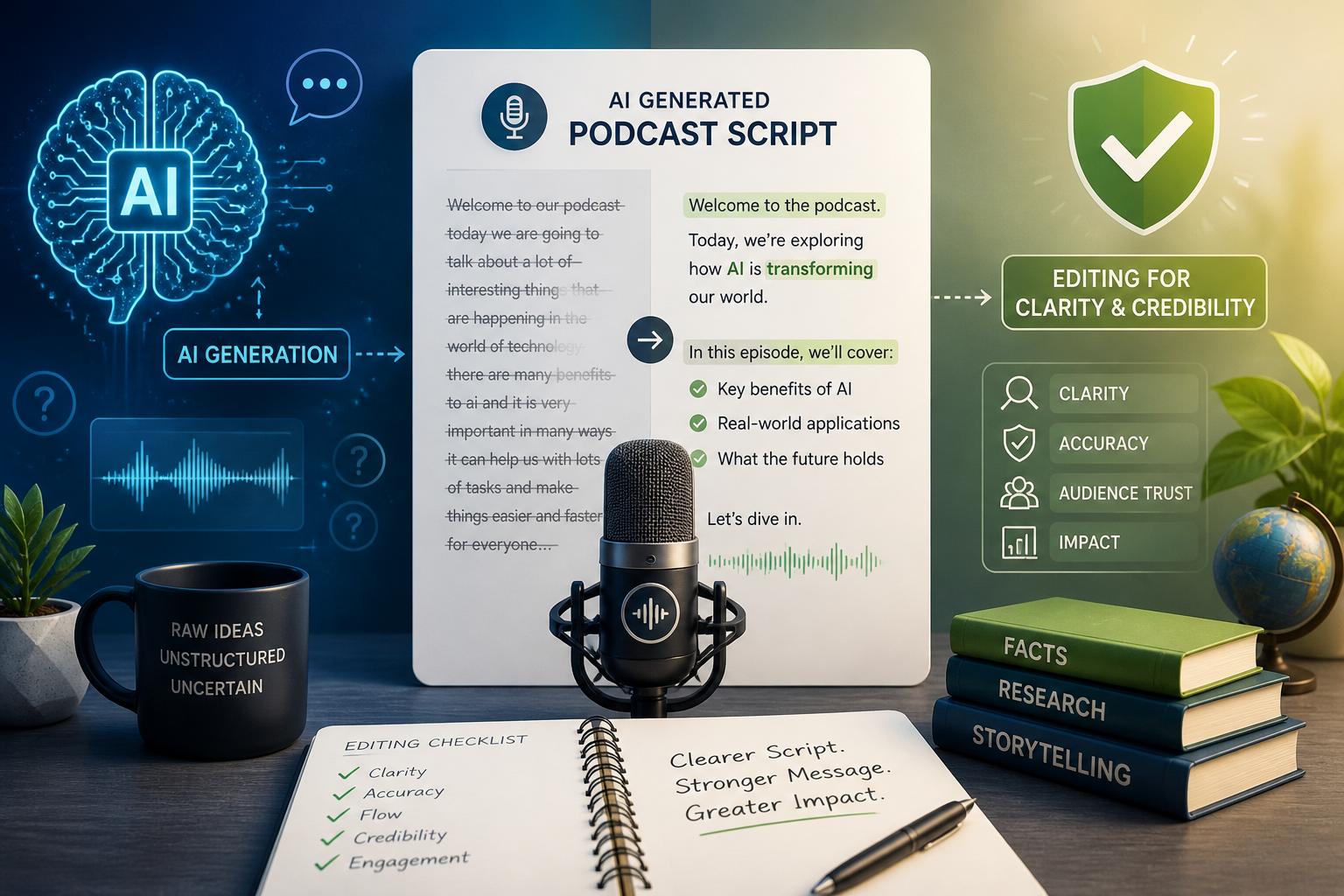
AI can give you a decent starting draft, but a podcast script has to work out loud. A sentence that looks polished on a screen may sound stiff or exhausting when a host reads it into a microphone. Read every section aloud.If the host has to pause in an awkward place,repeat a phrase,or take a breath halfway through a thought,rewrite it.
Keep the language direct and specific. Replace broad claims with wording the episode can supportand check every name, date, quotationand attribution before recording.When a source makes a claim, let listeners here where it came from. That small bit of context often does more for credibility than a long explanation.
It also helps to put the host back into the script. AI writing frequently enough leans toward neat transitions and generic observations. Let the presenter ask a real question, acknowledge uncertaintyor react in a way that fits their voice. Use contractions if they sound natural. Break up dense explanations. Give listeners one idea at a time.
Using a synthetic voice well
Synthetic voices can be useful for narration, temporary demos, accessibility, or filling a small gap in production. The right choice is usually the one that is easiest to listen to, not the one with the most dramatic personality. Clear pronunciation, steady pacingand natural pauses matter more than novelty.
Try the voice with real copy before committing to it. Include names, dates, quotations, technical termsand a section where the mood changes. Listen on headphones, then on an ordinary phone speaker. A voice that sounds fine in a preview can become tiring over a full episode.
Be cautious with emotional delivery, especially in serious reporting. Overly dramatic emphasis can make a story feel less trustworthy, while overly smooth phrasing can make it feel impersonal. If AI narration plays a substantial role in an episode, telling listeners is usually the sensible choice. Clear disclosure respects the audience and keeps attention on the reporting itself.
Human review is still the final step
AI can definitely help research, structure, edit audioand generate synthetic voices, but it should not have the final say. Someone on the production team needs to verify the facts, listen for missing contextand remove claims that sound more certain than the evidence allows.
That review should cover both the reporting and the listening experience. Check that quotations are accurate, names and technical terms are pronounced correctly, and sensitive topics are handled with care. Then listen for repetition, rushed transitions, flat pacing, inconsistent audio, and moments where the script feels detached from the person presenting it.
If a synthetic voice is involved, make sure its use is permitted and that it is not imitating a real person without consent. A polished voice track is useful, but it does not make weak reporting stronger. The best approach is simple: use AI where it saves time or opens creative options, then let human judgment shape the final episode.
So, can AI make podcasts?
AI can make podcast production easier, fasterand more flexible. It can help with research preparation,script drafts,audio edits,and narration. but a good podcast still depends on human choices: what to investigate, what to leave out, how to explain uncertaintyand how to speak to listeners with clarity and care. Use the tools, but keep the editorial responsibility with people.
AI tools built by Emerald Force
Built and supported by Emerald Force.
You might also like
- Can AI Fake Photos? How Synthetic Images Look Real
- AI Handles Routine Service; Humans Handle the Rest
- How AI Can Scale and Tailor Misinformation
- AI Helps Both Sides: Security Choices Decide
- Few-Shot Prompting: Learning from a Few Examples
- Inference Cost: The Compute Behind Model Outputs
- How to Benchmark Tools Before Buying: A Practical Guide
- Can AI Remove Backgrounds? A Proven Vision Use Case
- How AI Clusters Customer Feedback and Detects Sentiment
- AI Center of Excellence: Standards and Adoption