

AI coding assistants are most helpful when the job is clear, containedand easy to check. They tend to do well with boilerplate, test generation, code transformation, and small feature scaffolding-not because they can replace engineering judgment, but because these tasks often follow established patterns. The trick is to give the tool a specific assignment, then review the result like any other change in your codebase.
Start with focused tests
Tests are often a safe place to use an AI coding assistant because the expected behavior can usually be described in plain language. Good candidates include validation rules, format conversions, error handling, permission checksand boundary conditions. If a developer can clearly explain what should go in and what should come out, AI can often help draft the test structure quickly.
The best requests describe the behavior to protect rather than simply naming a file. Rather of asking, “Add tests for this service,” explain the rule, the failure you want to preventand the edge cases that matter. For example, you might ask for tests covering empty and malformed inputs, a regression for a reproducible bug, or different authorization outcomes for different roles.
Generated tests still need a careful read. A test that only echoes the implementation can create a false sense of safety. Look for assertions that reflect a real requirement, use understandable fixturesand would fail if the behavior changed in a meaningful way. When the intended behavior is unclear, settle that question before asking AI to generate coverage around it.
Use AI for contained refactors
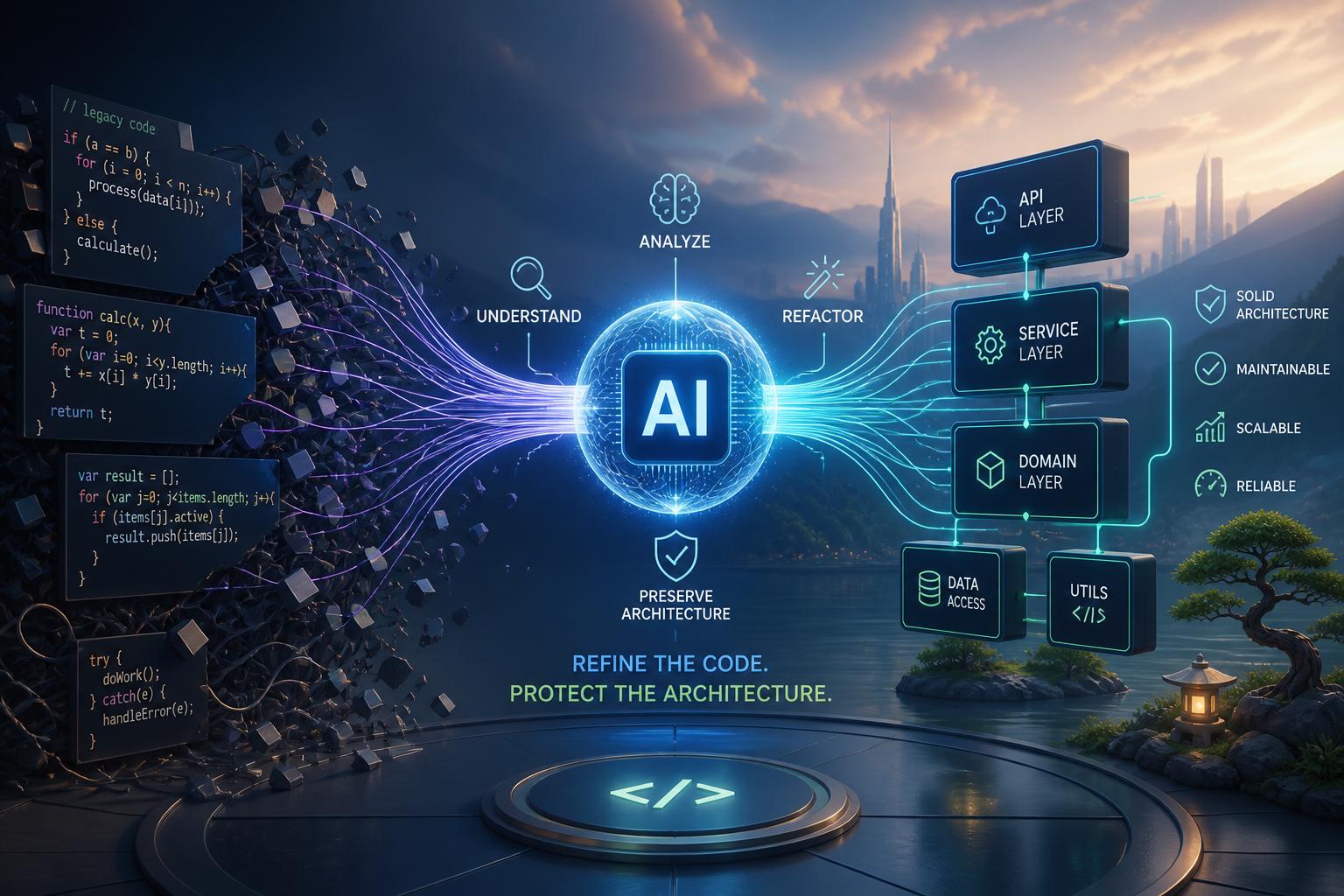
AI can be useful during refactoring when the scope is narrow.It can definitely help extract repeated code into an existing service, rename a confusing interface, split an oversized methodor reshape a long conditional into a pattern the codebase already uses. These are mechanical changes with enough context for a reviewer to evaluate them.
Context matters. Include the relevant interfaces, nearby examples, testsand any rules about module boundaries or dependencies. A generated patch may look tidy while still moving responsibilities to the wrong place.Passing tests are significant, but they do not automatically prove that a change respects the design of the application.
Treat the output as a first draft. Keep public behavior stable unless changing it is the point of the work, then inspect imports, constructor dependencies, error handling, and the resulting diff. If the code has little or no test coverage, characterization tests are a sensible first step. They establish what the code does now and make later changes easier to review with confidence.
Let it handle the setup work
Small scaffolding tasks are another strong fit. AI can create the predictable starting structure for a new service, feature module, command-line tool, or front-end component. That may include folders, starter files, configuration placeholders, test stubs, and names that follow conventions already present in the repository.
The goal is not to generate a complete feature and hope for the best. It is to avoid spending time recreating the ordinary pieces that every project needs. Give the model a nearby example to follow, state the framework and naming conventionsand be clear about what it should leave alone. Asking for a small scaffold first usually produces a cleaner result than asking for an entire feature in one pass.
That is where boilerplate test generation, clarification, transformationand small feature scaffolding tend to work well: the shape of the task is known, the output is easy to inspectand a developer can take over before assumptions pile up.
Keep review practical
AI-generated code does not need a special ceremony, but it does deserve a focused review. The reviewer should be able to see what changed, why it changedand how it was checked. Keep each request limited to one coherent task,avoid mixing in unrelated cleanup,and expect the usual evidence: relevant tests,type checks,linting,or a successful build.
Pay extra attention to new dependencies, permissions, configurationand generated defaults. Those choices may be easy for a tool to add and easy for a team to overlook. Changes involving authentication, payments, data deletion, migrations, or production settings call for closer human inspection as the cost of a wrong assumption is higher.
A useful working rule is simple: let AI draft code inside a boundary you have already defined, but do not let it define that boundary for you. People still need to make the calls that depend on product intent, domain knowledge, securityand the long-term maintainability of the code.
Use it where review is easy
AI is at its best when it helps with repeatable work that has clear constraints. Ask it to draft tests, make a contained refactoror set up the basic shape of a small feature. Then bring the same judgment you would bring to any pull request: confirm the behavior, question the assumptionsand keep only the code your team understands and wants to maintain.
AI tools built by Emerald Force
Built and supported by Emerald Force.
You might also like
- Can AI Fake Photos? How Synthetic Images Look Real
- AI Handles Routine Service; Humans Handle the Rest
- How AI Can Scale and Tailor Misinformation
- AI Helps Both Sides: Security Choices Decide
- Few-Shot Prompting: Learning from a Few Examples
- Inference Cost: The Compute Behind Model Outputs
- How to Benchmark Tools Before Buying: A Practical Guide
- Can AI Remove Backgrounds? A Proven Vision Use Case
- How AI Clusters Customer Feedback and Detects Sentiment
- AI Center of Excellence: Standards and Adoption