

Can AI systems be hacked? Yes. Like other software, they can be attacked through code, infrastructure, prompts, dataand the tools connected to them. The model may get most of the attention,but it is only one part of the system. A secure AI product depends on how its data is collected, how it is indeed built and deployed, what it can accessand how the team responds when something goes wrong.
protect the Data and Development Process
Many AI security problems begin before a model is ever released. Training data can include misleading examples, sensitive records, malicious instructionsor material intended to trigger unexpected behavior under certain conditions. The systems around that data matter too: collection scripts, labeling platforms, storage buckets, feature pipelinesand experiment trackers can all become entry points.
Teams should know where each dataset came from, who owns itand how it entered the training process. Limit who can change data, keep immutable versions where practical, scan files from untrusted sources, and investigate unusual changes in volume, format, languageor label distribution. Those checks will not catch every problem, but they make it harder for harmful or accidental changes to slip quietly into a training run.
The development pipeline deserves the same care. it frequently enough brings together source code, credentials, cloud compute, dependenciesand valuable model artifacts. A compromised package, exposed notebook token, altered configurationor swapped checkpoint can change a system long before the issue appears in the user interface. Treat model development as a release process, not an informal workspace. Use isolated environments, short-lived credentials, code review for pipeline changesand records that tie a deployed model back to its data, code, configurationand evaluation results.
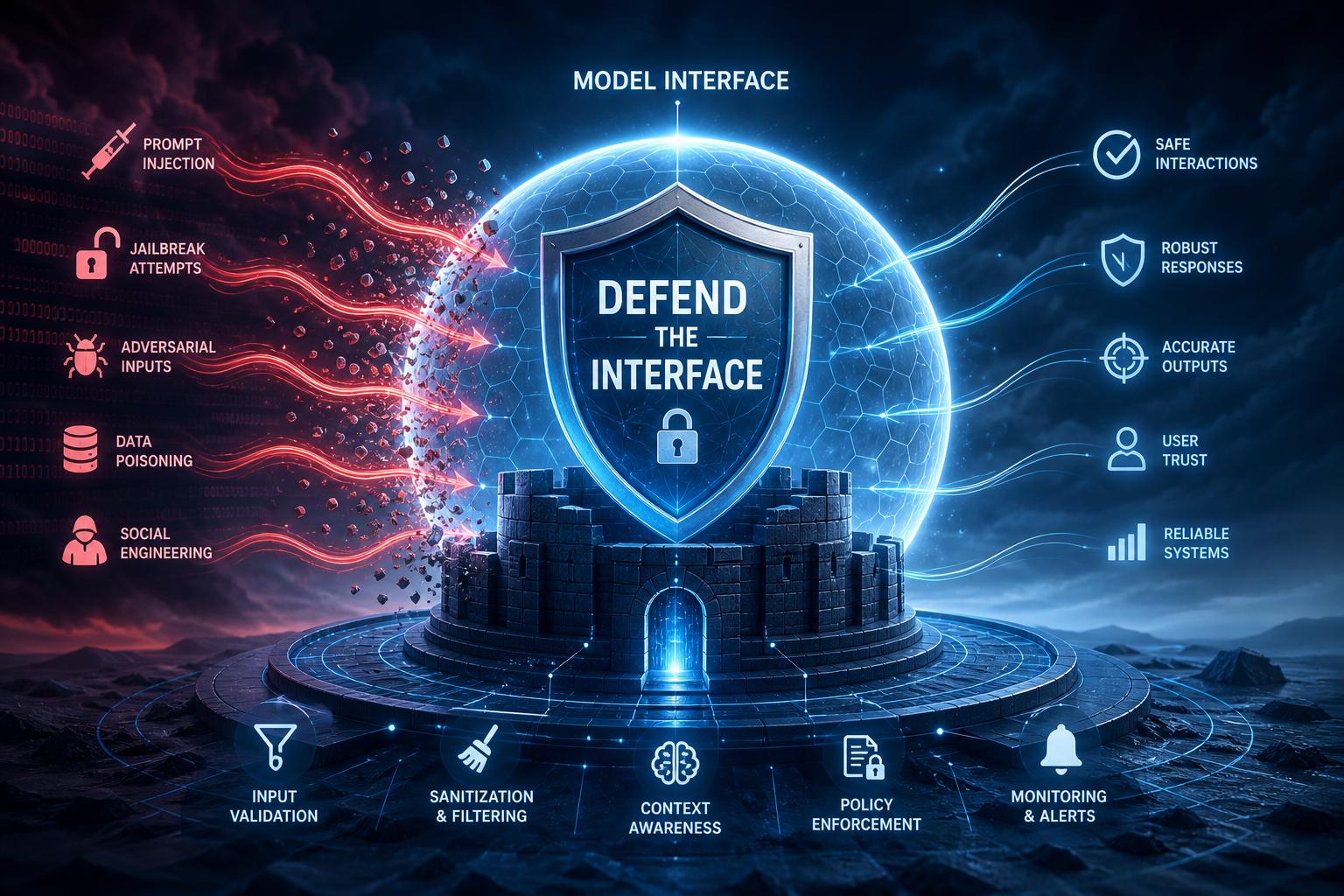
Treat Model Inputs as Untrusted
AI interfaces are appealing targets becuase they can turn plain language into answers, data access, and tool calls. A malicious instruction might arrive in a chat message, support ticket, uploaded document, web pageor image processed by an AI workflow. The concern is not just an embarrassing response. A model could be pushed to expose protected context, follow instructions hidden in untrusted contentor call a connected tool in ways the user was never meant to authorize.
Users, retrieved contentand tool output should not have the same authority as system policy. That distinction is central to defending against prompt injection. Keep sensitive data out of prompts when possible, limit the information and tools available to a modeland validate actions before they are carried out. High-impact actions-such as sending messages, changing records, moving moneyor accessing sensitive files-should have deterministic checks and, where appropriate, human approval.
Testing matters here. Teams should regularly try direct and indirect prompt-injection scenarios,including instructions embedded in uploaded files or retrieved pages. Monitor for unusual tool requests,repeated attempts to bypass restrictions,and patterns that suggest someone is probing for sensitive information. When AI systems are connected to business systems, the real security boundary is the connection between the model, identity controls, dataand actions.
Secure the Systems Around the Model
A well-protected model can still be undermined by weak infrastructure.Attackers may look for exposed deployment secrets, overly broad cloud permissions, unprotected model registries, compromised container imagesor unreviewed dependency updates. These are familiar software security issues, but an AI environment can make the impact wider.Access to an inference endpoint may reveal sensitive prompts and outputs, while access to a training or deployment pipeline can change model behavior upstream.
Pin and verify important dependencies, base imagesand model artifacts instead of accepting changes without review. Keep training, evaluation, stagingand production environments separate, with identities that have only the permissions they need. API keys, tokens, and dataset credentials belong in managed secret stores-not in notebooks, source codeor broadly visible deployment settings.
Production services should be built on the assumption that someone will probe them. Put model APIs behind authentication, apply sensible rate limits, restrict network accessand maintain a defined patching process for the operating system, runtimeorchestration layerand inference server. Good release records are just as critically important: teams should be able to identify the code, data version, dependenciesand model artifact behind a running deployment. If a supply-chain issue or bad configuration is discovered, that traceability makes rollback far more manageable.
Keep Testing and watching After Launch
Security does not end when an AI feature goes live. Models are updated,data sources change,new tools are connected,and attackers keep testing the boundaries. Monitoring should cover the entire workflow: unusual prompts, suspicious tool calls, unexpected data access, output anomaliesand changes in user behavior. the goal is not simply to collect more logs. It is to identify signals that point to meaningful risk, such as an agent trying to operate outside its normal role or a retrieval system surfacing restricted information.
red-team exercises help turn assumptions into evidence.Test prompt injection, malicious content in retrieved documents, attempts to extract data, poisoned inputs, privilege escalation, and misuse of connected tools. Findings should feed directly into an incident response plan with clear owners, escalation paths, containment stepsand procedures for preserving relevant logs.
when an incident occurs, separate the immediate response from the longer-term fix. Restrict risky integrations, revoke exposed credentials, isolate affected workflowsand notify the right people quickly. Then investigate how the control failed and address the underlying weakness before restoring normal operation. AI systems can be hacked,but a disciplined approach to data,interfaces,infrastructure,and response can considerably reduce the chances that a single weakness becomes a serious incident.
AI tools built by Emerald Force
Built and supported by Emerald Force.
You might also like
- Protect Family From AI Scams: Verify Before Paying
- Will AI Become Conscious? No Evidence So Far
- Where AI Agents Excel: Structured Digital Workflows
- How AI Strengthens Finance Teams and Reporting
- Can AI Fake Photos? How Synthetic Images Look Real
- AI Handles Routine Service; Humans Handle the Rest
- How AI Can Scale and Tailor Misinformation
- AI Helps Both Sides: Security Choices Decide
- Few-Shot Prompting: Learning from a Few Examples
- Inference Cost: The Compute Behind Model Outputs