
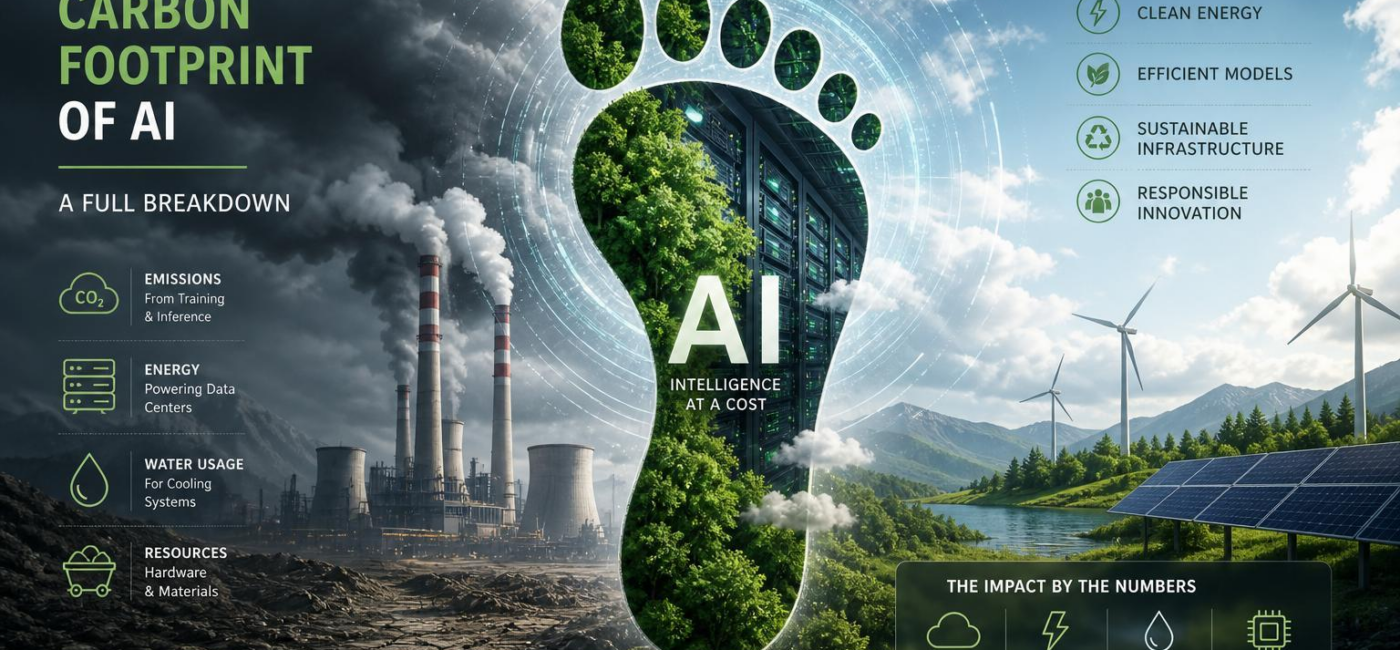
AI has a physical footprint, even when the product feels entirely digital. The carbon footprint of AI is the greenhouse gas impact tied to training models, running them in production, making the hardware they depend onand operating the data centers around them. It is not captured by a single number. It changes with the model, the hardware, the electricity sourceand how frequently enough the system is used.
Training and everyday AI use
AI starts using energy long before it answers a question or generates an image. During training, a model processes large amounts of data repeatedly while its parameters are adjusted. That work may run across many specialized chips for days, weeks, or longer. The electricity supports more than processors: memory, networking, storageand cooling all draw power to.
The climate impact of training depends on several practical factors, including the size of the model, how long it is trained, the efficiency of the hardware, where the data center is locatedand the electricity available there. The same amount of computing can lead to very different emissions depending on whether the local grid relies heavily on fossil fuels or lower-carbon generation.
Once a model is deployed, the energy demand does not disappear. It changes shape. Inference is the power used whenever a live model responds to a prompt, labels an image, makes a adviceor performs another task. A single request may use much less energy than training, but a popular service can handle an enormous volume of requests over time. Training is usually a concentrated upfront expense; inference is the ongoing cost of keeping the service running.
What should be counted
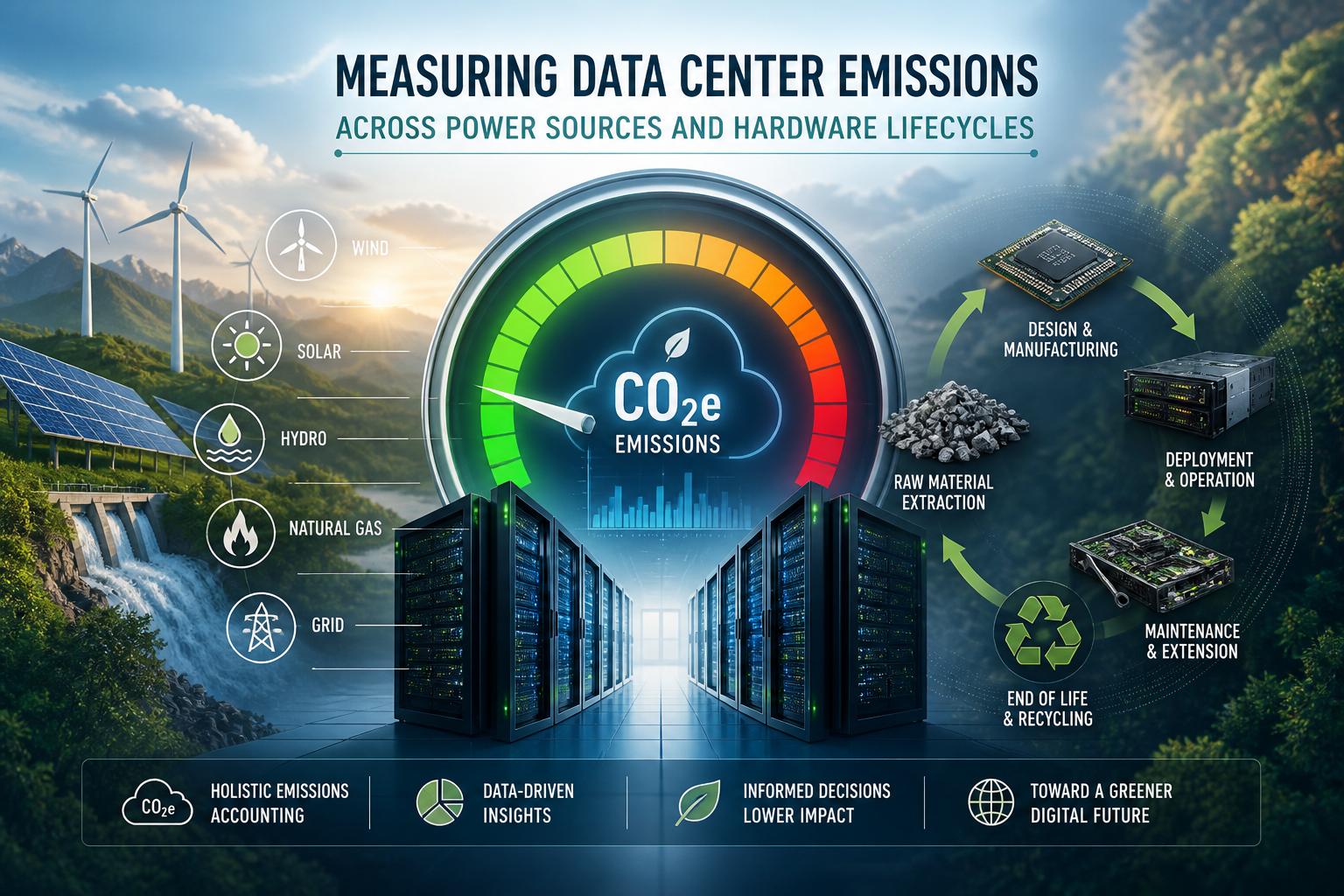
Electricity use is central to AI emissions,but it is not the whole story. A data center’s operational footprint varies with the local grid and can change throughout the day. Power drawn from a coal- or gas-heavy grid generally creates more emissions per kilowatt-hour than power from nuclear, hydro, wind, solar, or other lower-carbon sources.
This is why broad annual renewable-energy claims do not always tell the full story. A company may purchase enough clean-energy credits to match its annual consumption while its data centers still run at times when fossil fuels supply much of the local grid. A more useful assessment looks at both total electricity use and the carbon intensity of the power available when and where the computing takes place.
| Emission source | What should be counted | why it matters for AI |
|---|---|---|
| Operational power | Server, storage, network, coolingand backup-system electricity | Large training and inference workloads can run continuously |
| Hardware production | mining, chip fabrication, assembly, packagingand transport | Accelerators and memory carry emissions before frist use |
| hardware retirement | Refurbishment, reuse, recyclingand disposal | Short replacement cycles can raise embodied emissions |
Hardware deserves the same attention as the electricity meter. GPUs, CPUs, memory, networking equipment, racksand cooling systems all carry embodied emissions from material extraction, manufacturing, transportand assembly. Those emissions should be considered over the equipment’s useful life. Hardware that spends much of its life idle can have a higher impact per useful task than equipment that is well utilized, maintained, and kept in service longer.
The costs beyond the model
Model size is an obvious part of the picture, but it is not the only one.Larger models often require more computing to train, yet the long-term impact may come from how they are used after release. Every prompt, image request, transcription, search resultor recommendation requires work in a data center. For widely used systems, the accumulated energy used during daily operation can become a major part of the overall footprint.
That is why efficiency matters beyond speed and cost. A system that can deliver a useful result with less computation generally needs less electricity to do so. In many cases, a smaller model designed for a narrow task might potentially be a more sensible choice than a larger general-purpose model.
Cloud infrastructure also has costs that are easy to overlook. Cooling systems use energy and, in some locations, water. Networks move data between regions. Storage is copied for reliabilityand spare capacity may remain powered on to handle demand spikes. the physical equipment behind those services must eventually be manufactured, transported, repaired, reused, recycled, or discarded. Looking at the entire system gives a more honest answer than focusing on one training run alone.
Making AI use more responsible
There is no single fix for AI emissions. The most practical gains usually come from ordinary decisions made throughout a system’s life: choosing a model that fits the job, avoiding needless retraining, improving hardware utilizationand measuring energy alongside cost, speedand quality.
Teams can also reduce operational emissions by running workloads in locations or at times when lower-carbon electricity is available, where that is feasible. Clean energy helps, but it does not remove the need to avoid waste. Replacing accelerators too quickly, keeping rarely used data indefinitely, or running large models for tasks that do not need them can still create avoidable environmental costs.
Responsible deployment starts with a simple question: is the computing being used worth the resources it requires? Organizations do not need to abandon AI to take that question seriously.They can document major compute projects, keep hardware in service when possible, retire systems that no longer provide enough valueand be clearer about the energy and infrastructure behind their products.
AI will continue to depend on electricity, data centersand physical hardware. The goal is not perfect accounting or zero impact overnight. It is to make the trade-offs visible and ensure that each use of AI is proportionate to the value it delivers.
AI tools built by Emerald Force
Built and supported by Emerald Force.
You might also like
- Why AI Pilots Stall: Governance, Workflows, Trust
- How AI Can Help You Cook Smarter Every Day
- AI Disclosure at Work: Policy, Clients, and Risk
- AI Can Build Websites: From HTML to Backend Scaffolds
- AI Voice Scams Are Rising: Why Verification Matters
- Letting AI Run Terminal Commands: Essential Safeguards
- AI Lowers Routine Costs, but Expertise Still Decides
- AI Agents Today: Useful but Still Need Oversight
- How AI Enables Robots to Perceive, Plan, and Interact
- Retrieval-Augmented Generation: A Clear Guide