

Preparing students for AI-driven work is not mainly about teaching them to use teh newest tool.It is indeed about helping them think clearly, work well with others, handle information responsiblyand know when to question an answer that looks convincing. Students should practice writing, analysis, collaboration, statistics, digital toolsand ethical judgment-the skills that help them use AI without handing over their own thinking.
Using AI with care and good judgment
Students become comfortable with AI by using it for real tasks, not by memorizing terminology. They can learn to write clearer prompts, notice when a response misses the pointand revise their questions when the first result is weak. Just as vital, they should compare AI-generated material with reliable course sources and decide whether the answer is accurate enough to use.
One useful exercise is to have students ask an AI tool to explain a topic, then check the response for unsupported claims, missing contextor vague language. From there, they can rewrite the material in their own words and support it with sources they understand and can defend. The point is not to treat AI output as finished work. It is to treat it as a draft that still needs human review.
Ethics should be part of that process from the start. AI can produce confident but incorrect answers, repeat bias found in it’s training dataor create privacy problems when users enter personal or sensitive information. Students also need a clear sense of what counts as appropriate help. Brainstorming,outlining,and feedback may be acceptable in many settings; submitting machine-generated work as their own thinking is not.Learning where that line falls will matter in school and in the workplace.
Question the data, not just the result
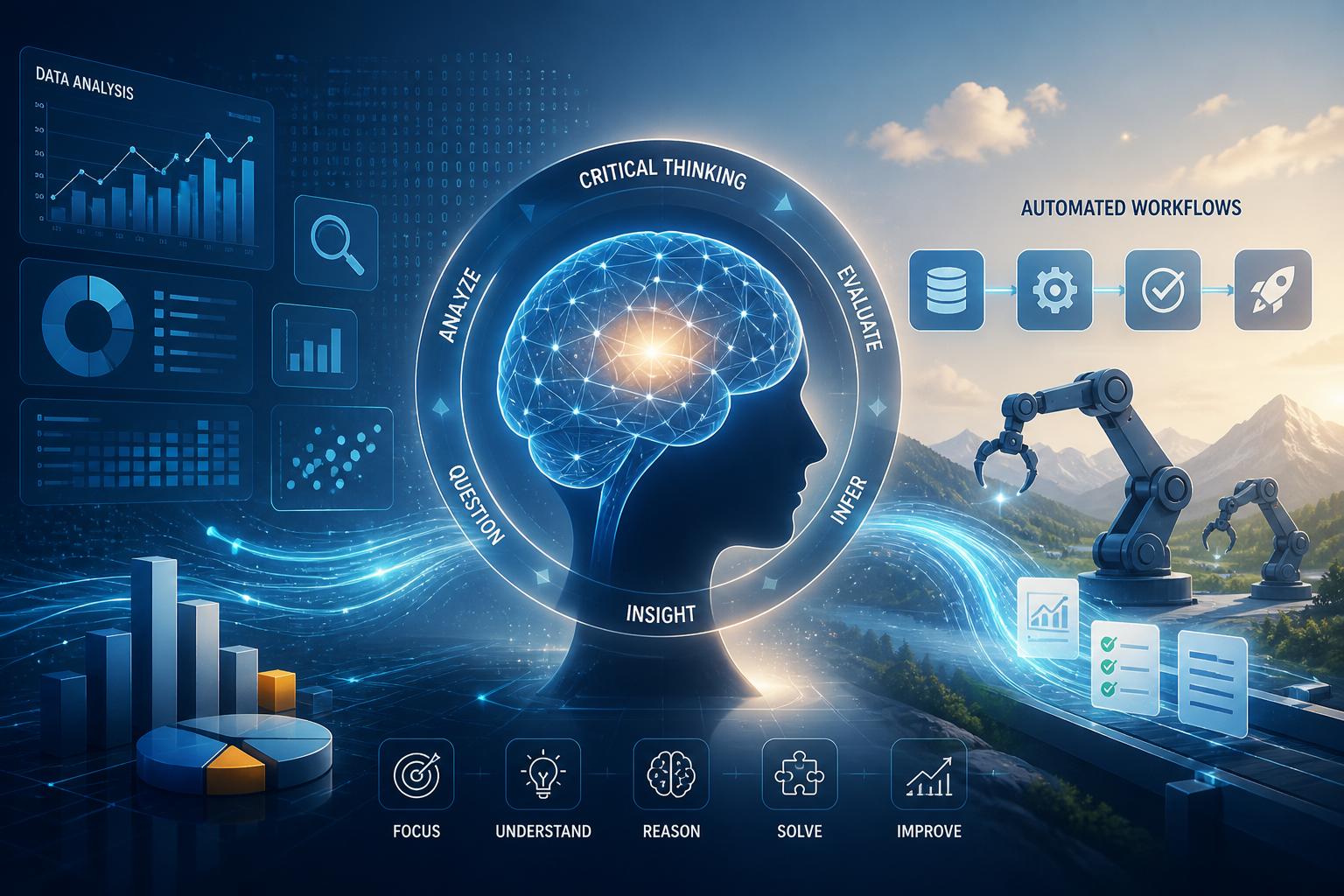
Automated systems can sort information, summarize documentsand flag patterns quickly. They cannot decide on their own whether the information is complete, relevantor fair. Students need the basic habits of data analysis: asking where data came from, noticing what might potentially be missingand checking whether a result actually answers the question they were trying to solve.
A polished chart or a neatly worded suggestion can make an answer feel more reliable than it is. Students should get used to looking underneath the surface. What was measured? What was left out? Is the conclusion stronger than the evidence allows? Who could be affected if the system gets it wrong? Those questions turn critical thinking into a practical skill rather than an abstract classroom exercise.
Teachers can build this into regular assignments. Students might compare two summaries of the same reading, examine the assumptions behind a predictionor explain what new evidence would change their recommendation. Thes activities teach them that automated output is useful, but it is indeed never a substitute for checking the work.
Strengthen the skills people bring to the work
AI can help organize information and produce routine drafts, but workplaces still depend on people who can listen, explain, negotiate, and take responsibility.Students need practice communicating with different audiences, working through disagreementand making decisions when there is no obvious right answer.
These are not separate from technical skills. they shape whether technology is used wisely. A student who can explain a complex idea clearly,notice how a decision may effect others,and raise concerns about bias or privacy is better prepared for AI-driven work than someone who can simply operate a tool.
Schools can develop these abilities through ordinary classwork. Group projects can ask students to describe how they shared responsibilities and handled conflict. Research assignments can include a discussion of who may be harmed by an automated decision. Presentations can be evaluated for clarity, evidenceand audience awareness-not just whether the slides look polished. The goal is not to outperform AI at routine tasks. It is to bring judgment, empathyand accountability to work that involves AI.
Make learning and revision part of the routine
AI tools and workplace expectations will continue to change, so students need more than a fixed set of technical skills. They need to be comfortable learning something unfamiliar,testing what they find,and changing direction when the evidence does not hold up. That habit can be developed in every subject, from science labs and history research to writing, designand technical courses.
Assignments should leave room for revision. A student might compare an AI-generated summary with the original sources, identify errors or gaps, and then write a corrected version that explains the choices made. In group work, rotating responsibilities can give each student a chance to research, question, edit, and present rather than settling into one role every time.
Preparing students for AI-driven work means giving them repeated chances to learn, test, reviseand explain their reasoning. The tools will change. The ability to write clearly, analyse evidence, collaborate with others, use digital tools responsibly, and make sound ethical decisions will remain useful wherever they work.
AI tools built by Emerald Force
Built and supported by Emerald Force.
You might also like
AI Literacy: Understanding, Limits, and Responsibility
- Why AI Pilots Stall: Governance, Workflows, Trust
- How AI Can Help You Cook Smarter Every Day
- AI Disclosure at Work: Policy, Clients, and Risk
- AI Can Build Websites: From HTML to Backend Scaffolds
- AI Voice Scams Are Rising: Why Verification Matters
- Letting AI Run Terminal Commands: Essential Safeguards
- AI Lowers Routine Costs, but Expertise Still Decides
- AI Agents Today: Useful but Still Need Oversight
- How AI Enables Robots to Perceive, Plan, and Interact