

Will AI increase inequality? It could-especially if most of the gains flow to large firms, their ownersand workers whose skills closely complement the technology. AI may raise productivity, create useful new tools, and open up new kinds of work. But those benefits will not necessarily be shared evenly. Who owns the infrastructure, who has access to the best toolsand who has a voice in workplace decisions will matter just as much as the technology itself.
Why the biggest gains may go to dominant firms
AI rewards control over costly and hard-to-replicate resources: computing infrastructure, proprietary data, established distribution channels, intellectual propertyand the money to experiment before a product turns a profit. Large companies already have many of these advantages. They can spread progress costs across a large customer base, add AI features to products peopel already useand negotiate from a stronger position with suppliers and buyers.
that does not just mean higher productivity. It can also mean a greater ability to keep the value that productivity creates.A company with deep pockets can invest more in data, computing powerand specialized talent, then use the resulting profits to strengthen its position further. Smaller competitors may still benefit from AI, but they may do so as customers of a few powerful platforms rather than as equal participants in the market.
Workers can gain from AI tools, too, but their wages do not automatically rise when their output does. If an employer can produce more with the same staff-or maintain output with fewer people-a larger share of the gains may go to investors and senior owners unless workers have enough bargaining power to claim part of it.
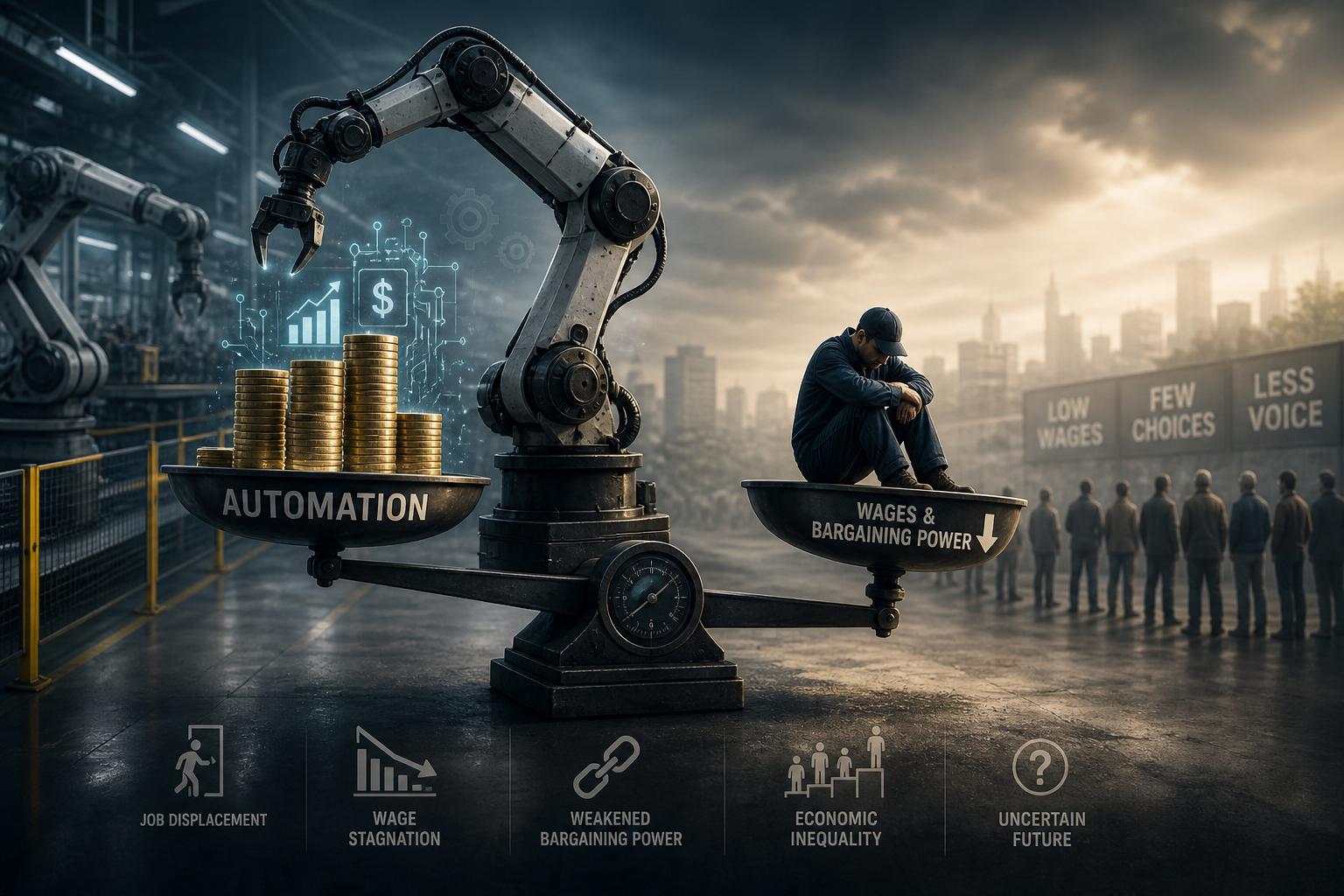
How automation can weaken workers’ bargaining power
Automation does not have to erase a job to affect pay and working conditions. When employers can replace parts of a role with software, machines, or AI-assisted systems, that possibility can change negotiations. Workers may feel pressure to accept slower wage growth, fewer hours, stricter targets, or less predictable schedules because they fear being replaced.
The risk is greatest for people who already have limited savings, weak legal protectionsor few other employers nearby. In those situations, automation can increase the value produced at work while reducing the share that reaches the people doing it.
Companies may also redesign jobs rather than eliminate them.A smaller group of highly paid specialists might oversee automated systems, while more workers are left with fragmented tasks that are closely monitored and easier to measure. That can reduce autonomy and make collective action more difficult. When schedules shift frequently and workers are ranked against one another through performance data, it becomes harder to build the stability and trust that support better pay and conditions.
Access matters as much as the software
AI will not spread its benefits evenly simply because the tools are widely available. Meaningful participation often requires reliable computing capacity, useful data, cloud servicesand people who understand how to build, evaluate, secureand manage AI systems. Large firms can hire specialized teams and absorb the cost of trial and error. Small businesses, public institutionsand communities with fewer resources may be limited to using tools designed elsewhere, under terms they had little role in setting.
that gap matters as the organizations with the strongest resources can use AI to improve research, forecasting, operationsand product development. Others may face pressure to cut costs or automate tasks without gaining much control over how the technology is introduced.
the skills gap can deepen the divide.Workers who understand data,model limitations,security,and workflow design may move into more valuable roles. Those without access to training may encounter AI mainly as something imposed on their jobs. Closing that gap takes more than offering a software subscription. It also means affordable computing resources, practical education, shared research capacity, and fair rules around access to essential data and platforms.
How the gains could be shared more broadly
None of this is inevitable. Public policy, business choicesand worker organizing can shape whether AI becomes another channel for concentrated wealth or a source of broader productivity growth.
Competition policy is one part of the answer. When a small number of companies control cloud infrastructure, data, distribution, and other essential inputs, smaller firms and public-interest organizations may struggle to compete. Sensible antitrust enforcement, interoperable systemsand open standards can help prevent control of key infrastructure from turning into lasting control of the economic gains.
Workers also need more than training on how to use new software. They may need transition support, portable benefits, income protectionand a real voice in decisions about monitoring, scheduling, hiringand job design. Profit-sharing arrangements, employee ownershipand gain-sharing agreements can give workers a direct stake when AI improves output or reduces labor time.Where public money helps build valuable AI infrastructure, governments can also seek a public return rather than allowing all of the upside to become private wealth.
AI could increase inequality, but it does not have to. The central question is not whether the technology creates value. It is who has the power to shape it, who owns the systems behind itand who gets to share in the rewards.
AI tools built by Emerald Force
Built and supported by Emerald Force.
You might also like
AI Literacy: Understanding, Limits, and Responsibility
- Why AI Pilots Stall: Governance, Workflows, Trust
- How AI Can Help You Cook Smarter Every Day
- AI Disclosure at Work: Policy, Clients, and Risk
- AI Can Build Websites: From HTML to Backend Scaffolds
- AI Voice Scams Are Rising: Why Verification Matters
- Letting AI Run Terminal Commands: Essential Safeguards
- AI Lowers Routine Costs, but Expertise Still Decides
- AI Agents Today: Useful but Still Need Oversight
- How AI Enables Robots to Perceive, Plan, and Interact