
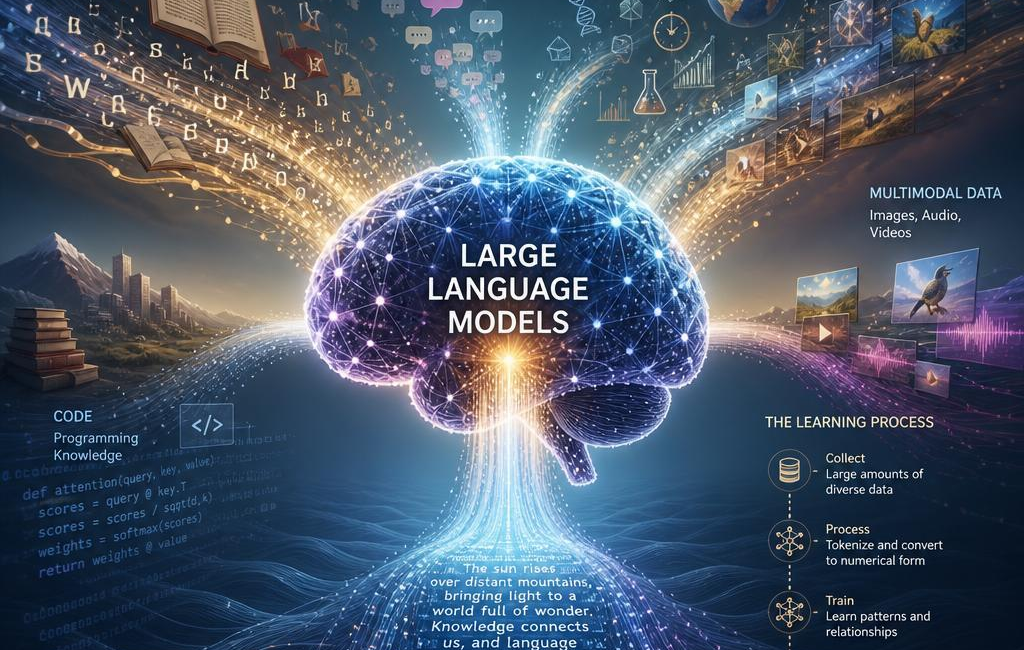
What is a large language model? A large language modelor LLM, is a model trained on vast amounts of text to predict and generate language. It learns from patterns in writing rather than from a hand-built set of grammar rules or a database of ready-made answers. That basic idea helps explain both what llms can do well and where thay can fall short.
The Text an LLM Learns From Matters
A language model starts with a huge collection of written material: books, articles, websites, reference works, public conversationsand other sources chosen for training. Those sources shape the patterns the model sees, from spelling and sentence structure to technical vocabulary, idioms, and cultural references.
Coverage matters. If a language variety, subject areaor perspective appears only occasionally in the training data, the model has fewer examples to draw on when responding to it. Quality matters, too.Errors, outdated information, biased languageand misleading material can all become part of the patterns the model learns. More text is useful, but it is not a substitute for thoughtful data selection and review.
Before training begins, text is divided into smaller units called tokens. A token might be a full word, part of a word, punctuation mark, numberor space pattern. Breaking text this way gives the model a format it can process. common words may use only a few tokens, while unusual names, specialized terms, code, or languages with different writing systems can require more.
The model does not store complete sentences like entries in a phrasebook. Rather, it learns how tokens tend to relate to one another. That is why it can create new wording for a prompt, while still carrying the strengths and blind spots of the material it was trained on.

How Transformers Use Context
Most modern LLMs use a design called a transformer. Rather than reading a sentence strictly one word at a time, a transformer can weigh relationships among tokens across the passage. This process,known as attention,helps the model decide which earlier words are most relevant to the next prediction.
Take the sentence, “The book on the shelf was old.” The model needs to connect “was” with “book,” not “shelf.” Attention helps it make that distinction.It also helps with pronouns, negation, topic shifts, and details introduced much earlier in a paragraph.
As text moves through multiple layers, the model builds a richer depiction of the context. Some patterns may relate to grammar, while others help track topic, toneor the relationship between a question and the information that came before it. This is not the same as human understanding. It is a learned way of identifying language patterns and estimating what text is most likely to fit next.
Learning by Predicting the next Token
At its core,training asks the model to predict the next piece of text from what it has already seen. Given “The cat sat on the…,” it learns that “mat” is a more likely continuation than an unrelated word. It repeats versions of this task across an enormous number of examples, adjusting its internal parameters each time.
That simple exercise teaches the model much more than vocabulary. To make useful predictions, it has to pick up recurring patterns in grammar, phrasing, topics, toneand the ways ideas connect across sentences. A large language model becomes useful not because it retrieves one perfect answer, but because it can estimate a plausible continuation based on the prompt and surrounding context.
Training often continues after this initial phase. Developers may use examples that teach a model to follow instructions, summarize text, translate, answer questionsor prefer one response over another based on human feedback. These steps can make a model more helpful in conversation, but they do not make it automatically correct. It can still produce a convincing response that contains an error.
Testing and Responsible Use
A model is not dependable simply as it was trained on a great deal of text. It needs careful testing for accuracy, consistency, usefulness, safety, and performance across different ways people might ask the same question. Testing should include straightforward requests as well as unclear, misleadingand high-stakes prompts, since weaknesses often show up in those harder cases.
Reviewers also need to look beyond weather an answer sounds polished. An LLM may misstate facts, repeat stereotypes found in its training material, expose sensitive informationor express more confidence than the evidence supports. Good evaluation makes those problems visible so they can be addressed rather than overlooked.
Responsible practices begin with the data itself: where it came from, whether it was handled appropriately, which voices might potentially be missingand how sensitive material is protected. Human reviewers are still essential because automated tests cannot fully judge context, nuanceor potential harm.feedback from users and subject-matter experts can reveal issues that do not appear in controlled testing.
What This Means in Practise
LLMs are powerful tools for working with language, but they are not all-knowing systems. They generate responses from learned patterns,not from direct experience or guaranteed access to the truth. Used thoughtfully, they can definitely help people draft, explain, summarize, translateand explore ideas. Used carelessly, they can spread mistakes with notable confidence.
The best way to think about them is as refined language prediction systems: flexible, frequently enough usefuland always worth checking when accuracy matters.
AI tools built by Emerald Force
Built and supported by Emerald Force.


You might also like
- How AI Writes Scripts: Scenes, Dialogue, and Structure
- Why One Model Cannot Serve Every AI Task Safely
- Keeping AI on Topic: Define Scope and Core Task
- Suspicious AI Content: Pause, Verify, Then Act
AI Worker Monitoring: Legal Limits Employers Face
- How AI Reads PDFs, Charts, Screenshots, and Photos
- Access Control in AI: Rules for Use and Access
- AI Rationales Aren’t Always Faithful Explanations
- AI for Homework: Tutoring Allowed, Final Answers Limited
- AI in Healthcare: The Risks of Overtrust