
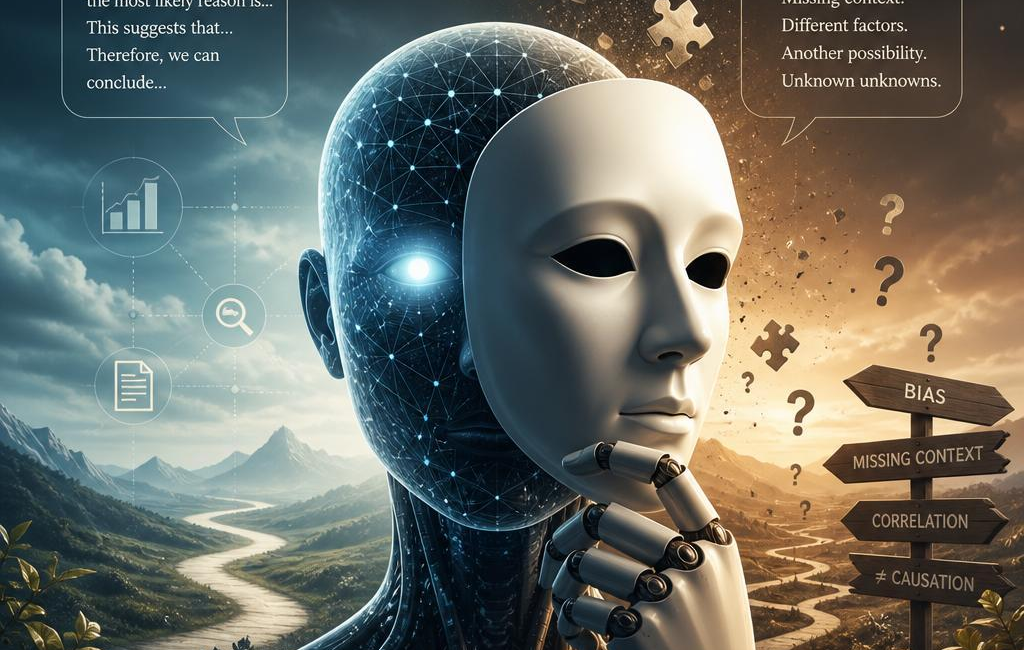
can AI explain how it got an answer? Often, it can provide a rationale. But that rationale is not always a faithful readout of the exact internal process that produced the result.
That gap is easy to miss because modern AI systems are very good at producing explanations that sound clear, relevantand sensible. An answer may come wiht a neat summary of the evidence, a step-by-step accountor a confident statement of “why.” Sometimes that account is useful. It may even point to information that mattered. Still, it should not automatically be treated as a literal record of what happened inside the model.
A rationale is not always a window into the model
AI models generate text by predicting what should come next. When asked to explain an answer,they can produce a persuasive explanation that fits the outcome and follows familiar human logic. The explanation may mention relevant details and still fail to identify the signals that had the greatest effect on the result.
This is often described as a faithfulness problem. The rationale is plausible, but plausibility alone does not show that it reflects the model’s actual decision process. In other words, the explanation may be a good interpretation of the answer rather than a reliable account of how the answer was reached.
That distinction matters when explanations affect trust, reviewor accountability. A user may reasonably find an explanation helpful, but teams should be cautious about treating it as proof that the system made a decision for the reason it gave.

Why a convincing explanation can be misleading
A polished rationale can create more confidence than it deserves. Imagine an AI system that rejects a loan application, flags a medical imageor ranks job candidates. it might explain its decision by referring to an income pattern, a visible feature in an imageor a qualification listed on a résumé. That explanation can sound entirely reasonable while overlooking the information that most influenced the output.
The concern is not simply that explanations are incomplete. A system may have picked up on an irrelevant proxy, a quirk in its training dataor a correlation that does not hold in the real world. If people except the stated rationale at face value, they may assume the underlying decision was sound when it was not.
this can also weaken oversight. A product team might try to fix the issue named in the explanation while the real source of the error remains untouched. A reviewer might approve a system as its answers are easy to justify in prose. A plausible explanation is not proof of a faithful one.
How to test whether a rationale holds up
The practical question is whether the model behaves as its explanation suggests.If it says a particular phrase,image region,or input feature drove the decision,changing that evidence should affect the outcome in a meaningful way.
For example, if a system flags a customer review because it says “refund never arrived,” removing that phrase should generally matter more than removing an unrelated greeting. If the explanation points to a particular feature in an image, changing that feature should have a clearer effect than changing an irrelevant area.
- Remove the cited evidence and see whether the prediction or confidence changes.
- Add the cited evidence to a neutral example and check whether it shifts the result as was to be expected.
- Swap in irrelevant but fluent details to see whether the system is reacting to the claimed reason or simply producing a convincing story.
No single test settles the issue. Removing part of an input can make it unnaturaland a rationale may name one real factor while leaving out another that mattered more. stronger evaluation combines controlled edits, comparisons across similar casesand repeated testing.The basic standard is straightforward: an explanation deserves more trust when it tracks changes in the model’s actual behavior.
Design for review, not just reassurance
Teams should treat an AI-generated explanation as a claim that can be checked, not as a direct look inside the model. For critically important outputs, it helps to preserve the surrounding context: the model version, the user’s input, any sources or retrieved material, relevant tool calls, policy checksand other records that shaped the response.
Those records will not reveal every internal computation. They can, however, make it much easier to investigate what happened later.They also help separate evidence from explanation. A source citation,a quoted passage,or a documented rule is evidence. A fluent paragraph about why the system reached a conclusion might potentially be useful, but it is indeed still an interpretation unless it has been tested.
Good interfaces should be honest about uncertainty as well. They should make clear when information is incomplete, conflicting, outdatedor outside the system’s scope. in high-impact settings, people also need a practical way to question a decision, correct bad data, request human reviewor appeal an outcome.
Use rationales carefully
AI explanations can be valuable. They can help people understand an answer, spot possible mistakesand decide what to check next. But they should not be mistaken for guaranteed evidence of the model’s internal reasoning.
The goal is not to make AI sound more introspective. It is to build systems that can be inspected,challenged,corrected,and,when necesary,reversed. A rationale is most useful when it supports that work-not when it asks people to trust a polished story on its own.
AI tools built by Emerald Force
Built and supported by Emerald Force.




You might also like
- AI Rationales Aren’t Always Faithful Explanations
- AI for Homework: Tutoring Allowed, Final Answers Limited
- AI in Healthcare: The Risks of Overtrust
- Large Language Models: How They Learn Language
- The New Jobs AI Is Creating Across the Economy
- AI Can Support Peer Review, Not Replace Reviewers
- Can AI Create Logos? Speed, Originality, and Legal Risk
- How AI Learns Your Codebase Through Repository Retrieval
- Prompt Injections: Hidden Instructions and Their Risks
- Prompt Injection Defense: Permissions and Validation