
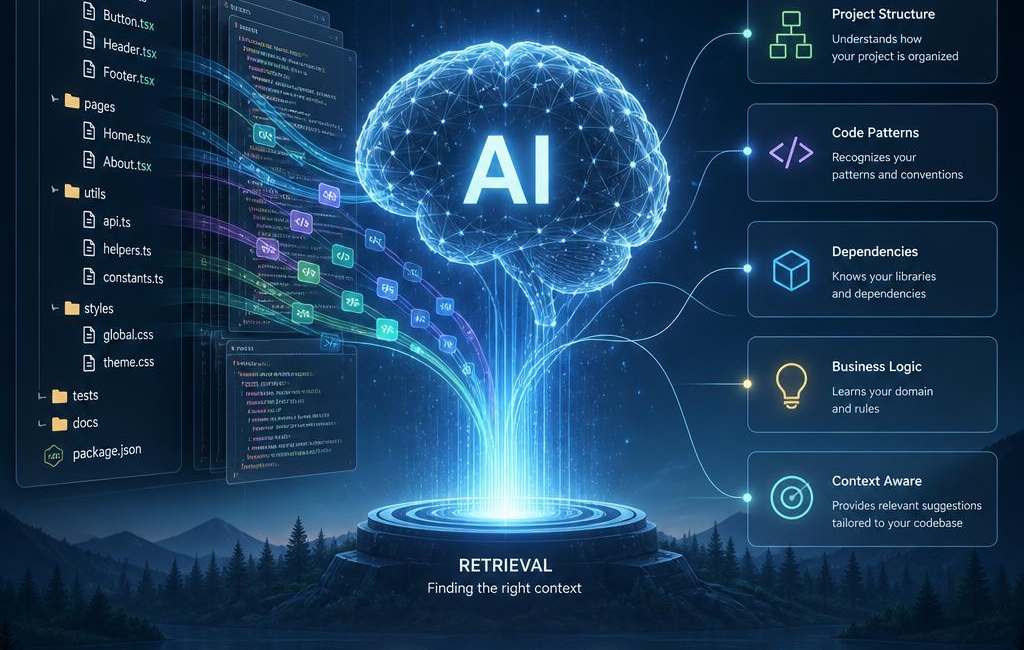
Can AI learn my codebase? Not in the way a teammate does over months of work, but it can build a useful, evidence-based view of a repository when it can retrieve the right context at the right time. Rather of guessing from a prompt alone, a repository-aware assistant can look up the files, symbols, tests, configurationand documentation connected to the question.
That distinction matters. Ask about authenticationand the useful context is not every file containing “auth.” It is indeed the route handler, middleware, token utilities, relevant environment settings, and tests that define the expected behavior. The quality of that retrieved context shapes the quality of everything that follows: explanations, debugging helpand suggested changes.
Finding the Right Context
A repository is not one giant document. It is indeed a web of files, dependencies, conventionsand history. Retrieval helps an AI narrow that web into a working set that relates to the task at hand.
Good retrieval goes beyond keyword matching. A function name might appear in a controller, an interface, a mockand an old migration. Those references are not interchangeable. By bringing in nearby code and relevant relationships, an assistant has a better chance of telling public contracts from internal helpers, current patterns from leftoversand intended behavior from an accidental implementation detail.
That makes questions such as “Where is this setting applied?” more useful. Rather than returning a handful of text matches, the assistant can trace the setting from configuration through the code that consumes it and into the tests that verify the result.

Keeping Code in Context
Retrieval works better when the repository is broken into meaningful pieces. Functions, classes, modules, configuration blocks, tests, and documentation sections are usually better units than arbitrary slices of text. Each piece should retain enough information to explain what it is and where it belongs: file path, language, imports, exported symbols, parent classand relevant comments.
That context helps distinguish code that looks similar but serves different purposes. A validate() method in an authentication service is not necessarily related to a validate() method in a payment workflow. The name alone is weak evidence; its location, dependencies, callers, and surrounding code tell the more useful story.
It can also help to preserve more than one representation of meaningful code. Raw source is useful for precise technical questions. A short description can make plain-English searches easier to match. A broader view of the containing file or subsystem keeps the architectural purpose from getting lost. None of those views is enough on its own,but together they make it less likely that the AI will find a superficially similar snippet and miss the local rules that actually matter.
Following the Code Path
A practical retrieval workflow starts with the developer’s intent, then follows the code paths connected to that request. If someone is changing an API endpoint, relevant context may include the endpoint itself, the service it calls, related interfaces, callers, configurationand the tests that describe both successful and failed requests.
Documentation belongs in that picture too,but selectively. A root README may explain project-wide conventions, while a package-level guide might describe an important boundary that is not obvious from the code. Architecture notes, API contractsand comments are most useful when they directly govern the code being examined.
Directory scope and version context matter as well. A migration guide may be essential when working in a legacy module and irrelevant for a newer service. The aim is not to give the model more text.It is indeed to give it the right evidence: executable behavior alongside the written intent behind it.
With retrieval over your repository, an AI can answer grounded questions about your specific codebase rather than relying on generic programming patterns.That does not make every answer correct, but it gives the model a much stronger basis for explaining what it found and why a proposed change may fit.
Setting Sensible Boundaries
Repository retrieval should not mean unrestricted access to everything in version control. Teams need clear rules about which repositories, branches, directories, generated filesand ancient commits can be indexed or retrieved. Access should follow the same least-privilege approach used for people: an assistant working on one service should receive the context needed for that service, not unrelated internal projects or sensitive material.
Secrets, private keys, customer exports, local configuration, security incident notesand protected documents should normally be excluded. It is also worth keeping a record of the files and revisions used for significant recommendations or generated changes. That makes review easier and gives teams a way to understand what informed an answer.
- Define who can approve retrieval access for each repository or code area.
- Exclude sensitive data and protected documentation by default.
- Keep AI-generated changes in the normal testing, securityand code-review process.
Context also needs maintenance. Indexes should be refreshed after meaningful changes, while stale branches and obsolete generated artifacts should be removed when they are no longer useful. Clear architecture notes, module ownership, dependency conventionsand coding patterns give both the assistant and human reviewers a better reference point than scattered comments or old tickets.
What Repository-Aware AI Can Actually Do
an AI assistant does not truly absorb a codebase onc and know it forever. Its understanding depends on the context it can retrieve, the permissions it hasand the quality of the repository itself.When those pieces are handled carefully, it can help developers navigate unfamiliar areas, explain relationships between filesand draft changes that are tied to the project rather than copied from a generic example.
The goal is not to replace engineering judgment. It is indeed to make the first pass through a large codebase faster and more grounded-while keeping humans responsible for review, testing, securityand the final decision.
AI tools built by Emerald Force
Built and supported by Emerald Force.

You might also like
AI Worker Monitoring: Legal Limits Employers Face
- How AI Reads PDFs, Charts, Screenshots, and Photos
- Access Control in AI: Rules for Use and Access
- AI Rationales Aren’t Always Faithful Explanations
- AI for Homework: Tutoring Allowed, Final Answers Limited
- AI in Healthcare: The Risks of Overtrust
- Large Language Models: How They Learn Language
- The New Jobs AI Is Creating Across the Economy
- AI Can Support Peer Review, Not Replace Reviewers
- Can AI Create Logos? Speed, Originality, and Legal Risk