
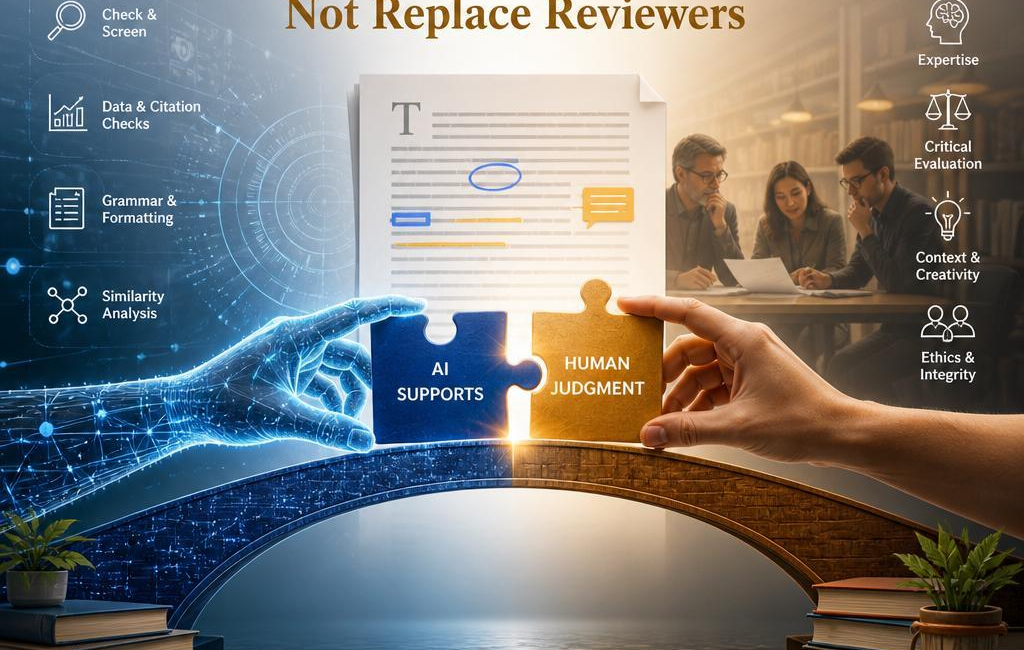
Can AI replace peer review? No. It can support routine checksorganize informationand help reviewers get to the right questions faster, but it cannot take responsibility for a scholarly judgment.
Peer review depends on more than finding a missing citation or an inconsistent number. It asks whether a study is well designed, whether its claims match its evidence, and whether the work adds something meaningful to the field. Those decisions still require people with subject knowledge, independenceand a willingness to explain their reasoning.
Where AI can help
AI is most useful at the begining of the process, as a screening tool rather than a decision-maker. It may help editors spot incomplete submissions, missing declarations, inconsistent reportingor references that do not appear to match the claims being made.It can also point reviewers toward passages, figuresor citations that deserve a closer look.
That is valuable work,provided the results are treated as prompts rather than conclusions.A tool can flag a possible problem without understanding why a method was chosen, how a term is used in a particular disciplineor whether an apparent inconsistency has a legitimate clarification. It may also be wrong while sounding certain.
Evidence checks need the same caution. A paper may cite a relevant study but extend its findings too far. A limitation may be acknowledged in one place and overlooked in the conclusion. The quality of underlying data may not be clear from the manuscript at all. AI can help identify where a reviewer should look; it cannot settle those questions on its own.
The practical boundary is simple: use AI for triage, consistency checks, citation matchingand questions for follow-up. Do not use it to accept or reject a paper,determine its originality,or decide between competing interpretations of the evidence.

Why expert judgment still matters
Peer review is not a checklist. Reviewers need to consider whether the research question matters, whether the chosen method suits the questionand whether the conclusions go further than the results allow.An AI tool might notice that a control group is absent. A qualified reviewer is the one who can decide whether that is a serious flaw, a reasonable limitationor something addressed through another valid study design.
interpretation is equally important. Good reviewers recognize uncertainty,weigh alternative explanations,and notice when a neat conclusion conflicts with what is already known in the field. They can also distinguish between a paper that needs clearer reporting and one whose central argument dose not hold up.
This is where accountability matters most. Reviewers explain their concerns in a way authors can respond to, challengeand improve upon. A machine-generated assessment may be a useful starting point, but it is not a substitute for a reasoned review signed off by someone prepared to stand behind it.
Protect confidentiality and integrity
Any use of AI in peer review must begin with clear rules about confidentiality. Manuscripts are frequently enough unpublished and sensitive. Reviewer identities, editorial correspondenceand underlying data may be confidential as well. They should not be entered casually into external AI services.
Journals need to define which tools are approved,what information may be shared with them,how prompts and outputs are handled,and who can review the record of use. An AI-generated summary might help an editor compare reviewer comments or identify missing declarations, but it should never become an unexplained editorial decision.
A sensible policy should also require people to verify any AI-generated claim, citation checkor recommendation before it affects the outcome of a submission. Use should be documented internally, and the process should be reviewed for errors, biasand potential exposure of confidential material. Authors and reviewers should have a clear way to raise concerns if they believe a tool has been used improperly or has produced a factual error.
Build a workflow around people
The best role for AI is to reduce repetitive preparation work, not to make the judgment call. It can help surface missing disclosures, duplicated text, unclear passages, citation inconsistenciesor departures from a journal’s submission requirements.Those results should appear as visible, reviewable prompts with enough context for a person to assess them.
From there, responsibilities should remain clear. AI can prepare and flag. Reviewers examine methods, evidence, limitations, noveltyand interpretation. Editors weigh the reviews alongside journal policy, conflicts of interestand the wider publication record.
A reliable workflow also keeps a record of what happened to AI-generated flags: which ones were reviewed, which were dismissedand why. Reviewers should be free to disagree with a suggestion, add context the tool missed, and report problems with the system. That creates a useful audit trail without turning peer review into a black box.
AI can assist, but people remain responsible
AI can make parts of peer review more manageable, especially where the work is repetitive and rules-based. It can help editors and reviewers focus their time where it matters most.But trust in scholarly publishing still rests on human expertise,transparent reasoning,and responsibility for the final decision.
Used carefully, AI can support peer review.It should not replace the reviewers whose judgment gives the process its value.
AI tools built by Emerald Force
Built and supported by Emerald Force.
You might also like
AI Worker Monitoring: Legal Limits Employers Face
- How AI Reads PDFs, Charts, Screenshots, and Photos
- Access Control in AI: Rules for Use and Access
- AI Rationales Aren’t Always Faithful Explanations
- AI for Homework: Tutoring Allowed, Final Answers Limited
- AI in Healthcare: The Risks of Overtrust
- Large Language Models: How They Learn Language
- The New Jobs AI Is Creating Across the Economy
- AI Can Support Peer Review, Not Replace Reviewers
- Can AI Create Logos? Speed, Originality, and Legal Risk