

Challenges in Data Quality and accessibility Undermining Enterprise AI Success
One of the most pernicious obstacles to deploying prosperous AI solutions at scale is the pervasive issue of poor data quality and accessibility. Enterprises often rely on legacy systems and fragmented data sources that lack standardized formats or enforce inconsistent validation rules. This inconsistency results in datasets plagued by inaccuracies, missing values, and duplications, which ultimately skew AI model training and degrade prediction reliability. Additionally, data silos across departments restrict smooth data flow, forcing AI initiatives to contend with incomplete or outdated information. Without a holistic view and trustworthy datasets, even the most sophisticated AI algorithms cannot deliver meaningful insights or robust automation outcomes.
Key contributors to these challenges include:
- Disparate data formats and lack of integration protocols
- Inadequate data governance policies and quality control mechanisms
- Limited access due to security, privacy, or infrastructural constraints
- Fragmented ownership of data assets leading to accountability gaps
| Issue | Impact on AI |
|---|---|
| Inconsistent data formats | Model training errors and increased preprocessing time |
| Data silos | Partial context, limiting AI decision accuracy |
| Poor data governance | Untrustworthy outputs, eroding stakeholder confidence |
| Access restrictions | Delayed insights and inability to leverage real-time analytics |
Overcoming these barriers demands enterprise-wide commitment to data harmonization strategies, rigorous governance frameworks, and scalable infrastructure that balances security with accessibility. Only by establishing trusted, integrated data foundations can AI projects transcend failure risks and achieve transformative business impact.
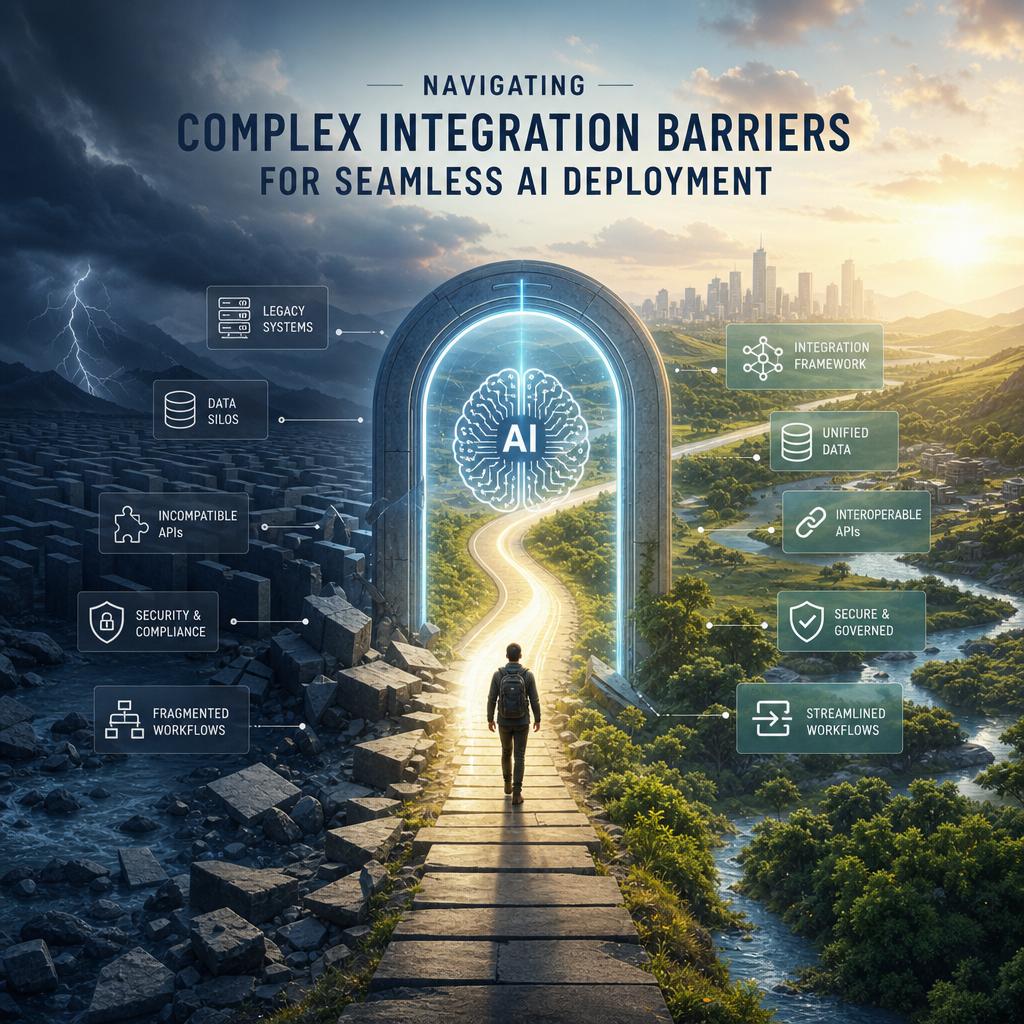
Navigating Complex Integration Barriers for Seamless AI Deployment
Enterprises often grapple with a complex web of integration challenges that hinder the smooth deployment of AI solutions. These barriers arise from fragmented legacy systems, incompatible data formats, and siloed operational platforms that refuse to communicate seamlessly.Successful AI integration demands more than just plugging in an algorithm; it requires a holistic approach to unify diverse technologies under a coherent architecture. Key integration obstacles include:
- Disparate data pipelines that disrupt real-time analytics
- Lack of standard APIs across enterprise software ecosystems
- Resistance from IT infrastructure unable to scale with AI demands
- Security protocols conflicting with AI data accessibility
Overcoming these hurdles necessitates strategic collaboration between AI specialists, IT teams, and business units to redesign workflows and data handling processes. Embedding AI into existing platforms without degrading performance or security requires robust middleware solutions and adaptive frameworks that can handle evolving business rules. The table below outlines how select integration challenges correlate with potential mitigation strategies to promote seamless AI adoption.
| integration Barrier | Impact on AI Deployment | recommended Strategy |
|---|---|---|
| Legacy System Incompatibility | Delayed data flow, inconsistent model training | API standardization and modular middleware layers |
| Data Silos | Incomplete datasets, biased AI outputs | Centralized data lakes with governed access |
| Security Restrictions | Limited AI model access, stalled innovation | Adaptive security frameworks balancing access and protection |
Building and Sustaining Trust in AI Systems Through Transparency and Accountability
Trust serves as the cornerstone for the successful deployment of AI systems in an enterprise habitat.Transparency acts as a vital mechanism to foster this trust, ensuring stakeholders understand how AI models reach their conclusions. By embracing explainable AI frameworks, organizations can demystify algorithmic processes and provide clarity on data sources, model decisions, and potential biases. this level of openness not only empowers decision-makers but also reassures users and regulators, reducing skepticism and resistance. Enterprises that emphasize transparency create a culture were AI outputs are not just accepted but critically examined, empowering users with confidence and fostering informed collaboration.
Accountability complements transparency by establishing clear ownership and responsibility for AI outcomes. defining roles-from data stewards to algorithm auditors-guarantees that mechanisms for monitoring and correcting AI behavior are actively maintained. Below is a simple accountability matrix illustrating key functions:
| Role | Primary Responsibility | Key Action |
|---|---|---|
| Data Steward | Data quality and compliance | Ensure accuracy, manage updates |
| Model Developer | Algorithm design and validation | Build unbiased, robust models |
| Ethics Officer | Oversight of ethical implications | Identify risks, recommend adjustments |
| End User | Operational use and feedback | Report anomalies, suggest improvements |
the synergy of transparent communication and defined accountability creates an ecosystem where AI systems are continuously scrutinized, improved, and trusted. Enterprises that embed these principles into their AI governance frameworks not only mitigate risk but also accelerate adoption and innovation.
Optimizing Workflow Alignment to Maximize AI Impact and User Adoption
To truly harness the potential of AI, it is indeed essential that the technology seamlessly integrates with existing workflows rather than appearing as an intrusive add-on. When AI tools disrupt familiar processes, adoption rates plummet, and the promised benefits dwindle. Successful alignment involves understanding users’ day-to-day tasks, pain points, and decision-making frameworks, than tailoring AI outputs to complement these factors. Embedding AI insights into the natural flow of work-through context-aware notifications, automated data entry, or decision-support dashboards-ensures minimal cognitive friction and encourages continual engagement.
Effective workflow optimization for AI adoption also demands a cross-functional approach. Business leaders, IT teams, and end users must collaborate closely to identify friction points and iterate on solutions that adapt as needs evolve. Consider the following strategic components for alignment:
- Clear role Definition: Specify how AI augments versus replaces tasks,avoiding confusion and resistance.
- Training and Support: Provide ongoing education tailored to user proficiency levels and changing AI capabilities.
- Feedback Loops: Implement mechanisms to capture user insights for continuous improvements.
| Aspect | Benefit | Impact on adoption |
|---|---|---|
| Contextual Integration | Real-time relevance | Higher user trust |
| Automation of Routine Tasks | Increased efficiency | Reduced resistance |
| User-Centered Design | Improved usability | Continuous engagement |