

Universities’ Initial Responses to Artificial Intelligence Challenges
Faced with teh rapid integration of artificial intelligence tools into academic environments, many universities rush to implement measures aimed at preserving academic integrity. Initial strategies varied widely; some institutions opted for outright bans on AI-generated content during examinations and assignments, citing concerns over fairness and authenticity. Others focused on establishing mandatory disclosure policies, requiring students to clearly indicate when and how AI tools were utilized in their work. These early responses reflect a broader struggle to balance innovation with ethical standards in education.
- Hard bans: Prohibition of AI tool usage during assessments.
- Disclosure requirements: Mandatory reporting of AI involvement in coursework.
- Guidance development: Creation of detailed AI usage policies for faculty and students.
| University | Response Type | Policy Highlights |
|---|---|---|
| Alpha State | Ban | No AI tools allowed in exams; strict penalties enforced |
| Beta Tech | Disclosure | Students must annotate AI-assisted sections in assignments |
| Gamma University | Combination | Ban in assessments, encouraged responsible AI use in research |
Universities’ pursuit of clarity around AI’s role has also led to intensified efforts in revising academic integrity codes and updating plagiarism detection frameworks. This phase highlights a transition from reactive bans towards a proactive, educative paradigm. By emphasizing openness and equipping educators with tools to recognize AI’s impact on student work, institutions aim to foster a culture where technology serves as a complement-not a shortcut-to learning.
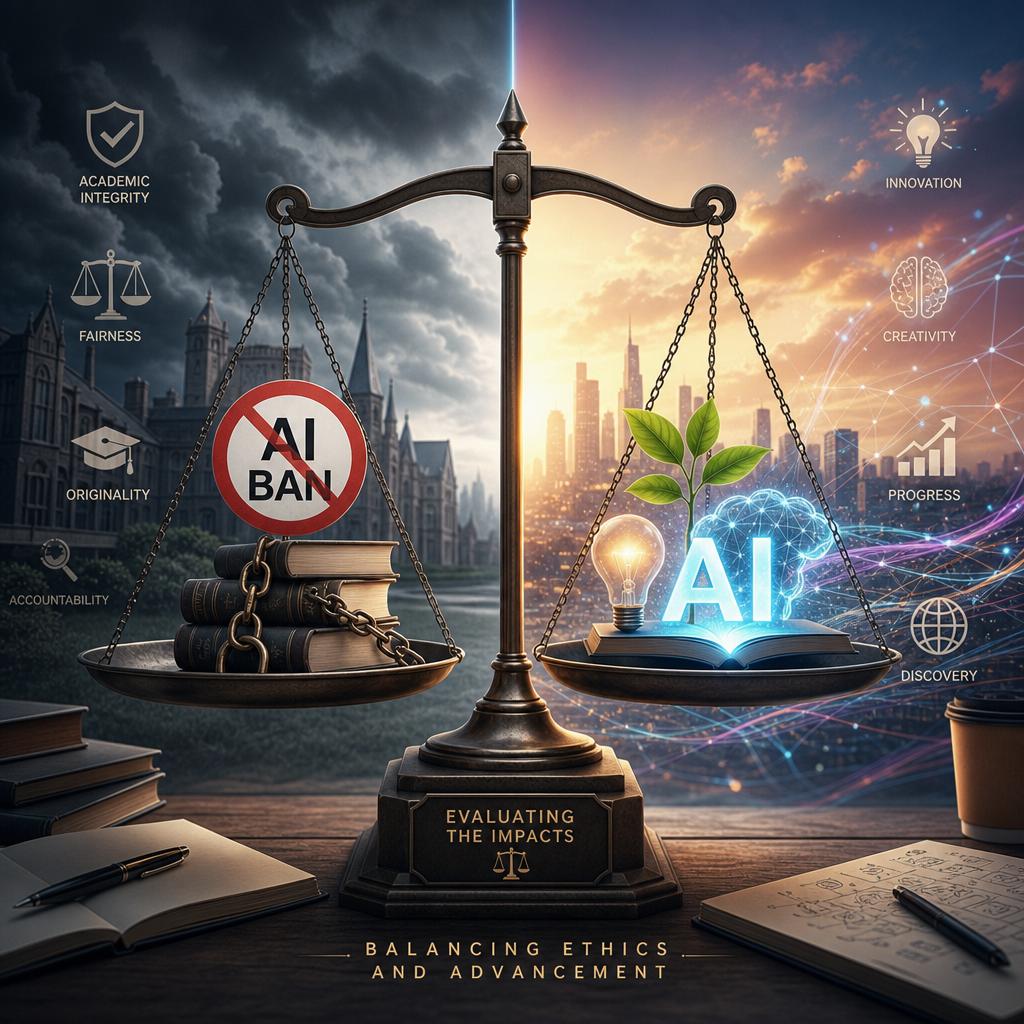
Evaluating the Impacts of AI Bans on Academic Integrity and Innovation
Imposing outright bans on AI tools in academic settings might seem like a straightforward solution to preserving integrity, but the ripple effects are far more complex. While these restrictions aim to curb plagiarism and ensure originality, they frequently enough spur unintended consequences such as stifling creativity and hindering the adoption of innovative learning technologies. Instead of relying solely on prohibitions, universities are gradually shifting toward frameworks that encourage transparency-balancing the potential of AI with the ethical standards of scholarship. This evolving approach supports a more nuanced understanding of how AI can be integrated without compromising the core values of academic honesty.
Key considerations in evaluating the impact of AI restrictions include:
- How bans affect students’ motivation to develop critical thinking skills versus dependency on automated solutions.
- The influence on faculty’s flexibility in designing curricula that leverage AI for personalized learning experiences.
- Implications for institutional innovation as universities navigate between regulation and technological advancement.
| Dimension | Impact of AI Ban | Impact of Disclosure Rules |
|---|---|---|
| Academic Integrity | Potentially rigid enforcement, higher detection efforts | Transparency fosters trust, encourages responsible use |
| Innovation | Innovation slowdown due to fear of non-compliance | Promotes experimentation within clear ethical boundaries |
| Student Development | Risk of discouraging skill development and exploration | Supports learning reflection and critical assessment of AI outputs |
Implementing Comprehensive AI disclosure Policies for Transparency
Universities are increasingly recognizing that transparency around AI usage is essential to foster trust and uphold academic integrity. by establishing detailed disclosure policies, institutions require students and faculty to explicitly state when and how AI tools contribute to their work. Such policies often mandate:
- Clear identification of AI-generated content in assignments and research publications.
- Description of the extent and nature of AI assistance utilized.
- Guidelines for ethical AI use aligned with institutional values.
This approach not only mitigates the risks of undisclosed AI dependency but also encourages critical engagement with AI technologies, ensuring users remain accountable for their outputs.
| Policy Element | Purpose | Implementation |
|---|---|---|
| Disclosure Statements | Ensure clarity on AI’s role | Mandatory inclusion in coursework and publications |
| Ethical Guidelines | Promote responsible AI use | Regular workshops and updated manuals |
| Verification Processes | Maintain academic standards | AI-detection software and peer reviews |
By embedding these protocols within their academic frameworks, universities create an surroundings where transparency is not optional but a core principle.This shift reflects a proactive stance toward technological evolution and sets a precedent for other sectors aiming to balance innovation with accountability.
Recommendations for balancing AI Integration with Ethical Academic Practices
Universities must adopt a nuanced approach to incorporating AI tools in academia that prioritizes transparency and integrity. One effective strategy involves mandating explicit disclosure when AI assistance has contributed to academic work.Such policies empower educators to assess the extent and nature of AI usage without outright banning these technologies, which are increasingly prevalent. Moreover, institutions should develop clear guidelines that specify acceptable contexts for AI use, distinguishing between permissible support tools and unethical shortcuts. This clarity fosters a culture of trust and accountability while leveraging AI’s benefits for learning enhancement.
- Implement mandatory AI-use declarations in assignments and research submissions.
- Define ethical boundaries for AI applications in various academic disciplines.
- Train faculty and students on the responsible and critical use of AI.
- Create oversight committees to review emerging challenges and update policies accordingly.
| Suggestion | Purpose | Impact |
|---|---|---|
| AI Disclosure Rules | Ensure transparency in AI use | Builds trust between students and faculty |
| Ethical Use Training | Educate on benefits and limitations of AI | Promotes responsible adoption |
| Usage Guidelines | Clarify permissible AI applications | Reduces academic misconduct |
| oversight committees | Monitor AI’s evolving role | Ensures policies remain relevant |
Ultimately, balancing artificial intelligence integration with ethical academic standards requires proactive governance and ongoing dialogue. Universities must not only enforce policies but also cultivate an environment where critical thinking about AI’s role in scholarship becomes a core element of education. Encouraging students to engage with AI thoughtfully, rather than fear or misuse it, will prepare them for a future where human creativity and technological tools coexist, enhancing the pursuit of knowledge rather than compromising it.