

Understanding the Fundamentals of Zero-Shot Prompting in Natural Language Processing
Zero-shot prompting is a transformative approach in natural language processing that enables models to perform tasks without prior exposure to explicit examples or task-specific training data.This technique relies heavily on the model’s inherent ability to generalize from vast pre-trained knowledge, interpreting the instructions embedded in the prompts and producing relevant outputs accordingly. Unlike customary supervised methods, zero-shot prompting leverages the contextual understanding encoded within large language models, bridging the gap between human instruction and machine execution effortlessly.
Key components that make zero-shot prompting effective include:
- Instruction Clarity: Precise and clear wording in prompts directs the model to comprehend and act on the intended task.
- Context Awareness: Utilizing contextual cues helps the model infer nuanced meanings and expectations without direct examples.
- Model Pre-training: The depth and diversity of pre-training datasets empower the model to generalize across a wide range of domains and topics.
| Aspect | Description | Impact on Zero-Shot |
|---|---|---|
| Prompt Design | Choice of words and structure in prompt | Directly influences accuracy and relevance |
| Pre-trained Knowledge | Diversity of language corpus | Enables adaptability across different tasks |
| Model Size | number of parameters | Improves reasoning and understanding |
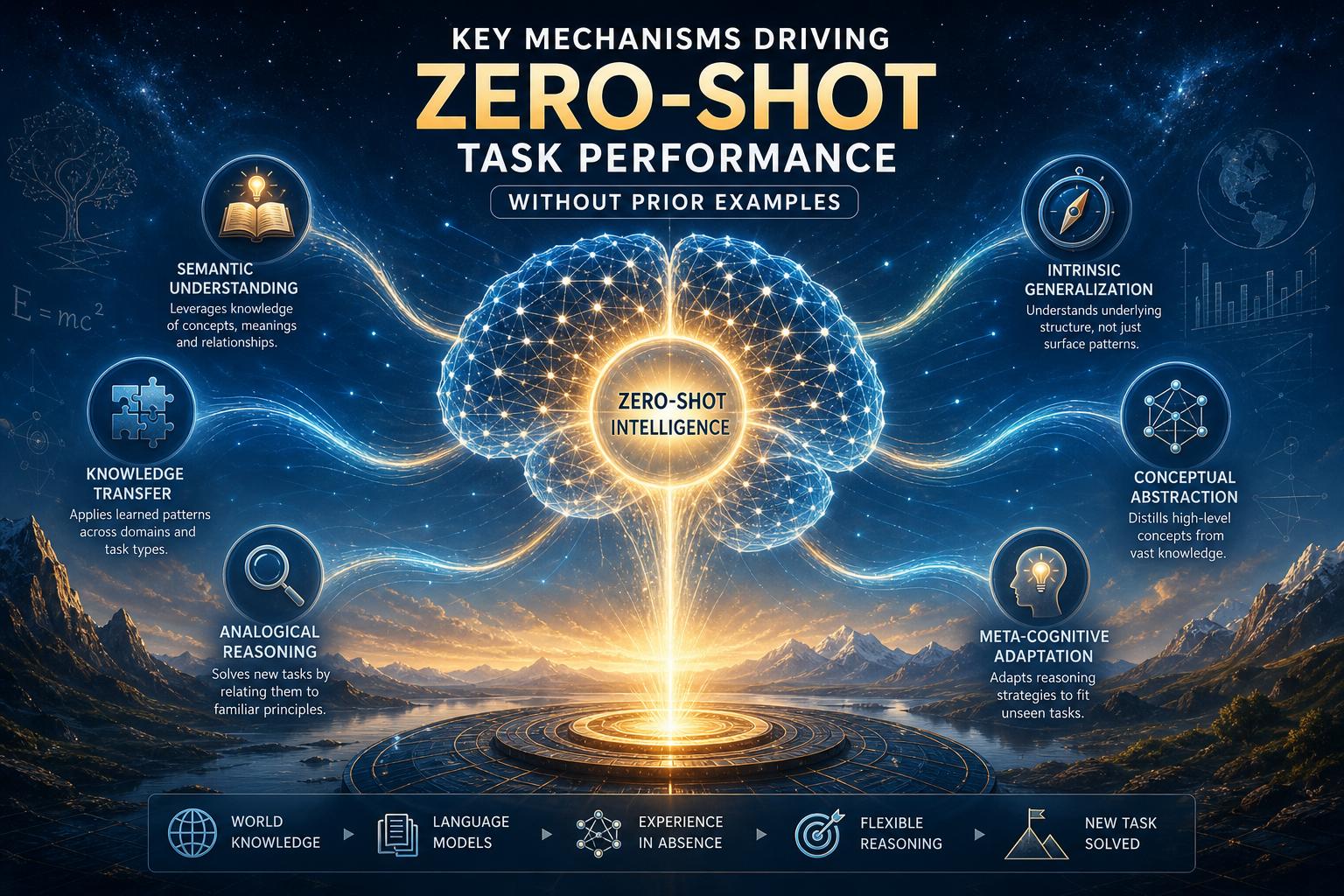
Key Mechanisms Driving Zero-Shot Task Performance Without Prior Examples
At the core of zero-shot task performance lies the remarkable ability of large language models to leverage contextual understanding and generalization. Unlike traditional supervised learning, where models require extensive example-driven training, zero-shot prompting taps into the latent knowledge encoded within the model’s vast pretraining on diverse text data. This intrinsic comprehension enables the model to identify task objectives based solely on the prompt’s instructions, effectively simulating task-specific reasoning without prior exposure to explicit examples.
Several mechanisms underpin this phenomenon, including:
- Semantic parsing: Interpreting natural language prompts to map instructions into executable tasks.
- Pattern recognition: Recognizing implicit relations and structures within the prompt aligned wiht previously encountered concepts.
- Transfer learning: Applying knowledge learned from related contexts to novel tasks without direct retraining.
- Probabilistic inference: Utilizing statistical correlations embedded during pretraining to predict the most plausible outputs.
| Mechanism | Role in Zero-Shot | Example |
|---|---|---|
| Semantic Parsing | Transforms language into logical task steps | Interpreting ”Summarize this article” properly |
| Pattern Recognition | Matches prompt nuances to learned patterns | Identifying sentiment clues in text |
| Transfer Learning | Adapts related skills to new commands | Using grammatical rules for language translation |
| Probabilistic Inference | predicts likely responses from learned data | Completing sentences with contextually relevant words |
Challenges and Limitations in Applying Zero-Shot Prompting to Complex tasks
While zero-shot prompting offers a powerful paradigm to tackle tasks without prior examples, it confronts intrinsic hurdles when applied to intricate scenarios. The core challenge lies in the model’s reliance on general knowledge and linguistic patterns, which may fall short when nuanced interpretation or specialized domain expertise is essential.Unlike few-shot approaches that provide contextual clues via examples, zero-shot models must infer task requirements purely from the prompt’s wording, increasing the risk of ambiguity or misinterpretation. This often results in outputs that lack precision, struggle with multi-step reasoning, or fail to capture subtleties critical to complex decision-making processes.
Key limitations include:
- Ambiguity Sensitivity: Slight changes in prompt phrasing can lead to significantly different responses, indicating fragility in understanding task nuances.
- Domain Constraints: Insufficient exposure to specialized knowledge restricts performance in niche or technical areas.
- Reasoning Gaps: Difficulty in handling multi-faceted tasks that require logical chains or hierarchical thinking.
| Challenge | Description | Impact on Task |
|---|---|---|
| Context Deficiency | Lack of examples reduces grounding in task specifics | Increased error rate and vague responses |
| ambiguity in Prompt | Prompt wording can confuse or mislead model | Unpredictable or inconsistent output |
| Complex Reasoning | Difficulty executing multi-step inferences | Oversimplified or incorrect conclusions |
Strategic Recommendations for Designing Effective Zero-Shot Prompts in AI Models
Mastering the art of zero-shot prompting demands a strategic approach that balances clarity and specificity without relying on example-driven guidance.To maximize the effectiveness of your prompts, it is essential to detail the task requirements explicitly, outlining expected outputs with precise language. Incorporating context that defines the target domain and constraints helps the AI model narrow down its focus, ensuring more accurate and relevant responses. Additionally, framing instructions using clear, concise imperatives encourages the model to follow the desired path of reasoning without ambiguity.
- Anchor prompts with role definitions to frame the AI’s perspective, such as “act as a data analyst…” or “Imagine you are a historian…”
- Use segmented instructions breaking complex tasks into smaller, manageable steps to enhance coherence
- Explicitly prohibit undesired outputs to steer away from ambiguity or irrelevant responses
To further enhance prompt design, consider a comparative approach that distinguishes subtle variations in phrasing and structure. The table below summarizes how different prompting elements influence output quality,helping guide the creation of prompts that strategically leverage language nuances for optimal zero-shot performance.
| Prompt Element | Effect on Output | Design Tip |
|---|---|---|
| Role Definition | Frames context and perspective | Specify roles to align model assumptions |
| Clear Task Description | Reduces ambiguity, increases precision | Use simple, direct language |
| Stepwise Instructions | Improves logical flow and coherence | Break complex tasks into subtasks |
| Negative Guidance | Prevents irrelevant or incorrect outputs | Explicitly state what to avoid |