

Understanding the Fundamental Principles of System Prompts
To harness the true potential of system prompts, it is indeed crucial to grasp the underlying framework that governs their operation. Fundamentally, system prompts act as the backbone, directing the flow and nature of interaction between users and AI assistants. These prompts are carefully designed to encapsulate contextual cues, behavioral boundariesand response guidelines that collectively ensure the AI operates within expected parameters. Understanding these rules enables developers and users alike to predict and control how assistants respond, enhancing reliability and relevance.
Key principles involve the balance between versatility and constraint,where prompts must be tailored to encourage helpfulness without compromising accuracy or ethical standards. Below is a concise overview of critical elements that outline the operational essence of system prompts:
- Context Awareness: Embedding necessary background details to maintain coherence across interactions.
- Behavioral Constraints: Setting explicit instructions that prevent harmful or inappropriate content.
- Response Optimization: Guiding the assistant to prioritize clarity, concisenessand pertinence.
- Ethical Considerations: Ensuring the assistant upholds fairness, privacy, and respect in its replies.
| Principle | Purpose | Example |
|---|---|---|
| Context awareness | Maintain consistent and relevant dialog | Remember previous user inputs |
| Behavioral Constraints | Prevent undesirable responses | Avoid generating offensive language |
| Response Optimization | Enhance clarity and usefulness | Summarize lengthy explanations |
| Ethical considerations | Promote responsible AI usage | Respect user privacy |
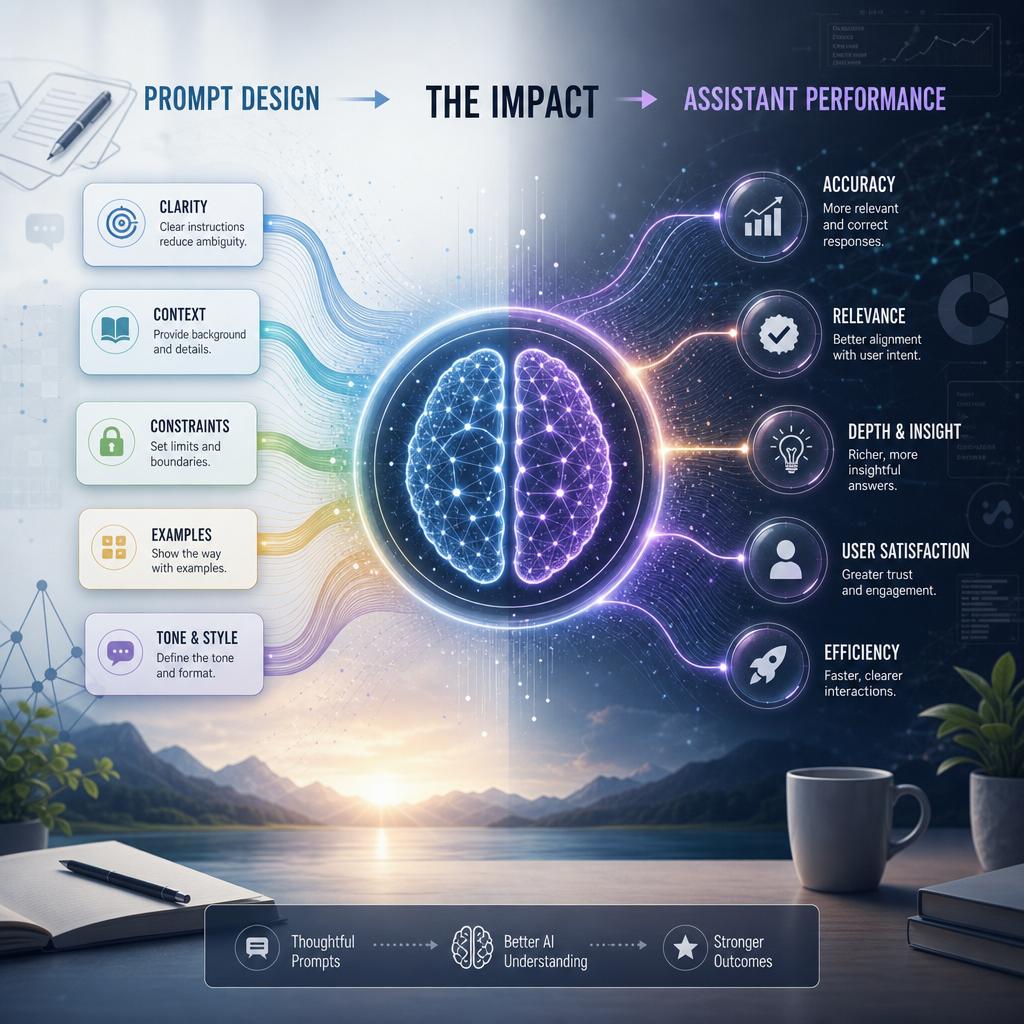
Analyzing the Impact of Prompt Design on assistant Performance
Carefully engineered prompts serve as the foundation for optimal assistant performance, influencing how the system interprets and responds to user inputs.A well-designed prompt enables the assistant to understand context, prioritize relevant informationand generate coherent, actionable responses. Conversely, ambiguous or poorly framed prompts can lead to vague or off-target outputs, diminishing user satisfaction.Central to effective prompt design is the establishment of clear, concise instructions that delineate the assistant’s role and constraints, ensuring consistency and precision in its behavior.
Key elements shaping prompt efficacy include:
- Clarity: Avoiding ambiguity by using explicit instructions.
- Contextual Depth: Providing enough background to guide nuanced understanding.
- Scope Definition: Setting boundaries to prevent irrelevant or overly broad answers.
- Task Specificity: Tailoring prompts to the domain or task enhances relevance.
| Prompt Feature | Impact on performance |
|---|---|
| Explicit Role Definition | Improved consistency and tone alignment |
| Conciseness | Faster response times with higher precision |
| Context Inclusion | Enhanced relevance and factual accuracy |
| Scope Limiting | Reduced confusion and off-topic replies |
Best Practices for Crafting Effective and Clear System Prompts
Effective system prompts are the backbone of seamless human-AI interaction.To ensure clarity and precision, it is essential to use concise and unambiguous language. Prompts should avoid jargon or overly complex sentences that might confuse the assistant. Instead, opt for straightforward expressions that guide the system toward the desired response. Additionally, incorporating context-specific details within the prompt helps the assistant understand the scope and limits of the task, reducing the risk of irrelevant or off-topic replies.
Another crucial practice involves structuring prompts to facilitate clear and direct instructions. Utilizing unnumbered lists can organize key points cleanly, making it easier for both the system and the user to track instructions. Consider the following simple framework for prompt design:
| Element | Purpose | Example |
|---|---|---|
| Instruction | Directs specific action | “Summarize the article’s main points.” |
| Context | Provides relevant background | “Focus on environmental impacts discussed.” |
| Output Format | Specifies desired response style | “Reply in bullet points.” |
By following these principles and maintaining brevity, you craft system prompts that empower assistants to respond accurately and efficiently, ultimately enhancing user experience and interaction quality.
Strategies for Enhancing User Interaction through Prompt Optimization
Maximizing user interaction begins with understanding how to craft prompts that are clear, concise, and contextually rich. Precise prompts enable digital assistants to deliver targeted responses, thereby enhancing the overall user experience. Focus on clarity and intent by including key details that guide the assistant without overwhelming it. As a notable example, rather than vague queries, prompts should specify the desired outcome and any constraints, helping the system tailor responses more effectively. This method reduces ambiguity and minimizes unnecessary follow-up questions, streamlining dialogue and increasing user satisfaction.
Equally crucial is the strategic use of tone and format within prompts to align with the interaction’s purpose. Employing conversational language for casual inquiries and formal structuring for professional contexts can dramatically influence user engagement. To illustrate, consider the following practical elements for prompt optimization:
- Contextual anchors: Incorporate relevant background information to maintain continuity.
- Action verbs: Use dynamic language to guide the assistant towards specific tasks.
- Open-ended vs. closed prompts: Balance between encouraging exploration and prioritizing direct answers.
| Prompt Element | Purpose | Example |
|---|---|---|
| Contextual Anchor | Maintain interaction flow | “Considering the previous transaction,explain…” |
| action Verb | Direct the system | “List”, “Compare”, “Summarize” |
| Open-ended Prompt | Encourage expansive responses | “What are the benefits of…?” |