
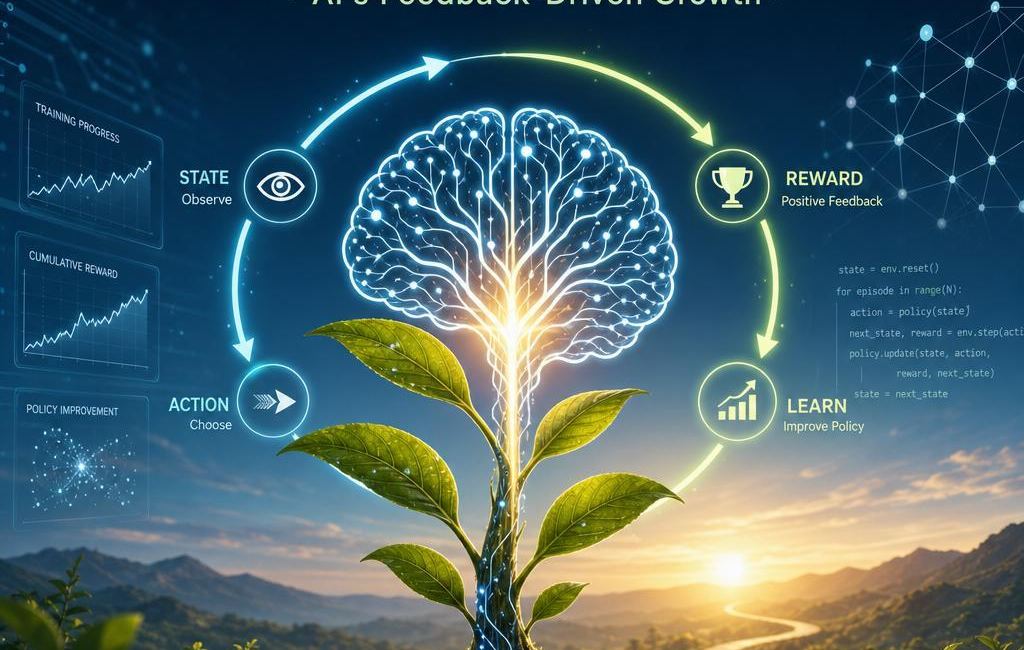
Understanding the Foundations and Core Principles of Reinforcement Learning
At its essence, reinforcement learning hinges on the interaction between an agent and its environment, where the agent learns to make decisions through a system of rewards and penalties. Unlike customary supervised learning, where models learn from labeled datasets, reinforcement learning thrives on trial and error, continuously refining its strategy based on feedback received.This dynamic framework allows the agent to discover optimal behaviors by maximizing cumulative rewards over time.
Several core principles underpin the efficacy of this approach:
- Exploration vs. Exploitation: Balancing the need to try new actions to gain knowledge with leveraging known actions to maximize reward.
- Reward Signals: Providing feedback that guides the agent towards accomplished outcomes, shaping its future decisions.
- Policy: The strategy that defines the agent’s decisions at any given moment.
- Value Function: Estimating the expected reward for a particular state, helping the agent prioritize actions.
| Component | Role |
|---|---|
| Agent | Decision-maker learning from interactions |
| Environment | context in which the agent operates |
| Reward | feedback signal guiding learning |
| Policy | Agent’s strategy for choosing actions |
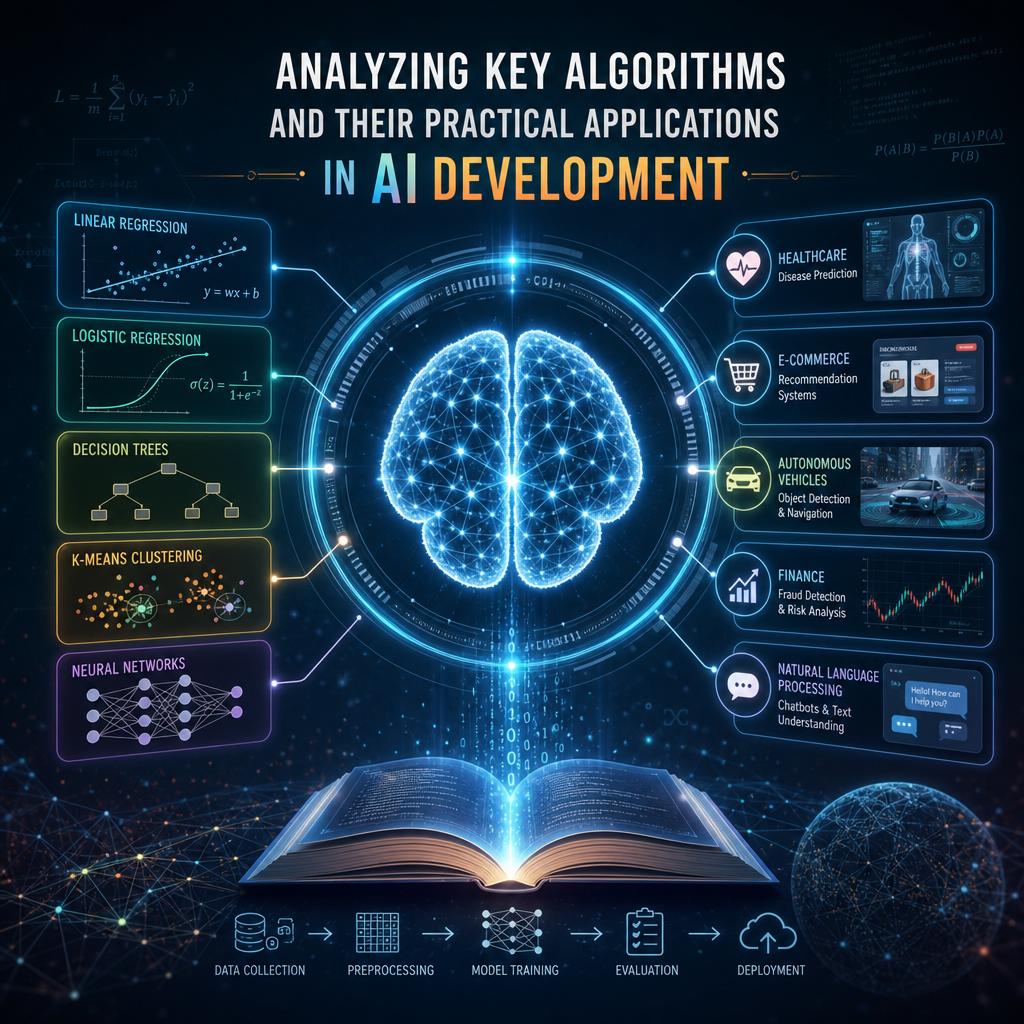
Analyzing Key Algorithms and Their Practical Applications in AI Development
At the heart of modern AI development lies a diverse array of algorithms that empower smart systems to learn, adapt, and optimize their performance. Among these, reinforcement learning (RL) stands out for its unique approach of learning through interaction and feedback, simulating real-world decision-making processes. Unlike supervised learning, which relies on labeled datasets, RL agents learn by receiving rewards or penalties based on their actions, enabling them to autonomously discover effective strategies. This trial-and-error paradigm has unlocked breakthroughs in robotics, game-playing AIand autonomous vehicles, where dynamic environments require continuous adaptation and improved performance over time.
The practical applications of these core algorithms are best understood by categorizing their functional impacts:
- Optimization under uncertainty: RL algorithms excel in scenarios where outcomes are probabilistic and facts is incomplete, such as financial modeling and supply chain management.
- Sequential decision-making: AI systems leverage these algorithms to plan multi-step actions, like navigating complex routes or scheduling tasks efficiently.
- Personalization and recommendation: Adaptive learning models tailor user experiences by refining preferences through feedback loops.
| Algorithm type | Key Feature | Primary Use Case |
|---|---|---|
| Q-Learning | Value-based learning | Game AI, robotics navigation |
| Policy Gradient | Direct policy optimization | Continuous control, robotics |
| deep Q-Networks (DQN) | Neural network function approximation | Complex decision environments |
Understanding how these algorithms operate and their specific utilities allows developers to harness AI more effectively, pushing the boundaries of automation and intelligent behavior in increasingly complex domains.
Evaluating Challenges in Reinforcement Learning and Strategies for Effective Implementation
Mastering reinforcement learning requires navigating a complex landscape where agents must learn from delayed and often sparse feedback. One major challenge is balancing exploration and exploitation, where the algorithm must decide whether to try new actions to gather data or leverage known actions to maximize rewards.This trade-off is critical, as excessive exploration can lead to inefficiency, while too much exploitation risks suboptimal policies. Additionally, the temporal aspect introduces difficulties such as credit assignment, determining which actions in a sequence contributed to success or failure. Without effective strategies, the learning process can become unstable or converge too slowly.
Effective implementation hinges on deploying robust techniques to confront these obstacles. Methods such as reward shaping can help accelerate learning by providing denser feedback signals, while incorporating experience replay enables agents to learn from past interactions, increasing stability. Moreover, using function approximation via deep neural networks aids in scaling reinforcement learning to environments with high-dimensional state spaces. Below is a concise comparison of common strategies used to enhance reinforcement learning agents’ performance:
| Strategy | Key Benefit | Common Use case |
|---|---|---|
| Reward Shaping | Denser feedback accelerates learning | Robotics and navigation tasks |
| Experience Replay | Improves sample efficiency and stability | Games and continuous control |
| Function Approximation | Enables handling complex state spaces | Visual and multi-sensor environments |
Optimizing Reinforcement Learning models for Enhanced Feedback-Driven Growth
Reinforcement learning models thrive on continuous interaction with their environment, leveraging feedback loops to evolve intelligently. By systematically optimizing these models, developers can enhance their ability to interpret reward signals and adjust strategies in real-time. Techniques such as reward shaping, exploration-exploitation balancingand dynamic learning rates play pivotal roles in fine-tuning performance. This approach not only accelerates the convergence towards optimal policies but also ensures sustained adaptability in complex, uncertain environments.
Key optimization strategies include:
- Adaptive Reward Design: Crafting reward functions that reflect nuanced objectives to guide model behavior more precisely.
- Experience Replay: Incorporating past interactions to stabilize learning and reduce variance.
- Policy Regularization: Preventing overfitting by introducing constraints that encourage generalization.
- Hyperparameter Tuning: Systematic adjustment of learning rates, discount factorsand batch sizes for maximal efficiency.
| Optimization Aspect | Impact on Model | Implementation Example |
|---|---|---|
| Reward Shaping | Improves learning speed and goal alignment | Incorporating intermediate rewards for progress milestones |
| Exploration Strategies | Balances finding and exploitation of strategies | Using epsilon-greedy with decay schedule |
| experience Replay | Reduces correlation between samples for stability | Sampling mini-batches from memory buffer |