

Understanding the Foundations of Multimodal AI and Its Core Components
At the heart of modern multimodal AI lies the capability to seamlessly process and interpret diverse types of data-including text, images, audioand even video-to achieve a cohesive understanding of information. This integration hinges on the interaction between several foundational components: data embedding techniques that translate different modalities into a shared representational space, cross-modal transformers that enable contextual linking across data types, and fusion mechanisms that combine these streams of information into unified outputs. Each component plays a critical role in ensuring that multimodal systems can not onyl analyze inputs independently but also capture the nuanced relationships that exist between modalities, thus outperforming single-modality AI models.
Understanding these components can be simplified by breaking them down into core functionalities:
- Embedding Layers: Convert raw data into vector forms recognizable by neural networks.
- Attention Mechanisms: Highlight relevant features across modalities, enhancing context awareness.
- Fusion Strategies: methods such as early fusion (combining data first) or late fusion (combining decisions) integrate modality-specific insights.
| Component | Function | Example Submission |
|---|---|---|
| Text Embedding | encodes sentences into vectors | Chatbots understanding user queries |
| Image Encoder | Extracts visual features | Medical imaging diagnosis |
| Audio Processor | Analyzes sound patterns | Speech recognition systems |
By encapsulating these core elements, multimodal AI systems can mimic human-like perception and decision-making, pushing the boundaries of applications across industries-from healthcare to autonomous vehicles-where comprehensive understanding and context-driven insights are paramount.
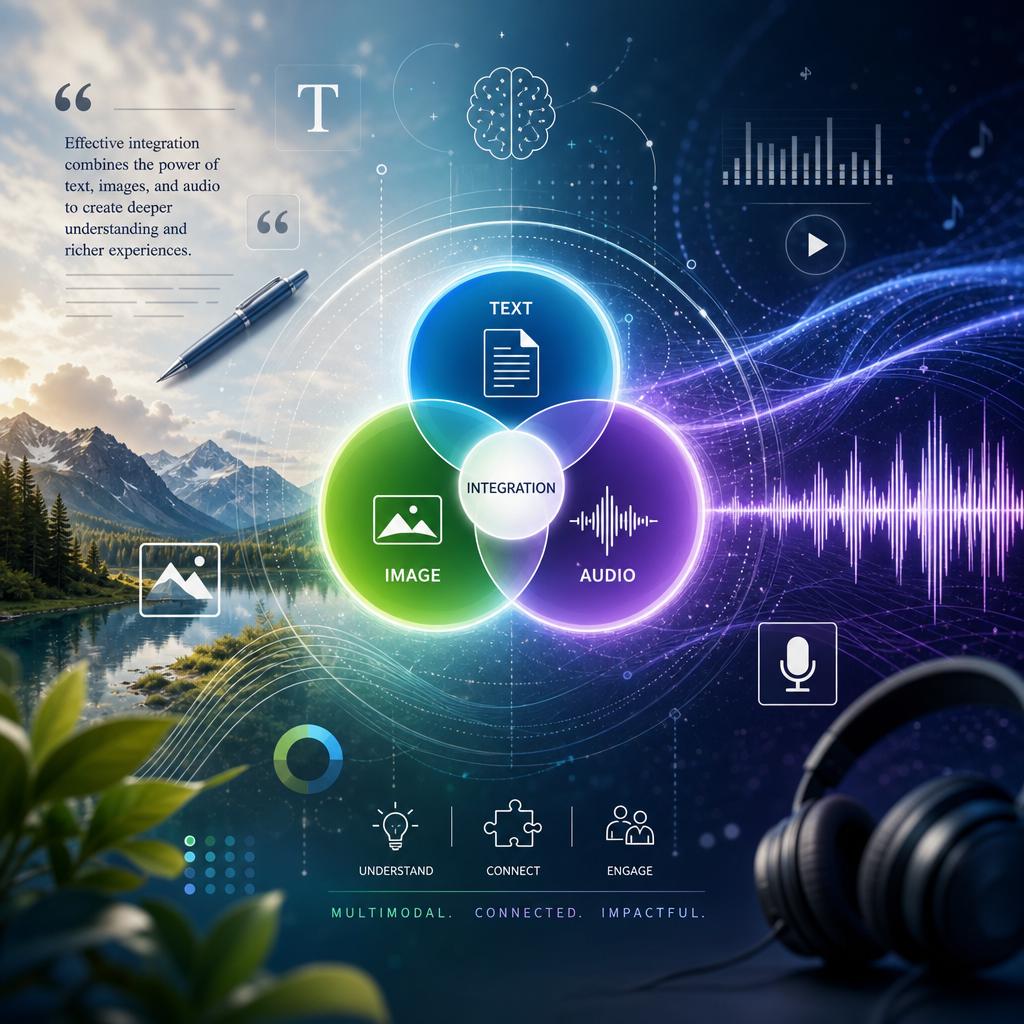
Exploring Techniques for Effective Integration of Text, Imagesand Audio Data
Combining diverse data types such as text, imagesand audio creates rich, multimodal datasets that pose unique integration challenges. Effective fusion demands techniques that respect the distinct characteristics of each modality while enabling them to complement one another. For example, early fusion strategies merge raw data inputs into a unified representation, allowing the model to capture intricate interdependencies at the feature level. Conversely, late fusion methods process each modality independently before synthesizing the results, preserving modality-specific strengths and promoting interpretability. A hybrid approach often offers the best of both worlds, adapting dynamically to task requirements and dataset nuances.
Key techniques frequently employed to optimize this integration include:
- Cross-modal attention – Directs model focus across modalities, enhancing context understanding.
- Multimodal Transformers – Exploit self-attention mechanisms to jointly analyze diverse inputs.
- Representation Learning – Learns shared latent spaces where meaningful correlations between modalities emerge naturally.
| Technique | Strength | Best Use case |
|---|---|---|
| Early Fusion | Captures fine-grained feature interactions | Tasks demanding tight modality alignment, e.g., video captioning |
| Late Fusion | Preserves modality independence and interpretability | Ensemble predictions from varied sources, e.g., sentiment analysis |
| Cross-modal Attention | Adaptive focus on complementary signals | Multimodal machine translation or question answering |
Challenges in Multimodal AI Development and Strategies for Overcoming Them
Multimodal AI development is fraught with intricate challenges that stem from the need to seamlessly fuse and process diverse data types such as text, images, audioand video. One of the foremost obstacles is data heterogeneity, where discrepancies in data formats and representations demand elegant preprocessing pipelines and alignment techniques. Additionally, the disparity in feature extraction methods across modalities often complicates the creation of unified models capable of holistic understanding. Another critical challenge is the computational overhead; integrating multiple modalities requires substantial resources that can hinder scalability and real-time application performance.
To effectively navigate these challenges, researchers and developers employ a range of strategies, including:
- Cross-modal embedding: transforming different modalities into a shared representation space to enhance compatibility and interaction.
- Attention mechanisms: Dynamically weighting the importance of each modality to improve contextual understanding and reduce noise.
- Modular architectures: Designing flexible components that can be independently optimized for individual modalities before joint training.
- Efficient data augmentation: Expanding datasets with synthetic or transformed multimodal samples to strengthen generalization.
| Challenge | strategy |
|---|---|
| Data Heterogeneity | cross-modal embedding |
| Computational Load | Modular architectures |
| Feature Extraction Variability | Attention mechanisms |
| Limited Training data | Efficient data augmentation |
Best Practices and Future Directions for Implementing Multimodal AI Solutions
successful implementation of multimodal AI solutions hinges on embracing modular frameworks that allow dynamic integration of diverse data types, such as text, imagesand audio. Interoperability plays a critical role; leveraging standardized data formats and APIs ensures seamless communication between components. Equally crucial is the emphasis on data quality and balanced representation-models perform best when trained on datasets that are rich, diverseand reflective of real-world variability across multiple modalities.Incorporating robust mechanisms for continuous learning and adaptation enhances resilience to domain shifts and evolving user needs.
- Prioritize multimodal data alignment: Ensure synchronization and correspondence between modalities to boost contextual understanding.
- Implement explainability tools: Facilitates openness in decision-making by revealing how different inputs influence outputs.
- Optimize computational efficiency: Design architectures mindful of resource constraints, deploying edge computing or model compression where feasible.
| Best Practice | Key Benefit | Future Consideration |
|---|---|---|
| Adaptive Fusion Techniques | Improved contextual accuracy | Real-time personalization |
| Multimodal Data Augmentation | Robust model generalization | Cross-domain transfer learning |
| Ethical Bias Mitigation | Fair and inclusive AI outcomes | Obvious audit frameworks |
Looking ahead, future directions are geared toward enhancing the adaptability and autonomy of multimodal systems.The rise of self-supervised learning and generative models promises to reduce dependency on extensive labeled data,unlocking the potential for richer and more nuanced multimodal representations. Integration with emerging technologies like augmented reality (AR) and virtual assistants will further expand practical applications, creating highly immersive and personalized user experiences. Furthermore, a growing focus on ethical AI demands proactive measures to embed fairness, accountabilityand transparency throughout system development lifecycles, ensuring that multimodal solutions not only advance technology but also uphold societal values.