

Understanding the Role of Inference in artificial Intelligence Systems
In artificial intelligence systems, inference acts as the critical bridge between the model’s training phase and its practical submission. While training involves feeding vast datasets into algorithms to learn patterns, inference is the process where the AI applies this learned knowledge to new, unseen data to generate predictions or decisions. This transition is essential because it transforms raw computational power into actionable insights, enabling AI to operate autonomously in real-world environments.Essentially, inference is what empowers AI systems to recognize images, understand speech, or recommend products dynamically, based on the deep learning achieved during training.
Key aspects of inference in AI include:
- Model Generalization: The ability of the AI to accurately interpret and act on inputs that differ from its training data.
- Latency and Efficiency: Ensuring that inference is executed swiftly and with optimized computational resources, especially in real-time applications.
- Scalability: The capability to handle numerous inference requests simultaneously without degradation in performance.
| aspect | Training | Inference |
|---|---|---|
| Purpose | Model learns from data | Model applies learning to new data |
| Complexity | High computational cost | Optimized for speed and efficiency |
| Output | Trained parameters | Predictions or decisions |
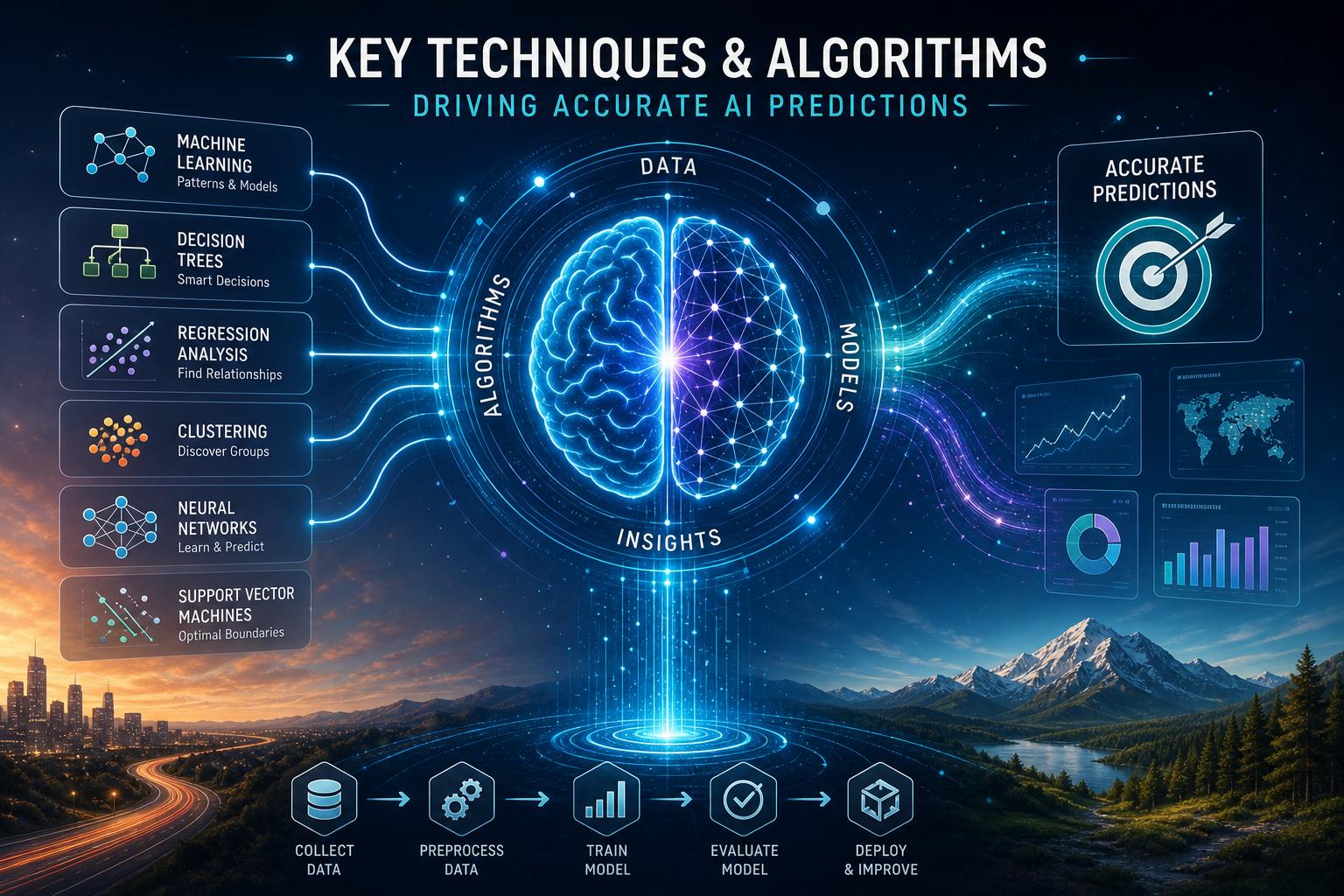
key Techniques and Algorithms driving Accurate AI Predictions
At the heart of delivering precise AI predictions lie several advanced techniques and algorithms, each designed to optimize the inference process. Among the most foundational are neural networks, wich simulate the human brain’s interconnected neuron structure to identify patterns in vast datasets. Convolutional Neural Networks (CNNs) excel in image and video recognition, leveraging spatial hierarchies, while Recurrent Neural Networks (RNNs) and their derivatives like LSTMs specialize in sequence prediction, such as language processing and time-series forecasting. These architectures are often combined with optimization algorithms-like gradient descent variants-that fine-tune model parameters to minimize prediction error during both training and inference phases.
Complementing these models are various filtering and ensemble methods that enhance robustness and accuracy. Techniques such as Bayesian inference introduce probabilistic reasoning, enabling AI systems to weigh uncertainty and update predictions dynamically as new data arrives. Additionally, ensemble approaches like bagging and boosting aggregate multiple model outputs to reduce bias and variance, leading to more reliable outcomes. The table below summarizes these core algorithms and their primary applications:
| algorithm/Technique | Primary Use Case | Key Advantage |
|---|---|---|
| Convolutional neural Networks (CNNs) | Image & Video Analysis | spatial feature extraction |
| Recurrent Neural Networks (RNNs) | Sequence & Time-series Prediction | Captures temporal dependencies |
| Bayesian Inference | Probabilistic Reasoning in Predictions | Incorporates uncertainty |
| Boosting & Bagging | Model Aggregation | Enhances accuracy and stability |
Optimizing Inference Performance for Real-Time Applications
Maximizing the efficiency of AI inference in real-time scenarios requires a multifaceted approach that balances speed, accuracy, and resource utilization. One of the key strategies involves model compression techniques such as quantization and pruning, which reduce the model size and computational load without significantly degrading performance. Additionally, leveraging specialized hardware accelerators like GPUs, TPUs, or FPGAs can dramatically decrease latency, enabling instantaneous predictions even under heavy workload. Careful pipeline optimization, including batch processing, asynchronous execution, and caching of frequent queries, further contributes to smoother real-time responsiveness.
When deploying AI models in time-sensitive environments, it is crucial to monitor and fine-tune inference workflows continuously. The table below summarizes commonly employed optimization techniques alongside their primary benefits and trade-offs:
| Optimization Technique | Benefit | Consideration |
|---|---|---|
| Quantization | Reduces model size and speeds up calculations | Potential minor accuracy loss |
| Pruning | removes redundant parameters, improving efficiency | Requires retraining for optimal results |
| hardware Acceleration | Significantly lowers inference latency | Increased deployment cost and complexity |
| batch Processing | Improves throughput by handling multiple inputs | May add small delay per request |
| Asynchronous Execution | Enables non-blocking execution for faster response | More complex implementation and debugging |
Best Practices for Enhancing Model Reliability and Interpretability During inference
Ensuring reliability during inference demands rigorous validation and continuous monitoring of AI models in production environments. One critical approach is implementing robust input validation, which helps prevent unexpected or erroneous data from skewing predictions. Additionally, employing techniques such as ensemble models or confidence scoring can significantly enhance decision confidence, enabling systems to gauge the certainty of their outputs and flag ambiguous cases for human review. Maintaining a thorough audit trail of inference requests and outcomes also facilitates troubleshooting and fosters transparency in AI decision-making processes.
interpretability should be prioritized to build trust and facilitate actionable insights from AI systems. Utilizing model explainability tools like SHAP or LIME allows stakeholders to visualize feature contributions and understand the rationale behind predictions. Implementing feature importance dashboards can make complex models more approachable for non-technical users, strengthening cross-functional collaboration. Below is a concise comparison of popular interpretability methods frequently enough used during inference:
| Method | Interpretability Focus | Typical Use Case |
|---|---|---|
| SHAP | Global & Local Feature Impact | Detailed instance-level description |
| LIME | Local Surrogate Models | Explaining individual predictions |
| Saliency maps | Visual Feature Highlighting | Image and text data interpretation |