

Understanding the Foundations of Generative AI and Its Core Mechanisms
Generative AI operates by analyzing extensive datasets to identify underlying patterns and structures. This foundational process enables AI systems to create new, authentic-seeming content based on learned examples rather than simple replication. At its core, generative models harness statistical probabilities to predict and generate sequences-whether words, imagesor sounds-that reflect the intricate nuances embedded in the training data. Key mechanisms include:
- Pattern recognition: Identifying features and regularities across datasets.
- Probabilistic modeling: Estimating the likelihood of data elements following one another.
- Iterative refinement: Enhancing outputs through feedback loops during training phases.
Understanding these processes sheds light on the diversity of content generative AI can produce, from realistic text conversations to original artworks. The models rely heavily on complex architectures such as transformers, autoencoders, and GANs (Generative Adversarial networks), each with unique strategies for generating data. The following table summarizes popular generative AI architectures, highlighting their core strengths and typical applications:
| architecture | Core Strength | common Uses |
|---|---|---|
| Transformers | contextual understanding | Language generation, translation |
| Autoencoders | Dimensionality reduction | Image reconstruction, anomaly detection |
| GANs | Realistic data synthesis | Image generation, style transfer |
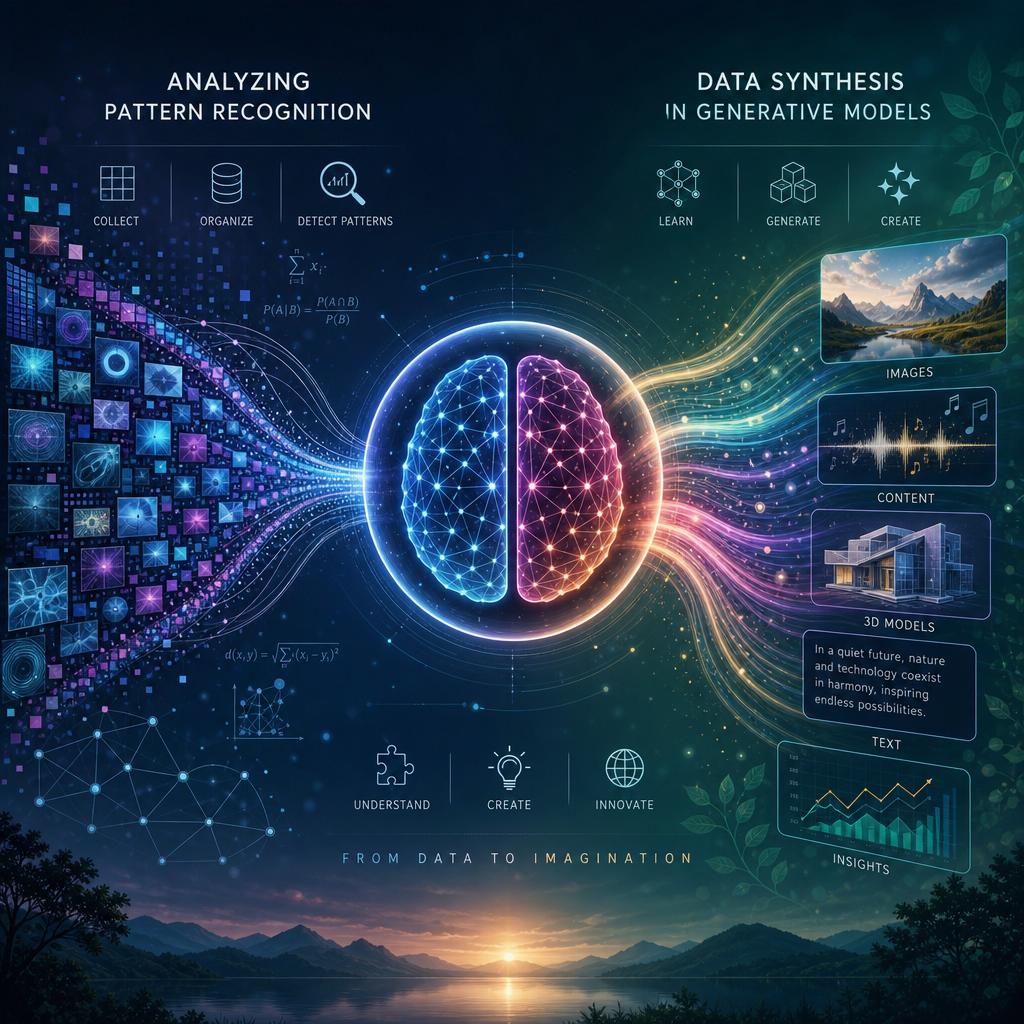
Analyzing Pattern Recognition and Data Synthesis in generative Models
At the core of generative AI lies a elegant interplay of pattern recognition and data synthesis. These models meticulously analyze vast datasets, extracting intricate structures and correlations that often elude human perception. This deep understanding of patterns allows generative systems to predict and recreate content that is not merely a copy but an original composition grounded in learned features. Whether in text, imagesor sound, the AI identifies latent representations-hidden abstract elements-that serve as blueprints for generating new material with high fidelity and contextual coherence.
To appreciate how generative models operate, consider the steps involved:
- Feature Extraction: Identifying fundamental elements within the input data, such as shapes, syntax, or rhythms.
- Latent Space Mapping: Transforming complex data into a compressed, interpretable format where relationships between features become evident.
- Content generation: Synthesizing new data points by sampling from the latent space, ensuring novelty while maintaining structural integrity.
| Process Stage | Description | Outcome |
|---|---|---|
| Pattern extraction | Analyzing data to find repeating elements | Feature portrayal |
| Representation Learning | Encoding data into latent representations | Dimensionality reduction |
| Data Synthesis | Generating new content from learned features | Original, plausible outputs |
Exploring Practical Applications and industry Transformations Driven by Generative AI
Generative AI is revolutionizing industries by enabling innovation in ways previously unimaginable. By analyzing vast datasets and recognizing intricate patterns, it crafts unique content that ranges from text and images to music and code. In marketing, such as, businesses are deploying AI-powered tools to generate tailored advertising copy and dynamic visuals, drastically reducing turnaround times and amplifying campaign effectiveness. The technology also plays a pivotal role in healthcare by synthesizing medical data to assist in diagnostic imaging and drug discovery, pushing the boundaries of precision medicine.
Key practical applications include:
- Automated content creation for media, reducing manual effort while maintaining creativity
- Personalized learning experiences through AI-generated educational materials
- Enhanced product design with AI-generated prototypes and simulations
- Improved customer engagement by powering conversational agents and chatbots
| Industry | Generative AI Impact | Example |
|---|---|---|
| Entertainment | Creating original scripts and visual effects | AI-assisted movie scene generation |
| Finance | Generating predictive models and risk assessments | Automated market trend reports |
| Manufacturing | Optimizing design and production workflows | AI-created product prototypes |
| Retail | Personalizing customer interactions | Dynamic product descriptions |
Implementing Best Practices for Ethical and Effective Use of Generative AI Technologies
When leveraging advanced generative AI technologies, adhering to ethical standards and proven best practices ensures both the integrity of the output and the accountability of its creators. Transparency in AI deployment is crucial; users must disclose when content is AI-generated to maintain trust and avoid misinformation. Moreover, AI models should be trained on diverse and representative datasets to mitigate inherent biases that could perpetuate stereotypes or exclusion. Consistent monitoring and updating of AI systems help identify unintended consequences early, promoting a positive and responsible use of these tools.
Effective use also involves clearly defined operational guidelines:
- implement strict data privacy measures to protect sensitive information.
- Regularly audit AI outputs for accuracy, fairness, and relevance.
- Provide users with options to customize AI behavior to fit specific ethical frameworks and organizational policies.
- Maintain human oversight to intervene and refine AI-generated content when necessary.
| Best Practice | Purpose |
|---|---|
| Transparency | Builds credibility and avoids misuse |
| Bias Mitigation | Ensures fairness and inclusivity |
| User Customization | Aligns AI outcomes with specific values |
| Human Oversight | Maintains quality and ethical standards |