

Understanding the Architecture and Functionality of AI Knowledge Bases
at the core of AI knowledge bases lies a elegant architecture designed to efficiently organize and access vast amounts of curated facts. These systems integrate various data ingestion pipelines that filter and validate content before indexing it for retrieval. The architecture typically employs a combination of semantic networks, ontologies, and relational databases to model knowledge in a way that machines can understand contextually. This enables AI to deliver grounded responses rooted in verified data rather than generating speculative answers.By structuring data hierarchically and associatively,knowledge bases facilitate rapid and relevant information extraction,which forms the backbone of applications ranging from virtual assistants to expert systems.
Functionality-wise, AI knowledge bases hinge on several fundamental mechanisms that ensure accuracy and efficiency:
- Data Curation: Continuous updating and pruning of resources to maintain relevancy.
- Inference Engine: Applies logical rules to derive new knowledge from existing facts.
- Query Processing: Translates user requests into precise information retrieval commands.
- Feedback Loops: Incorporates user interactions to improve the quality and scope of answers over time.
| Component | Role | Example |
|---|---|---|
| Ontology | Defines the relationships between concepts | Medical taxonomy for symptoms and conditions |
| Semantic Layer | facilitates contextual understanding | Word-sense disambiguation in natural language queries |
| Data Index | Stores structured and unstructured data for quick lookups | Indexed product specifications in e-commerce |
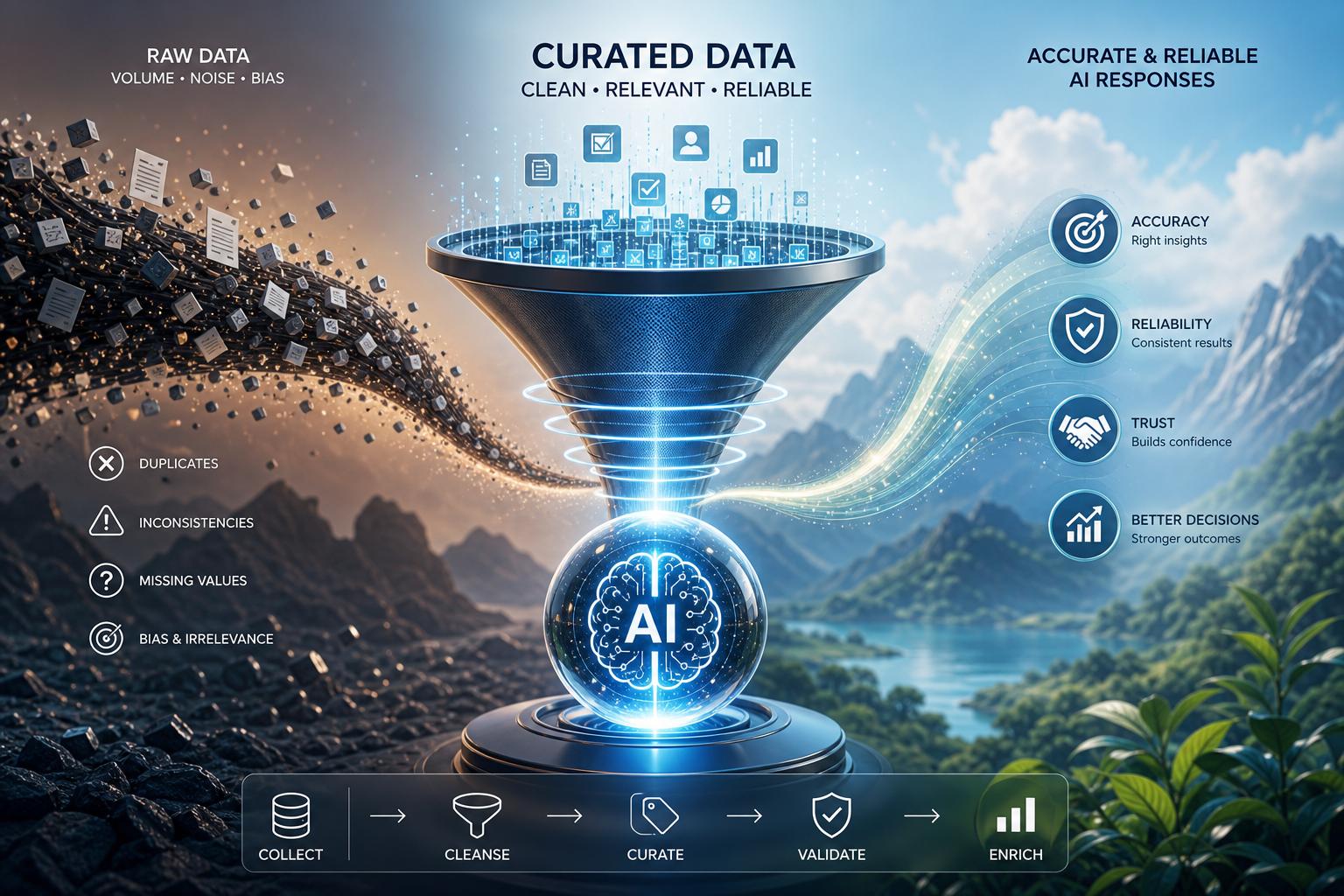
Exploring the Importance of Curated Data for Accurate and Reliable AI Responses
Curated data is the backbone that supports the integrity and trustworthiness of AI-driven knowledge bases. Unlike raw or unfiltered datasets, curated content undergoes rigorous selection, validation, and refinement processes to ensure each piece of information is accurate and relevant. This meticulous approach mitigates the risk of misinformation and enhances the AI’s ability to provide grounded answers, especially in complex domains where precision is critical. The quality of the AI’s responses directly depends on how well the data has been managed, verified, and updated over time.
- Selective sourcing: Drawing information only from reputable and specialized data providers.
- Continuous vetting: Regular reviews to eliminate outdated or erroneous data.
- Contextual relevance: Aligning data points to specific use cases and knowledge areas.
| Benefit | Impact on AI Responses |
|---|---|
| Increased Accuracy | Reduces misinformation and improves trustworthiness. |
| Enhanced Relevance | Delivers answers tailored to specific queries and contexts. |
| Improved Consistency | Maintains uniform response quality across diverse topics. |
With curated data serving as the foundation, AI systems can transcend superficial or generic answers to offer deeply contextualized insights. This is particularly vital for applications in healthcare, legal advising, and scientific research, where basing conclusions on verified data can be the difference between correct and harmful outcomes.By investing in robust data curation workflows,organizations ensure their AI not only retrieves facts but interprets and applies them reliably,fostering user confidence and supporting informed decision-making at scale.
Best Practices for Developing and Maintaining Effective Knowledge Bases
Maintaining a robust knowledge base requires more than just aggregating data; it demands systematic curation and consistent updates. Regular reviews ensure the accuracy and relevance of stored information, preventing outdated or redundant content from undermining the reliability of AI-generated answers. Incorporating user feedback and analytics can guide significant content improvements, highlighting gaps or frequently accessed topics for deeper exploration. furthermore, employing a modular structure with clear categorization enhances both human and machine navigation, enabling AI models to fetch grounded answers backed by precise, context-rich data.
- Prioritize data quality: Validate sources rigorously to build trustworthiness.
- Foster collaboration: Engage domain experts to enrich knowledge base accuracy.
- Automate updates: Use AI tools to flag obsolete entries and suggest modifications.
- Optimize searchability: Implement metadata and tagging for faster information retrieval.
| Practice | Benefit | Example |
|---|---|---|
| Content Versioning | Track changes to maintain clarity | Timestamped article revisions |
| User Engagement Analytics | Identify popular and problematic topics | Heatmaps and query logs |
| Cross-referencing Entries | Improve contextual understanding | Linked articles and definitions |
Strategies for Enhancing AI Grounding through Quality Data Curation and Validation
Achieving reliable AI grounding requires a meticulous approach to data curation that prioritizes accuracy, relevance, and diversity. Quality data must be systematically collected from authoritative sources and undergo rigorous cleansing processes to eliminate noise and inconsistencies. This curation should emphasize the inclusion of varied contexts to enhance an AI model’s ability to interpret nuances across domains. Employing methods such as human-in-the-loop validation, automated anomaly detection, and cross-referencing with verified datasets ensures that the foundation on which AI systems build their knowledge is both robust and credible. Without these stringent quality checks, AI models risk propagating errors, bias, or superficial information that compromise the trustworthiness of their outputs.
Complementing curation, the validation phase serves as a critical checkpoint to verify the integrity and applicability of the data before it informs any AI-driven decision-making processes. Effective validation strategies include comparative analysis across multiple datasets, continuous feedback loops from real-world deployment, and adaptive learning mechanisms that adjust as new data emerges. The table below highlights key validation techniques alongside their primary benefits:
| Validation Technique | Primary Benefit |
|---|---|
| Cross-dataset Consistency Checks | Ensures uniformity and reduces contradictions in knowledge bases |
| Human Expert Review | incorporates domain expertise to catch subtle errors and biases |
| Real-time Performance monitoring | Detects grounding failures early through ongoing output evaluation |
| Automated Anomaly Detection | Flags unusual or outlier data points for further examination |
By integrating these complementary strategies, AI systems can maintain verifiable, grounded knowledge that supports informed and reliable answers across diverse applications.