

Understanding the Fundamental Components of AI Agents and Their Decision-Making Processes
At the core of AI agents lies a sophisticated architecture built to mimic bright behavior through a sequence of strategic steps. These agents operate by constantly perceiving their surroundings, processing facts, and executing decisions aimed at fulfilling predefined objectives. Their decision-making frameworks are typically structured around three fundamental pillars:
- Perception: Gathering inputs from sensors or data streams to build an accurate model of the current state.
- Planning: Evaluating potential actions and their consequences to formulate an effective course toward the target.
- Action: Implementing the chosen steps in the real or simulated environment to advance toward accomplishing goals.
Each of these components is tightly integrated, ensuring that AI agents adapt and respond fluidly as circumstances evolve. To illustrate, consider a simple decision-making matrix that AI agents may use when prioritizing actions based on goal urgency and resource availability:
| Goal Urgency | Resource Availability | Priority of Action |
|---|---|---|
| High | High | immediate execution |
| High | Low | Resource reallocation before action |
| Low | High | Deferred or standby mode |
| Low | Low | Minimal action or halt |
Through such dynamic assessments, AI agents not only pursue goals efficiently but also maintain the flexibility needed in complex environments. This interplay of perception, planningand action underpins the agent’s ability to learn from experience and optimize future decisions, driving continuous betterment in autonomous systems.
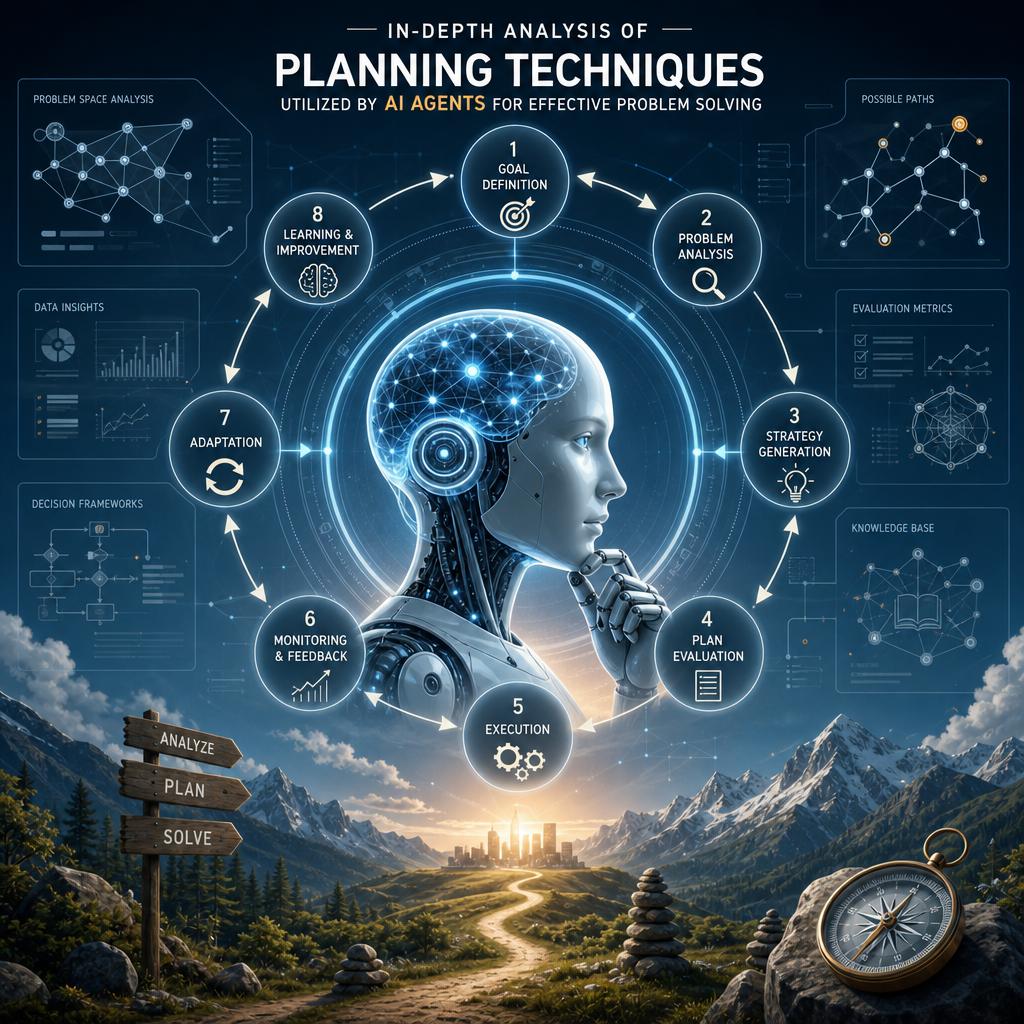
In-Depth Analysis of Planning Techniques Utilized by AI Agents for Effective Problem Solving
Modern AI agents rely heavily on sophisticated planning frameworks that enable them to break down complex problems into manageable tasks. Central to these techniques is the ability to anticipate future states and evaluate the consequences of different actions systematically. This is often achieved through heuristic search algorithms, which prioritize paths most likely to lead to goal achievement efficiently. AI agents also leverage decision-theoretic approaches to quantify uncertainties and optimize outcomes based on probabilistic reasoning.These combined methodologies empower agents not only to react to immediate stimuli but to formulate long-term strategies that align with overarching objectives.
At the core of effective problem solving lies a structured cycle of planning and execution, supported by continuous feedback mechanisms. The main components contributing to this dynamic process include:
- Task decomposition: Dissecting complex goals into hierarchical sub-goals.
- State-space exploration: Navigating through possible scenarios by evaluating state transitions.
- Resource management: Allocating limited computational or real-world resources efficiently.
- Plan revision: Adjusting strategies in response to new information or unexpected obstacles.
To illustrate, consider the following example of planning stages executed by a goal-oriented AI agent:
| Planning Stage | description | Outcome |
|---|---|---|
| Goal identification | Define clear objectives based on agent’s purpose. | Focused direction for action sequences. |
| Plan Generation | create candidate action sequences using algorithms. | Multiple strategic options to evaluate. |
| Plan Evaluation | Assess plans for feasibility, resource useand risk. | Selection of optimal path forward. |
| Execution & Monitoring | Implement plan steps and track progress continuously. | Dynamic adaptation to changing environments. |
Exploring the Mechanisms Behind Action Execution and Adaptability in Dynamic Environments
The effectiveness of AI agents in dynamic environments hinges on their ability to execute actions with precision while continuously adapting to unforeseen changes. At the core of this capability lies a sophisticated interplay between perception, decision-making, and real-time feedback processing. These agents employ advanced algorithms to evaluate multiple potential actions, predict possible outcomesand dynamically update their strategies to align with evolving scenarios. This adaptability ensures that each action taken not only moves the agent closer to its goal but also maintains resilience against environmental uncertainties.
Key components involved in this process include:
- Predictive Modeling: Anticipating environmental shifts and agent responses before execution.
- Hierarchical Planning: Structuring decisions from high-level goals to granular actions.
- Feedback Loops: Continuously monitoring outcomes to fine-tune ongoing actions.
- Context Awareness: Interpreting environmental cues to adjust plans dynamically.
| Mechanism | Function | Benefit |
|---|---|---|
| Planning | Develop action sequences | Structured goal pursuit |
| Execution | Perform selected actions | Direct environment interaction |
| Adaptation | Modify actions post-feedback | Enhanced robustness |
Strategies for Defining and Pursuing Goals to enhance AI Agent Performance and Reliability
To maximize both the performance and reliability of AI agents, it is crucial to adopt a structured approach to goal definition and pursuit. Clear, well-defined goals act as a compass, guiding an agent’s decision-making process and ensuring alignment with desired outcomes. Effective strategies emphasize the importance of setting goals that are not only specific and measurable but also adaptable to dynamic environments.This adaptability allows AI agents to recalibrate objectives in response to emergent data, unforeseen challengesor shifting priorities, ultimately improving their resilience and long-term success.
Furthermore, the pursuit of these goals should be supported by a robust framework that integrates continuous assessment and feedback mechanisms. Such a framework enables AI agents to evaluate their progress in real-time and adjust actions accordingly. Consider the following critical components that reinforce goal pursuit:
- Incremental milestones: Breaking down complex goals into achievable steps fosters steady advancement and allows for early detection of potential pitfalls.
- Context-awareness: Incorporating environmental and situational data to refine action plans boosts relevance and effectiveness.
- Risk management: Identifying and mitigating uncertainties ensures dependable agent behavior under varying conditions.
| Strategy | Benefit | Example |
|---|---|---|
| Adaptive Goal Setting | Maintains relevance in changing environments | Self-driving car adjusting route goals due to traffic |
| Continuous Feedback | Improves decision accuracy | Chatbot refining responses based on user feedback |
| Risk Assessment | Enhances reliability and safety | Industrial robot halting operations under error detection |