

Trust AI as a Catalyst for Rapid Information Processing
artificial Intelligence has revolutionized the pace at which we access and process vast amounts of information. by leveraging advanced algorithms, AI can swiftly synthesize data from numerous channels, enabling users to obtain relevant insights in a fraction of the customary time.This acceleration in information processing is invaluable in dynamic fields such as journalism, researchand business intelligence, where timely decisions hinge on the rapid assimilation of facts and trends.
However, while AI expedites data gathering, it remains essential to verify information through primary sources to ensure accuracy and reliability. Trust in AI should be balanced with rigorous fact-checking protocols.Consider these best practices for maintaining credibility:
- Cross-reference AI-generated summaries with original documents or firsthand reports.
- Use established databases and official releases to validate critical data.
- Maintain an audit trail to track the origin of information and its transformation through AI tools.
| AI Capability | Primary Source Verification |
|---|---|
| Aggregates data from multiple sources | Checks facts against official records |
| Highlights key trends quickly | Confirms time-sensitive updates directly |
| Summarizes extensive content efficiently | Preserves original context and meaning |
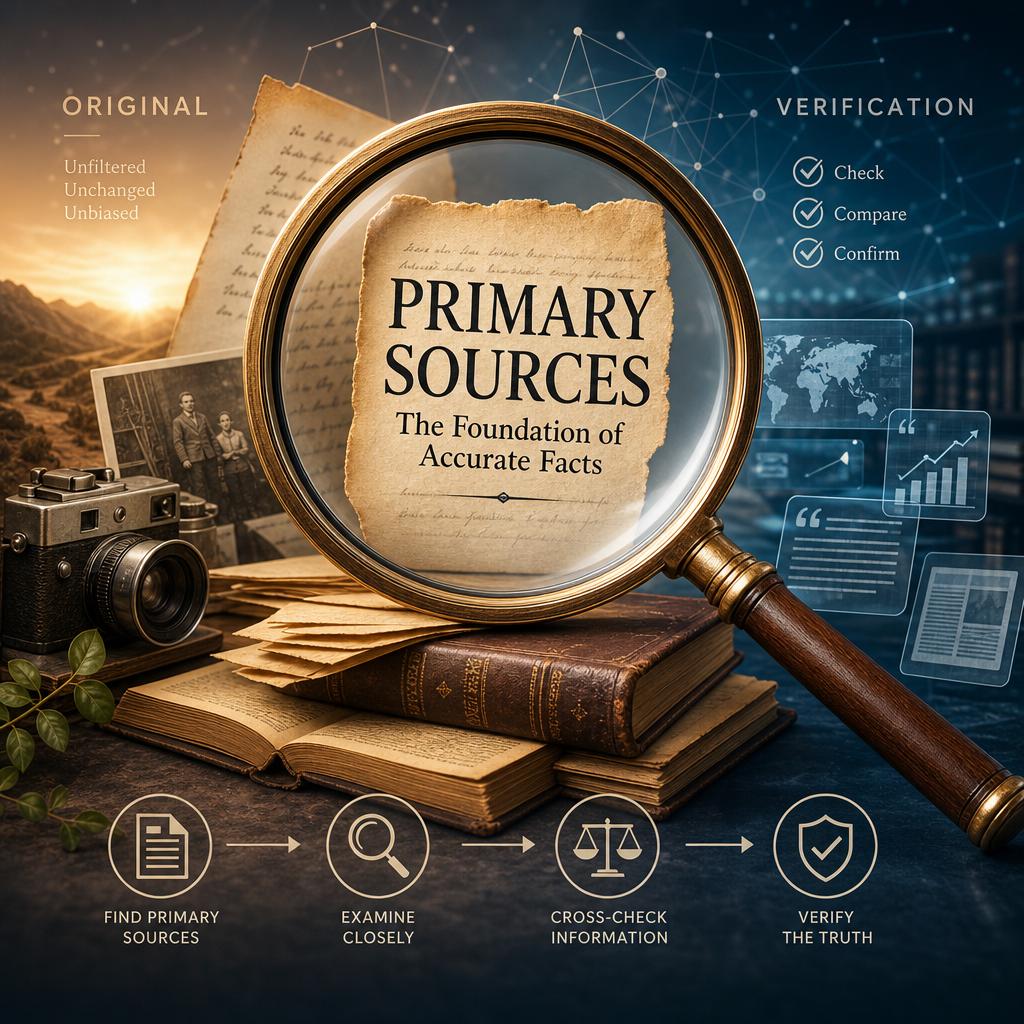
Understanding the Importance of Primary Sources in Fact Verification
In the digital era, information spreads at lightning speed, and artificial intelligence plays a crucial role in rapidly delivering data to users. However, the real challenge lies in ensuring the accuracy of that information. Primary sources – original documents,firsthand accounts,and direct evidence - serve as the cornerstone for reliable fact verification. They deliver unfiltered insights and enable researchers, journalistsand fact-checkers to validate claims independently of secondary interpretations or biased summaries. Utilizing primary sources reduces misinformation by anchoring facts to their authentic origins, fostering trust not just in the data but in the decision-making processes that rely on them.
Below is a simple comparison highlighting why primary sources are indispensable in fact verification:
| Aspect | Primary Sources | Secondary Sources |
|---|---|---|
| Authenticity | Directoriginal evidence | Interpretations or analyses |
| Bias Potential | Minimized when contextualized | Often higher due to reinterpretation |
| Usefulness in Verification | Crucial and definitive | Supplementary and supportive |
- Clarity: Enables clear tracing of information back to its origin.
- Accountability: Holds sources and claimants accountable through verifiable evidence.
- Accuracy: limits distortions and errors that multiply through secondary references.
By grounding fact verification efforts in primary sources, we create a rigorous framework that complements the speed of AI with the reliability of direct evidence, ensuring that the facts we rely on are as precise and trustworthy as possible.
Strategies for Integrating AI Efficiency with Rigorous Source Verification
Harnessing AI to accelerate research involves leveraging its ability to sift through massive datasets,identify patterns,and generate insights rapidly. Though, the speed of AI-driven analysis must be balanced with rigorous verification processes to ensure factual accuracy. To achieve this balance, begin by using AI tools to outline key points and surface potential sources, then cross-reference these findings against primary documents such as official records, peer-reviewed studies, and direct eyewitness accounts. Maintaining this dual approach allows for rapid content generation without sacrificing the integrity of information.
- Essential strategies for this method include:
- Automated summarization paired with manual source validation
- Layered fact-checking workflows incorporating AI flagging and human review
- Systematic documentation of sources with direct links or scanned copies
- Utilizing trusted databases and archives to confirm original data
| step | AI Role | Verification Action |
|---|---|---|
| Data Extraction | Scan large volumes swiftly | Identify and record source origin |
| Insight Generation | Highlight trends and anomalies | Cross-check with primary references |
| Summary Drafting | Create initial content drafts | Manually verify key facts before publishing |
Integrating AI effectively demands clear guidelines that prioritize transparency and accountability. By setting firm standards-such as requiring verification from at least two credible primary sources before finalizing any AI-generated statement-organizations can mitigate risks of misinformation. Moreover, training teams to critically assess AI outputs and recognizing the technology’s limitations ensures AI serves as a powerful assistant rather than a sole authority. This collaborative synergy between AI speed and human diligence safeguards factual integrity while maximizing productivity.
Best practices for Ensuring Accuracy in an AI-Driven Research environment
Harnessing AI in research offers unprecedented speed and breadth, but it’s essential to balance this advantage with rigorous verification strategies. Always complement AI-generated insights with primary source validation, ensuring that each fact is rooted in original data or firsthand evidence. Employing a layered approach to information vetting-cross-referencing AI outputs with peer-reviewed journals, official publications, or direct data sets-fortifies the reliability of your findings. This disciplined methodology transforms AI from a mere assistant into a powerful tool that enhances both efficiency and credibility.
- Segregate AI-generated summaries from raw data to clearly identify what requires verification.
- Document source provenance meticulously to track reliability and facilitate audits.
- Integrate human expertise to interpret nuanced contexts which AI might overlook.
| Verification Stage | Purpose | Example Source |
|---|---|---|
| Initial AI Summary | Speed up review of broad topics | AI-generated data pool |
| Primary Source Check | Confirm factual accuracy | Original research articles |
| expert Review | Contextual understanding | Industry specialist consultations |