

The Challenge of Defining and Measuring Artificial General Intelligence
Attempting to pinpoint what constitutes artificial General intelligence (AGI) remains a complex and unresolved endeavor. Unlike narrow AI systems designed for specific tasks, AGI aims to replicate the broad cognitive abilities of a human mind. However, this ambition stumbles against several essential challenges: the absence of a universally accepted definition, the lack of measurable benchmarks that capture true general intelligence, and divergent expert opinions on what capabilities are essential. Without a clear framework, efforts to categorize or predict AGI’s arrival become speculative exercises rather than scientifically grounded forecasts.
Measuring AGI involves more than evaluating isolated competencies; it demands assessing adaptability, reasoning, creativity, and learning within dynamic environments.Current AI evaluation methodologies, like benchmark tests or Turing-like evaluations, fall short of capturing these multidimensional traits. Consider the following difficulties:
- Dynamic cognitive integration: The seamless coordination of multiple cognitive domains under varied contexts.
- Autonomous goal formulation: The ability to set and pursue self-directed objectives beyond programmed instructions.
- Robust generalization: Transfer of knowledge from one domain to vastly different novel situations without prior exposure.
These complexities underpin why consensus remains elusive and why existing milestones are insufficient to map AGI’s trajectory.
| Component | Measurement Challenge |
|---|---|
| Reasoning | Contextual adaptability vs. static logic tests |
| Learning | Acquisition across unlimited domains |
| Creativity | Objective evaluation of novelty and usefulness |
| Self-awareness | Operational definition and empirical testing |
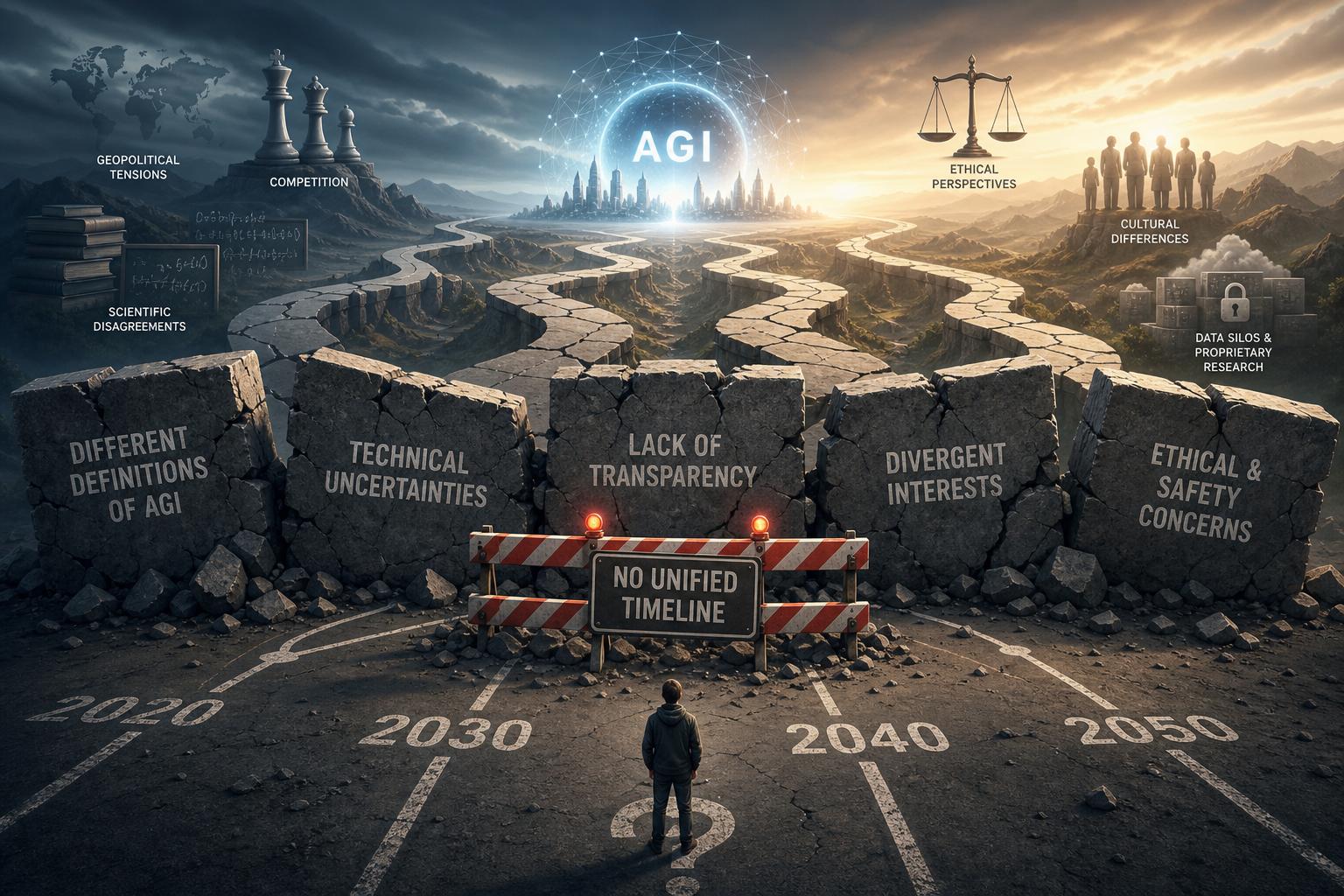
Barriers to Establishing a Unified Timeline for AGI Development
Predicting the arrival of Artificial General Intelligence (AGI) is hindered by diverse and complex obstacles that experts often find insurmountable. One primary issue is the absence of universally accepted benchmarks or tests that define what true AGI entails. Unlike narrow AI systems, which excel at specific tasks, AGI demands a holistic and adaptable intelligence that can generalize across domains. This intrinsic vagueness means that no single measure can confirm an AI’s general intelligence, fostering disagreement among researchers about when, or even if, AGI will materialize.
Adding to the challenge are key factors that fragment expert opinion and cloud timeline projections:
- Technological Uncertainty: Breakthroughs in algorithms, computational power, or neuroscience-inspired models could drastically accelerate development, yet such advancements are unpredictable.
- Philosophical disputes: Differing views on consciousness, intelligence, and the criteria that define AGI lead to varied interpretations of progress and readiness.
- Socio-Political Dynamics: Funding priorities,regulatory policies,and ethical concerns introduce external variables that influence research direction and pace.
| Barrier | Impact on timeline |
|---|---|
| Undefined AGI Criteria | Induces endless debate and no clear endpoint |
| Unpredictable Scientific Breakthroughs | Leads to sudden, unforecasted leaps or delays |
| Varying Interpretations of Intelligence | Diversifies research goals and progress assessments |
| Regulatory and Ethical Challenges | Restricts or redirects developmental efforts |
Divergent Perspectives and the lack of Consensus Among Experts
the quest for Artificial General Intelligence (AGI) is marked by a profound variance in expert opinions, each influenced by distinct assumptions, methodologies, and interpretations of intelligence itself. This divergence stems not onyl from differing technical perspectives but also from philosophical debates about the nature of cognition and consciousness.While some researchers emphasize the scaling of current machine learning techniques, others advocate for novel architectures or hybrid approaches that integrate symbolic reasoning with neural networks. Such fundamental disagreements make it difficult to establish a unified roadmap or to agree on the milestones that would signify true AGI achievement.
Complicating the landscape further, there is an absence of standardized benchmarks or tests that can conclusively validate whether an AI system has achieved generalized intelligence. Experts also disagree on the timeline, with predictions ranging from a few decades to several centuries, reflecting varied interpretations of technological progress and societal impacts. The table below encapsulates common expert positions, demonstrating the wide spectrum of optimism and skepticism pervasive in the discourse:
| Expert Viewpoint | Core Assumption | Projected Timeline | Key Challenges Highlighted |
|---|---|---|---|
| Optimistic Prometheans | Current tech will scale | ~20-30 years | Computational power, data |
| Cautious Skeptics | Need conceptual breakthroughs | 50+ years or indefinite | Understanding intelligence, reasoning |
| Philosophical Realists | AGI requires new paradigms | Uncertain, maybe never | Consciousness, subjective experience |
Strategic Recommendations for navigating Uncertainty in AGI Research
in the face of ambiguous progress and opaque benchmarks, it is indeed imperative for AGI researchers and stakeholders to adopt a multipronged strategy that balances ambition with prudence. Prioritizing transparent dialog among interdisciplinary teams can mitigate echo chambers and foster a more nuanced understanding of progress markers. Emphasizing robust experimental frameworks over speculative forecasts allows teams to iterate within defined parameters, avoiding the trap of chasing undefined endpoints. Equally important is the diversification of research agendas,which helps cushion against the biases of any single theoretical paradigm or model,thereby expanding the horizon of viable AGI pathways.
Effective navigation through the AGI uncertainty also requires institutional adaptability supported by flexible governance models designed to respond promptly to emerging insights. Below is a concise summary of strategic pillars critical for this navigation:
| Strategic Pillar | Key Actions | expected Outcome |
|---|---|---|
| Collaborative Transparency | Regular interdisciplinary reviews and open data sharing | More reliable consensus building and external validation |
| Experimental Anchoring | Developing standardized benchmarks and iterative testing cycles | Concrete progress metrics and error correction |
| Diversified Research Portfolios | Investing in parallel approaches including symbolic, neural, and hybrid systems | Reduced susceptibility to paradigm lock-in |
| Adaptive Governance | Implementing responsive policy frameworks tailored to technological developments | Regulatory agility and ethical safeguards |
By anchoring decisions in these pillars and fostering ecosystems that encourage rigorous reassessment, the AGI community positions itself not just to adapt to uncertainty but to leverage it as a strategic asset, thereby enhancing the robustness and credibility of its endeavors.