

Ownership Challenges in AI-Generated content Across Different Legal Jurisdictions
Determining the ownership of AI-generated content presents complex legal dilemmas that vary considerably across national boundaries. Some jurisdictions recognize the developer of the AI system as the default rights holder, while others lean toward the user directing the AI output. This lack of uniformity creates uncertainty for creators and businesses relying on AI to produce original works. Additionally, certain countries have yet to update their intellectual property laws to explicitly address non-human authorship, resulting in ambiguous or restrictive interpretations that can hinder commercialization and protection of AI-generated assets.
Integral to resolving these challenges is the role of contracts and clear agreements, which frequently enough bridge gaps left by differing statutory frameworks. Key considerations include:
- Assignment of rights: specifying whether rights are held by the user, developer, or jointly shared;
- Licensing parameters: defining how AI-generated content can be used, modified, or distributed;
- Attribution clauses: clarifying the authorship and moral rights in contexts where human input is minimal.
| Jurisdiction | Ownership Default | Contract Emphasis |
|---|---|---|
| United States | User directing AI | Assignment & Licensing |
| European Union | Varies by member state | Attribution & Moral rights |
| Japan | AI Developer | Clear Assignment |
This patchwork approach necessitates that stakeholders carefully tailor their agreements to accommodate jurisdiction-specific legal nuances, thus safeguarding their interests and clarifying ownership amidst evolving AI legislation.
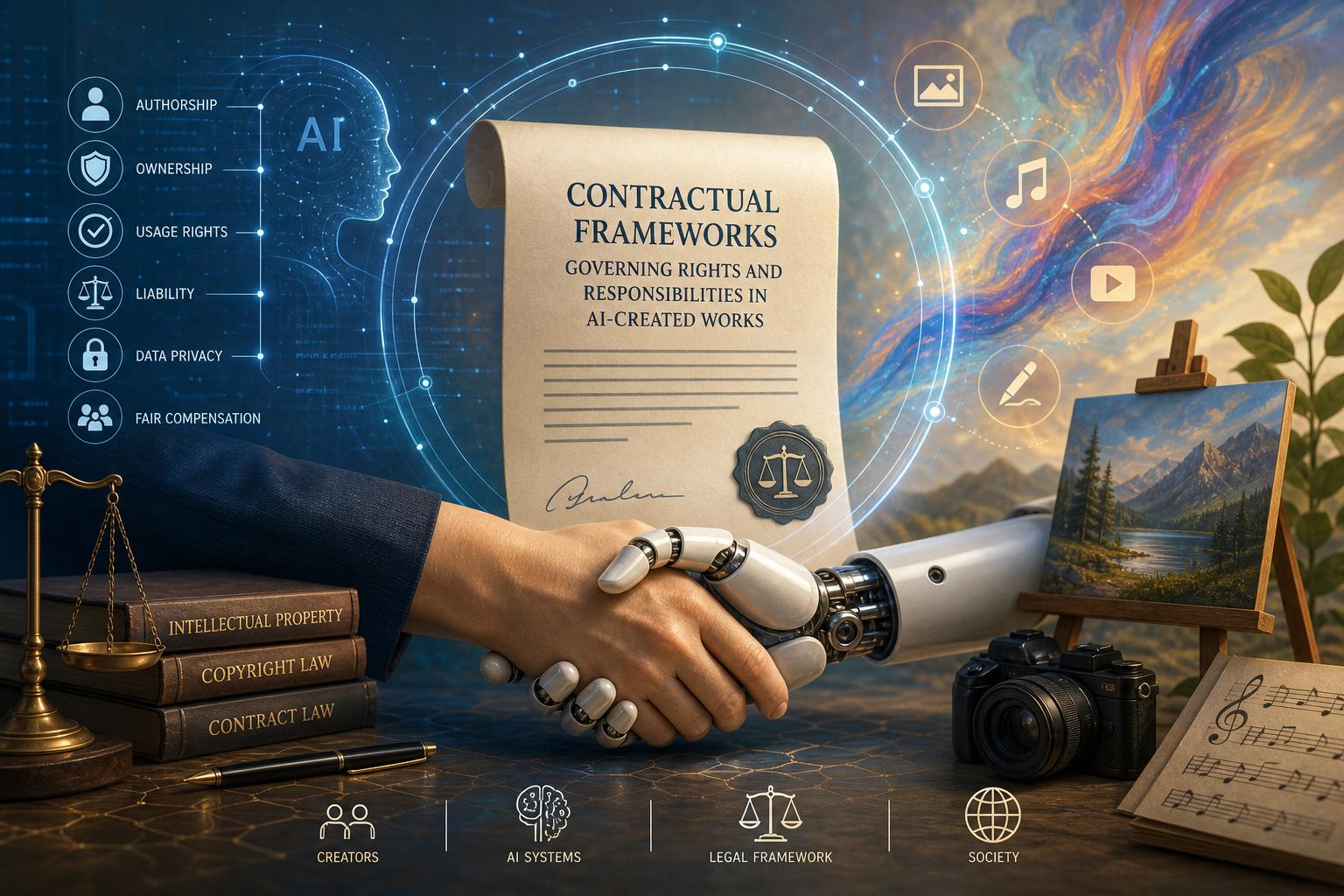
Contractual Frameworks Governing Rights and Responsibilities in AI-Created Works
determining ownership and outlining clear rights and responsibilities in AI-created works hinge on contractual agreements that define each party’s role and contributions.These frameworks often encompass terms that address the nuances introduced by AI involvement-such as whether the AI system is considered a tool, a collaborator, or an self-reliant creator under jurisdictional law. Key contractual elements will typically include:
- Defines ownership of the output: Assigning rights to the individual or entity commissioning or developing the AI.
- Licensing terms: Permission scope regarding use, distribution, and monetization of AI-generated content.
- Attribution requirements: Clarification on whether and how credit must be given.
- liability provisions: Accountability for errors, infringements, or ethical concerns in the content.
Moreover, given the varied legal interpretations around AI authorship, contracts serve as practical tools to delineate responsibilities and avoid disputes. For example, jurisdictions that do not recognize AI as a legal author require the contract to explicitly assign authorship or copyright to a human party. The table below summarizes common contractual clauses associated with AI-generated content rights:
| Clause | Description | Purpose |
|---|---|---|
| Ownership Assignment | Transfer of rights from AI developer/user to client | Clarifies who holds copyright |
| Use Restrictions | Defines permitted use cases and limitations | Controls content exploitation |
| Attribution | Specifies if credit must include AI’s role or developer | Maintains transparency |
| Indemnity | Protects parties from legal claims related to content | Mitigates risk |
Defining authorship in the age of Artificial Intelligence: Legal and Ethical Perspectives
The rapid advancement of artificial intelligence challenges conventional notions of authorship by blurring the lines between human creativity and machine-generated output. Key issues arise around jurisdictional variances, as countries differ widely in their recognition of AI as an author or creator under copyright law. Some jurisdictions, like the United States, emphasize human authorship and generally deny copyright protection to works created autonomously by AI, while others are exploring frameworks for attributing authorship more flexibly. Understanding these differences is crucial for creators, developers, and users of AI technology to navigate the complex landscape of intellectual property rights.
Contractual agreements play a pivotal role in defining ownership of AI-generated content, often serving as the primary mechanism through which parties can establish rights and responsibilities.These agreements typically address:
- Attribution: Who is legally recognized as the author or owner?
- Usage rights: Permissions around reproduction, distribution, and commercialization
- Liability: Responsibilities for potential copyright infringements or ethical violations
By proactively drafting detailed contracts, stakeholders can circumvent ambiguous legal standards and clearly delineate the ownership structure.This approach is becoming indispensable as AI-generated content gains commercial and cultural importance, demanding rigorous oversight that respects both ethical considerations and the evolving legal habitat.
Best practices for Establishing Clear Ownership and Licensing Agreements in AI Content Creation
When navigating the complexities of AI-generated content, it is indeed crucial to delineate clear ownership rights and licensing agreements from the outset. Establishing these agreements early helps mitigate disputes and protects all parties involved. Key elements to focus on include defining the scope of the licence, specifying whether it is indeed exclusive or non-exclusive, and clarifying who holds moral and economic rights. by explicitly addressing these points in contracts, stakeholders can prevent ambiguity regarding authorship attribution and usage rights, especially given that traditional copyright frameworks often lag behind AI advancements.
Best practices to consider:
- Identify jurisdictional nuances: Laws governing AI-generated works vary significantly between countries; choosing an applicable legal framework ensures enforceability.
- Specify contributions: Clearly state the role of human creators versus the AI system in the creative process to define authorship status.
- Include revision clauses: Agreements should allow for updates reflecting evolving AI capabilities and legal precedents.
- Establish risk management: Address liability concerns related to unintended infringement or misuse of AI content.
| Contract Element | Recommended Approach | Purpose |
|---|---|---|
| License Type | Non-exclusive with clear limits | Maintains creator versatility and broad usage control |
| Authorship Attribution | Explicit crediting of human contributors | Clarifies creative responsibility and preserves reputation |
| Jurisdiction | Choice-of-law clause favoring IP-amiable regions | Ensures legal protection and dispute resolution clarity |