

– Understanding the Role of AI as a transparent Educational Facilitator
AI in education is increasingly becoming a powerful tool, not as a hidden ghostwriter but as a clear and transparent facilitator that enhances the learning process. It functions best when students can see how AI supports their growth: providing tailored feedback, guiding problem-solving steps, and illuminating reasoning paths without substituting their own critical thinking. This clarity helps build trust and promotes autonomy, encouraging learners to use AI as a scaffold rather than a crutch.
Key attributes that define AI as an effective educational partner include:
- Visibility: Clear description of AI decisions and suggestions.
- Interactivity: Opportunities for learners to query and understand AI-generated content.
- Ethical Use: Emphasizing AI’s role as an assistant rather than a replacement for original work.
| AI Role | Educational Benefit | Transparency Feature |
|---|---|---|
| Personalized Feedback | Identifies strengths & weaknesses | Visible error explanation |
| Concept Clarification | Breaks down complex ideas | Step-by-step reasoning |
| Progress Monitoring | Tracks learner development | Accessible performance reports |
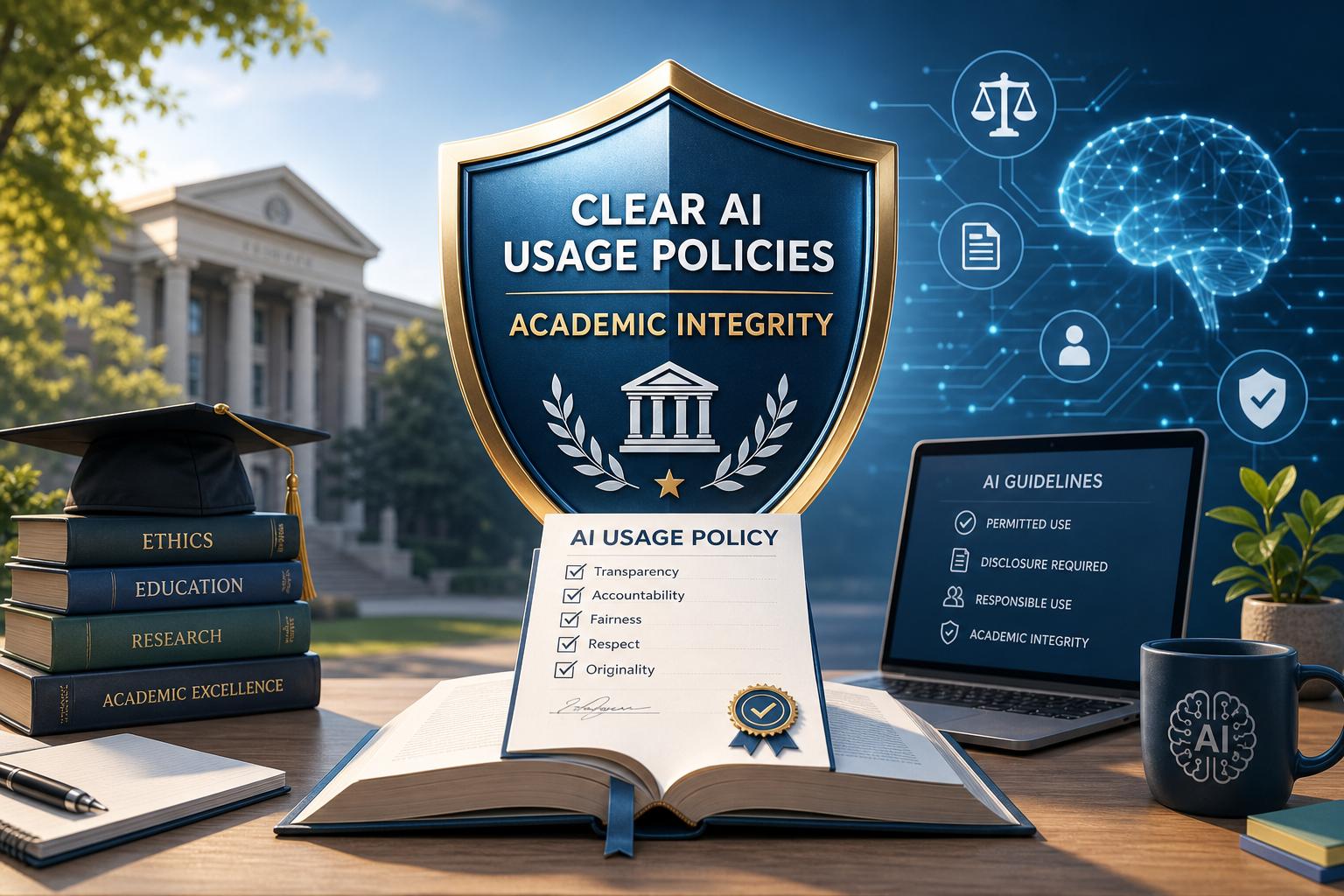
– Ensuring Academic Integrity Through Clear AI Usage Policies
to maintain the trustworthiness of academic institutions, it is imperative to establish explicit guidelines that delineate appropriate AI use in educational contexts. Clear policies foster transparency, ensuring students understand when and how AI tools may assist their learning without compromising original thought and personal effort. These frameworks promote responsible engagement by emphasizing AI as a supportive tutor that enhances comprehension, rather than a ghostwriter that replaces authentic work.
- Define acceptable AI applications: Specify tasks where AI can support research, brainstorming, and editing, while prohibiting its use for generating entire assignments.
- Require disclosure: Students should openly declare any AI assistance received, fostering accountability and academic honesty.
- Integrate educational workshops: Institutions can offer training sessions on ethical AI usage, ensuring learners appreciate both opportunities and limitations.
| Policy Element | Purpose | Benefit |
|---|---|---|
| AI Usage Boundaries | Clarify limits on automated content generation | Prevents plagiarism and maintains originality |
| Disclosure Requirements | Mandate transparency about AI involvement | Builds trust and encourages honest submissions |
| Ethics Workshops | Educate on responsible AI integration | Empowers informed and ethical decision-making |
– Techniques for Integrating AI Tools to Enhance Student Learning Experience
To leverage AI effectively in education, it is essential to position tools as transparent collaborators rather than hidden aides.By openly integrating AI tutors into the learning ecosystem, educators can foster an environment where students engage critically with AI-generated suggestions, enhancing their problem-solving skills. Techniques such as guided prompting empower learners to interact iteratively with AI systems, enabling deeper conceptual understanding rather than rote reproduction of answers. Furthermore, employing AI for formative assessment allows for personalized feedback loops that adapt to each student’s unique progress without supplanting the teacher’s instructional role.
Practical implementation includes the use of AI-powered dashboards that visualize student learning trajectories, making data-driven decisions accessible to both instructors and learners. Below is a strategic approach outlining key techniques:
| Technique | Purpose | Outcome |
|---|---|---|
| Interactive AI Prompts | Encourage student inquiry and engagement | Develops critical thinking |
| Transparent AI Feedback | Provide clear rationale behind AI suggestions | Builds learner trust and metacognition |
| Progress Visualization | Track and communicate learning milestones | Supports personalized learning pathways |
| Collaborative AI Tools | Facilitate teacher-student-AI interaction | Enhances collective problem-solving |
– Best Practices for Educators to Foster Collaboration with AI Tutors
Educators aiming to harness the potential of AI tutors should prioritize transparent interaction over mere delegation. This means openly integrating AI tools as collaborative aides in the learning process, rather than hidden “ghostwriters” generating content without student involvement. To achieve this, teachers must foster an environment where AI suggestions are clearly identified, explained, and discussed with students, ensuring learners understand the role and limitations of artificial intelligence in shaping their knowledge. Emphasizing an open dialog about AI’s contributions builds trust, encourages critical thinking, and empowers students to take ownership of their learning journey.
- set clear expectations: define what the AI tutor can and cannot do within assignments.
- Promote active engagement: Encourage students to question and refine AI-generated content.
- Maintain ethical standards: Avoid over-reliance on AI to preserve academic integrity.
Moreover, educators should develop strategies that integrate AI tutors as scaffolding tools which complement traditional teaching methods rather than replace them. Introducing structured activities where students and AI co-create solutions, analyze AI feedback, and iteratively improve their work cultivates a habit of reflective learning. Below is a simple framework that instructors can adopt to balance AI collaboration effectively:
| Phase | Educator Action | Student Role | AI Tutor Function |
|---|---|---|---|
| introduction | Explain AI capabilities and boundaries | Listen and ask clarifying questions | Provide transparent details and examples |
| Collaboration | Guide use of AI-generated content | Critically review and adapt suggestions | Offer tailored hints and feedback |
| Reflection | Facilitate discussion on AI input | Assess learning and AI utility | Highlight patterns and improvements |