

Understanding the Role of human Creativity in AI-Generated Art
while AI-generated art challenges traditional notions of creativity,the essential human spark remains indispensable. AI algorithms rely heavily on human-curated data sets, selection of parameters, and the nuanced interpretation of outputs.The creative process,therefore,becomes a collaborative effort where human intuition,emotion,and cultural context breathe life into machine-generated visuals. this synergy complicates the debate surrounding authenticity, suggesting that AI art does not exist in isolation but as an extension of human creative endeavors.
To better understand this relationship, consider the following distinctions in roles within AI art creation:
- Human Roles: Dataset curation, thematic direction, iterative critique, emotional input.
- AI Roles: Pattern recognition, rapid generation of variations, blending of styles.
| Aspect | Human Contribution | AI Contribution |
|---|---|---|
| Concept Development | Setting vision and intent | N/A |
| Execution | Selects algorithms, tweaks parameters | Generates diverse outputs |
| Interpretation | Attributes meaning, emotional resonance | Computes aesthetics based on data |
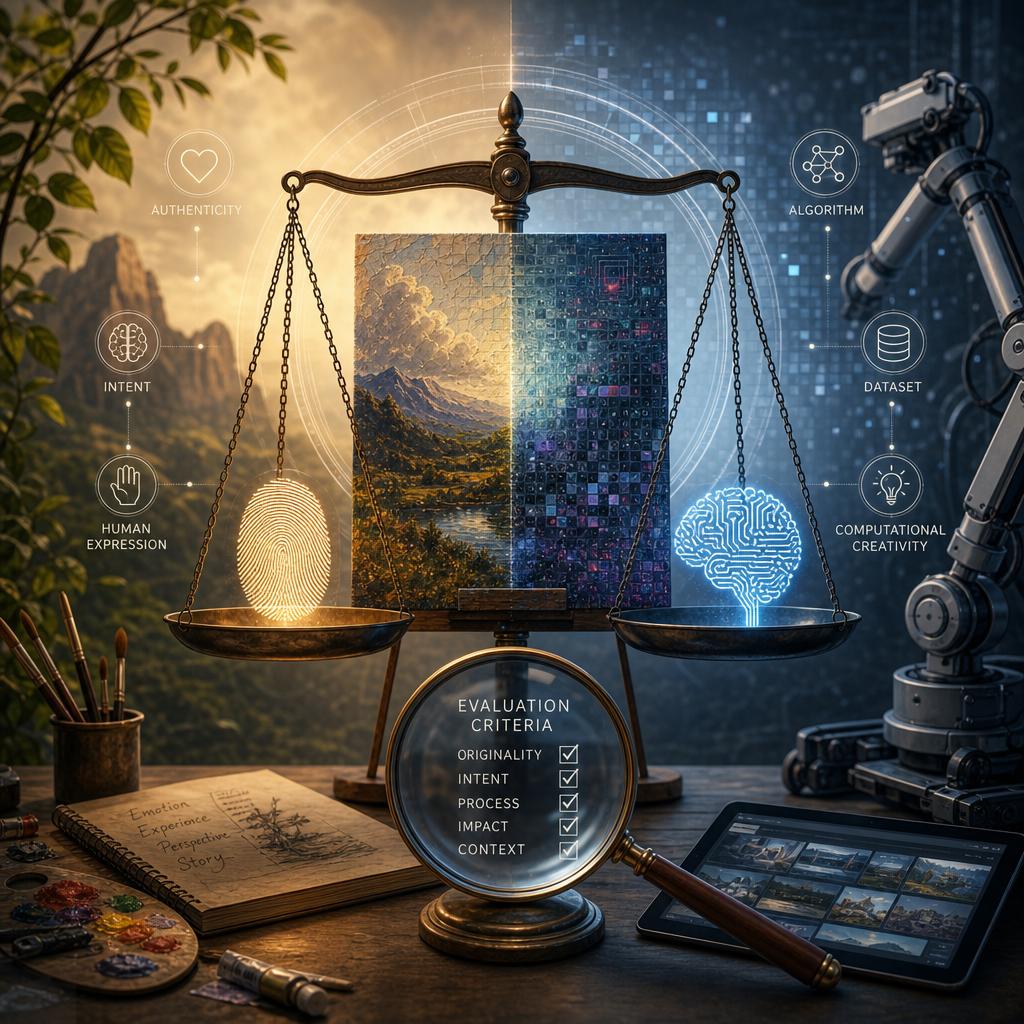
evaluating Authenticity Criteria in the Age of Machine-Made Artwork
In an era where algorithmic creativity challenges traditional artistic boundaries, the question of authenticity transcends mere craftsmanship. The very essence of what constitutes “real” art is under scrutiny as machines generate complex imagery with minimal human orchestration. Authenticity now hinges on the degree of human engagement, sparking polarized views among critics, collectors, and creators alike. Is the artist’s role reduced to programmer or curator, or does the infusion of human intent and conceptual guidance preserve the authenticity of machine-made masterpieces?
To unpack these complexities, it is helpful to consider key criteria often used to evaluate authenticity, reframed for this new context:
- intentionality: Does the artwork embody a purposeful human message or emotion beyond automated output?
- Creative Control: To what extent does the artist steer the final product versus leaving it to random machine iteration?
- originality: Can AI-generated visuals defy replication or are they merely derivatives of pre-existing data?
| Criterion | Human Art | AI Art |
|---|---|---|
| Intentionality | Embedded in concept and emotion | Programmed prompts, indirect emotion |
| Creative Control | Artist guides each detail | Artist guides algorithm, machine explores |
| Originality | Unique, non-reproducible styles | Novel combinations, but data-dependent |
Implications of AI Art on Traditional Art Markets and Intellectual Property
The intersection of AI-generated art with traditional art markets challenges long-standing notions of originality and value. While galleries and collectors have historically placed a premium on the artist’s hand, AI art introduces ambiguity around authorship and creative ownership.Questions arise such as: Does the algorithm deserve credit, or is value derived only from the human input in directing the AI? Traditional markets are reacting cautiously; some art institutions have embraced AI works as innovative collectibles, while others remain skeptical, wary of how such pieces fit within established provenance frameworks. This disruption stimulates dialog on how curators, buyers, and critics might redefine authenticity without diminishing the cultural importance of both human and machine contributions.
From an intellectual property outlook, AI art puts unprecedented strain on existing legal definitions. Current copyright laws typically require human authorship for protection, but AI as a co-creator or autonomous generator muddles this requirement. Key implications include:
- Ambiguity over who owns rights: The programmer, the user guiding the AI, or neither?
- Potential for mass reproduction: Algorithms can replicate styles rapidly, challenging exclusivity and market scarcity.
- new licensing models: Future frameworks may need to address shared or hybrid ownership between humans and AI systems.
| Aspect | Traditional art | AI Art |
|---|---|---|
| Authorship | Human artist | human + Algorithm |
| Uniqueness | One-of-a-kind | Often reproducible |
| IP Protection | Clear legal frameworks | Uncertain, evolving laws |
These challenges compel stakeholders to rethink frameworks governing art’s creation, ownership, and value in an era where technology blurs the lines between the authentic and the artificially generated.
Strategies for Integrating AI Art into Contemporary Artistic Practices
Integrating AI art into modern studios demands more than just technical adoption; it requires a recalibration of the artist’s role and creative process.Artists are increasingly embracing AI as a collaborative partner rather than a mere tool, using algorithms to generate novel visuals that serve as springboards for human refinement.This synergy allows a fusion of human intuition and machine computation, producing art that challenges traditional aesthetics while expanding expressive boundaries. To effectively incorporate AI,practitioners often explore iterative workflows where AI outputs are critically assessed and reworked,ensuring that human intentionality remains central to the final piece.
Key approaches in integration include:
- Hybrid Creation: Combining AI-generated elements with hands-on techniques such as painting or sculpture.
- Algorithmic Curation: Selecting and editing AI outputs to align with personal artistic vision and conceptual themes.
- interactive Interfaces: Developing real-time AI tools that respond dynamically to artist inputs during creation.
- Collaborative Ethics: Establishing transparent authorship protocols that acknowledge both human and machine contributions.
| Integration Strategy | Primary Benefit | Practical Example |
|---|---|---|
| Hybrid Creation | Enhanced textural depth | Painting over AI-generated prints |
| Algorithmic Curation | Focused narrative clarity | Editing AI compositions for thematic cohesion |
| Interactive Interfaces | Dynamic creative flow | Using AI brushes in digital drawing tablets |
| Collaborative ethics | Defined authorship and value | Co-crediting human and AI roles in exhibitions |