

The Evolution of Legal Operations Through Artificial Intelligence
Artificial Intelligence has revolutionized legal operations by automating complex processes that once required extensive manual labor. In the realm of document review, AI-powered tools dramatically reduce the time needed to sift through large volumes of contracts, discovery materialsand legal briefs. These clever systems employ natural language processing (NLP) to identify relevant information, flag inconsistenciesand suggest pertinent case law, ensuring that no critical detail is overlooked. As a result, legal teams can allocate resources more efficiently, focus on strategic decision-making, and significantly cut down on the risk of human error.
clause analysis, a vital component of contract management, benefits immensely from AI’s precision and speed. By automatically extracting and categorizing clauses, AI platforms enable lawyers to compare contract terms across multiple documents with ease.This technology also highlights unusual or non-standard clauses that may require closer scrutiny. Consider the comparison of traditional versus AI-driven processes below:
| Aspect | Traditional Method | AI-Enhanced Method |
|---|---|---|
| Speed | days to weeks | Minutes to hours |
| Accuracy | Prone to oversight | High consistency with minimal errors |
| Cost | Expensive due to manual labor | Reduced operational expenses |
| Scalability | Limited by human capacity | Easily scales across large datasets |
By integrating AI into legal workflows, firms gain the competitive edge needed to navigate increasing complexities while maintaining compliance and safeguarding client interests. Key benefits include:
- Accelerated review cycles that improve turnaround times.
- Enhanced risk management through consistent clause identification.
- Data-driven insights that inform negotiation strategies.
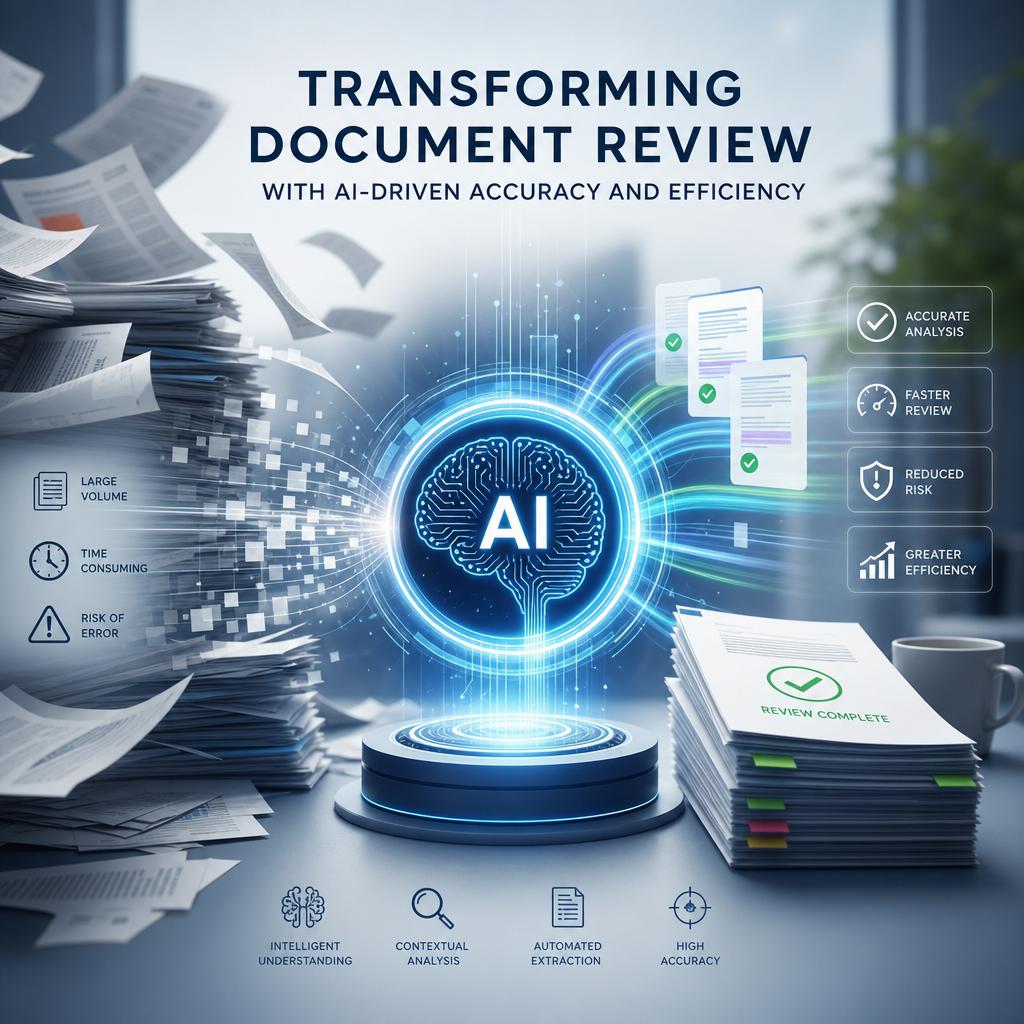
Transforming document Review with AI-Driven Accuracy and Efficiency
The integration of artificial intelligence into legal document review has revolutionized traditional workflows, yielding profound improvements in both accuracy and efficiency. AI-driven platforms are capable of identifying and extracting critical information from vast volumes of contracts, reducing human error and accelerating the review process. By leveraging advanced natural language processing algorithms, these systems can detect subtle discrepancies and inconsistencies that might otherwise go unnoticed, ensuring compliance and mitigating risk with an unprecedented level of precision.
Key benefits realized through AI-powered document analysis include:
- Automated Clause Recognition: quickly identifies and categorizes clauses, enabling rapid contract summarization and risk assessment.
- Consistency Checks: Ensures uniform terminology and conditions across multiple documents to prevent contractual conflicts.
- Prioritization of High-Risk Items: flags critical clauses for immediate attention, optimizing resource allocation during review stages.
| Feature | Traditional Review | AI-Driven Review |
|---|---|---|
| Speed | Days to weeks | Hours to minutes |
| Accuracy | Subject to human error | Consistent and precise |
| Scalability | Labor-intensive | Easily scalable |
Advanced Clause Analysis techniques Powered by Machine Learning
Machine learning has revolutionized the way legal professionals approach clause analysis, bringing unprecedented precision and speed to document review processes. By leveraging advanced algorithms, AI models can identify subtle variations and hidden risks within contract clauses that might be easily overlooked by human readers. This approach not only reduces manual labor but also enhances consistency,ensuring that every clause aligns with regulatory requirements and organizational policies.
Key benefits include:
- Automated risk assessment: AI evaluates clauses for potential legal pitfalls and flags areas needing attention.
- Context-aware interpretation: Algorithms understand the semantics of clauses beyond mere keyword spotting, enabling deeper insights.
- Scalability: Large volumes of contracts can be reviewed quickly without compromising accuracy.
| Clause Type | AI-Driven Analysis Focus | Typical Outcome |
|---|---|---|
| Indemnity | Risk exposure quantification | Clearer liability definitions |
| Termination | Condition detection and validity | Reduced contract disputes |
| Confidentiality | Compliance with data protection laws | Enhanced privacy safeguards |
Implementing AI Solutions for Optimal Legal Workflow Integration
Integrating AI into legal workflows revolutionizes the way law firms and corporate legal departments handle the immense volume of documents thay process daily. By automating document review, AI platforms rapidly identify relevant information, flag inconsistencies, and prioritize content for lawyers’ attention, significantly reducing manual labor and human error. This not only accelerates turnaround times but also enhances the precision of contract analysis. With the ability to understand natural language and legal terminologies, AI tools extract critical clauses and provide actionable insights, enabling legal teams to focus on strategy rather than routine tasks.
Key benefits of AI implementation in legal operations include:
- Enhanced accuracy: Minimizes overlooked clauses or errors through complete and consistent analysis.
- Time efficiency: Streamlines contract review cycles, allowing faster decision-making and client response.
- Resource optimization: Frees legal professionals from repetitive tasks to concentrate on higher-level matters.
- Risk mitigation: Provides early detection of potentially problematic clauses and compliance issues.
| Workflow Stage | AI Capability | Expected Outcome |
|---|---|---|
| Document ingestion | Automated data extraction | Faster planning and sorting |
| Clause Identification | Contextual analysis | Accurate clause categorization |
| Risk Assessment | Predictive analytics | Early detection of legal exposure |
| Review Feedback | Machine learning refinement | Improved AI model accuracy over time |