

Fine Tuning and Retrieval Defined: understanding the core Concepts
At its core, fine tuning involves adapting an existing machine learning model by training it further on a specialized dataset. This process refines the model’s parameters so it better fits a particular task or domain, improving accuracy and relevance in specific applications. Fine tuning requires access too the model’s internal architecture and usually, a sizable amount of annotated data that reflects the target use case. Through this targeted retraining, the model can exhibit enhanced performance in context-sensitive scenarios, making it a powerful method to customize solutions without starting from scratch.
On the other hand,retrieval approaches focus on dynamically fetching relevant details from a knowledge base or dataset at inference time,rather than modifying the underlying model.This technique leverages external data sources by searching and extracting the most pertinent pieces of information to supplement the model’s response generation. Retrieval methods are especially valuable when dealing with vast, frequently updated content where retraining would be impractical. They offer flexibility and immediacy by combining real-time data access with machine learning, leading to more informed and context-aware outputs.
| Aspect | Fine Tuning | Retrieval |
|---|---|---|
| Data Use | Trains on specialized datasets | fetches relevant external data |
| Model Change | Updates model parameters | Leaves model unchanged |
| Flexibility | Less flexible after update | More adaptable in real-time |
| Use Case | Specific tasks/domains | Dynamic, up-to-date info |
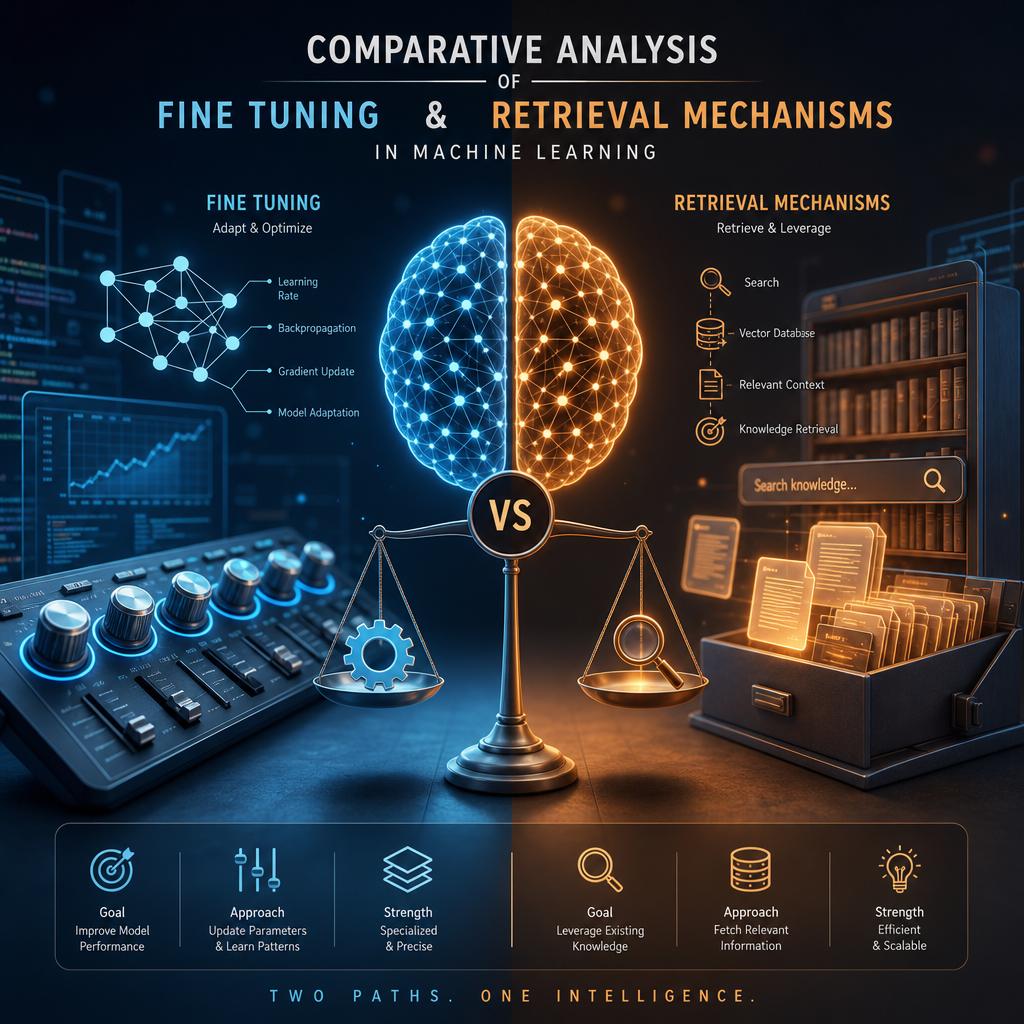
Comparative analysis of Fine Tuning and Retrieval Mechanisms in Machine Learning
Fine tuning in machine learning involves taking a pre-trained model and adapting it by continuing the training process on a domain-specific dataset. This process allows the model to refine its existing knowledge, tailoring it to nuanced use cases with relatively fewer data. It excels in scenarios where the underlying features and representations learned during initial training remain largely applicable but require subtle adjustments to boost performance. Key benefits include:
- Enhanced model accuracy on niche tasks
- Reduced training time compared to full model advancement
- Efficient leveraging of previously learned representations
Conversely, retrieval mechanisms operate by dynamically fetching relevant data or information from external sources to assist the model’s predictions, instead of modifying its parameters. This approach is potent where domain knowledge is constantly evolving or too vast to encode directly within the model.retrieval methods blend the strength of real-time contextual insights with the base model’s capabilities, offering flexibility and up-to-date responses.
| Aspect | Fine Tuning | Retrieval Mechanisms |
|---|---|---|
| Model Adaptation | Internal parameter adjustment | External data querying |
| Data Dependency | Requires labeled domain data | Requires curated external knowledge bases |
| Performance Focus | Specialized task accuracy | timely and relevant information retrieval |
| Flexibility | Static until retrained | Dynamic, up-to-date responses |
Practical Implications and Use Cases for Selecting Fine Tuning or Retrieval
Choosing between fine-tuning and retrieval methods frequently enough boils down to the specific demands of your project. Fine-tuning excels in scenarios where deep customization is necessary and domain-specific knowledge must be embedded directly into the model. This approach is particularly beneficial in industries like healthcare, legal, and finance, where the cost of errors is high and nuanced understanding is crucial. It ensures that the model not only understands generic language patterns but also adapts to specialized terminologies and contexts. However, fine-tuning requires significant computational resources and considerable labeled data, making it less ideal for projects with limited budgets or small datasets.
On the other hand, retrieval-based methods shine when flexibility and up-to-date information access are paramount. By leveraging external knowledge bases or document corpora,retrieval techniques enable models to pull in relevant data on-the-fly,which is especially useful for applications such as customer support chatbots,dynamic Q&A systems,and content proposal engines.The lightweight nature of retrieval systems often translates to faster deployment and easier maintenance compared to fine-tuned models.Here’s a comparison to summarize practical considerations:
| Aspect | Fine-Tuning | Retrieval |
|---|---|---|
| Adaptability | Highly domain-specific | Broad and flexible |
| Resource Requirement | High computational cost | Lower, mainly storage and indexing |
| Update Frequency | Infrequent retraining needed | Instant updates by modifying knowledge base |
| Data Needs | Large labeled datasets | Rich external data repositories |
Best Practices and Strategic Recommendations for Implementing Fine Tuning and Retrieval
When approaching fine-tuning and retrieval methods, a strategic mindset is essential to harness their full potential. Fine-tuning, which involves adapting a pre-trained model on a specific dataset, thrives on relevance and quality. Focus on curating a high-quality dataset that closely mirrors your target domain to ensure the adjustments the model learns are meaningful and impactful. Avoid overfitting by employing validation strategies such as cross-validationand consider incremental fine-tuning to progressively enhance model performance without eroding foundational knowledge. Implement robust monitoring tools to track model drift and performance metrics continuously after deployment.
On the retrieval side, best practices center on optimizing the search and indexing processes. Prioritize building an efficient embedding space using pre-trained vector representations and ensure your retrieval system supports fast similarity search techniques, such as Approximate Nearest Neighbor (ANN) algorithms. Regularly update your index with fresh data to maintain relevance and reduce latency for end-users. Key recommendations include:
- Balance precision and recall by fine-tuning retrieval parameters based on user feedback and query logs.
- Leverage hybrid models combining both traditional keyword-based methods with vector retrieval for enhanced accuracy.
- Implement caching layers to serve high-frequency queries swiftly, improving overall responsiveness.
| Aspect | Fine-Tuning Recommendation | Retrieval Recommendation |
|---|---|---|
| Data Updates | Periodic re-training with new labeled data | Incremental index updates |
| Performance Monitoring | Track validation loss and overfitting | Analyze query latency and precision metrics |
| User Feedback | Incorporate into training dataset | Adjust retrieval thresholds |