

Enhancing AI Code Quality Through Precise Context Definition
To achieve superior AI code quality, it is essential to anchor growth in well-defined context parameters. Context serves as the foundation upon which all AI functionalities rest, guiding algorithms to behave as expected within specific environments or scenarios. Without precise context definition, AI models risk generating outputs that are ambiguous, inconsistent, or irrelevant. By establishing clear boundaries and conditions, developers ensure that both the data inputs and code logic align seamlessly with the intended application domain, fostering robustness and reliability in performance.
Furthermore, explicit behavior specifications and rigorous testing protocols complement contextual clarity by reinforcing code accuracy and stability. Developers should focus on these key elements:
- Behavior specifications: Detail expected AI responses to given inputs, outlining success criteria and potential edge cases.
- Automated Tests: Implement tests that verify code adherence to the behavior under varying contexts, detecting regressions early.
- Iterative Refinement: Use test feedback to refine both context definitions and behavioral rules, ensuring continuous enhancement.
| element | purpose | Impact on Code Quality |
|---|---|---|
| Context | Defines environment & constraints | Prevents ambiguity & misinterpretation |
| Behavior | Specifies expected responses | enables predictable and consistent outputs |
| tests | Validates behavior under conditions | Ensures reliability and early error detection |
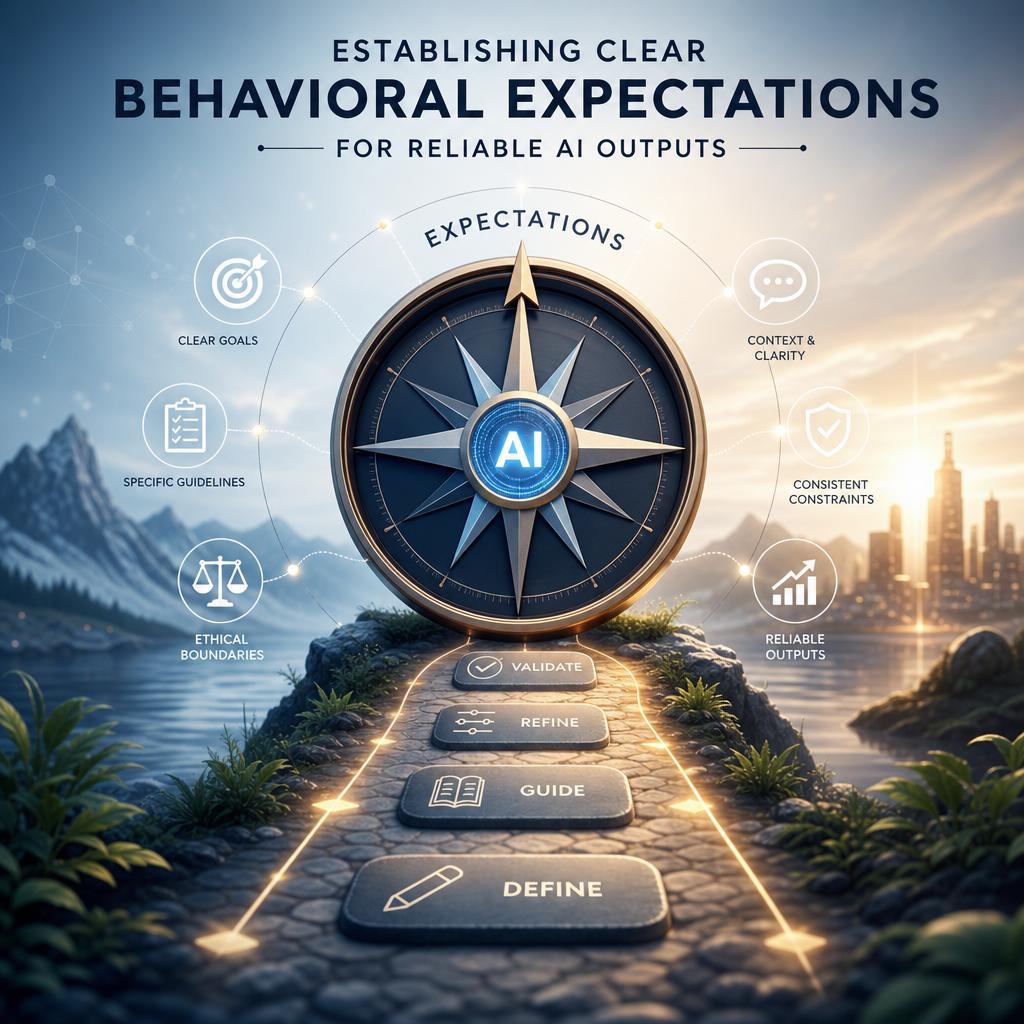
Establishing Clear Behavioral Expectations for Reliable AI Outputs
To achieve dependable AI outputs, it is essential to delineate specific behavioral standards that guide the AI’s decision-making processes. Clear behavioral expectations act as guardrails, ensuring that the AI responds consistently within the designed parameters. This involves defining precise operational scopes such as acceptable input types, expected output formats, response latency, and error handling protocols. By outlining these standards explicitly, developers can mitigate risks of ambiguous or unintended responses, fostering trust in AI-driven applications.
implementing these expectations systematically also streamlines testing and quality assurance. Consider the following key elements when establishing behavioral norms:
- Consistency Criteria: Define how the AI should behave under recurring scenarios to avoid output variability.
- Edge Case Handling: Specify rules for rare or unexpected inputs to maintain reliability.
- Performance Benchmarks: Set measurable standards for response times and accuracy.
| Behavior Aspect | Example Guideline |
|---|---|
| Output Format | Always return JSON for API responses |
| Error Handling | Gracefully notify user on invalid input |
| Latency | Responses within 300ms under normal load |
Implementing Rigorous Testing Strategies to Validate AI Performance
Ensuring AI models deliver reliable and accurate outcomes demands a multi-faceted approach to testing. A core principle is to define clear, measurable performance metrics that align with the intended application context-whether it’s natural language understanding, predictive analysis, or autonomous decision-making. Rigorous evaluation through cross-validation and stress testing under varied conditions exposes potential weaknesses early. Incorporating synthetic and real-world datasets helps simulate a comprehensive range of scenarios, ensuring robustness beyond controlled environments.
To maintain ongoing accuracy and adaptability, implement continuous testing pipelines that automate regression checks following any code or model update. Key elements include:
- Unit tests: Target individual components such as preprocessing and feature extraction modules for precise bug identification.
- Integration tests: Verify the interactions between AI subsystems, ensuring data flows and decision logic remain consistent.
- Performance benchmarks: Track latency, throughput, and resource consumption to balance speed with accuracy.
| Test Type | Purpose | Example Metric |
|---|---|---|
| Unit Test | Component correctness | Function output accuracy |
| Integration Test | Subsystem interaction | Data pipeline integrity |
| Performance Test | Resource usage | Response time (ms) |
Best Practices for Integrating context, Behaviorand Testing in AI Development
Effectively combining context, behaviorand testing within AI development demands a structured approach that maps out the AI’s operating environment and expected actions before code implementation. start by defining the context clearly-this means documenting the parameters, data inputsand conditions under which the AI is expected to operate. Next, precisely outline the AI’s behavior in response to diverse stimuli, ensuring that every function has an intended outcome aligned with user needs and ethical standards. Integrating these elements from the outset creates a robust framework that not only guides coding decisions but also streamlines the testing process downstream.
- Map Contexts: Identify variations in environment and inputs to prevent unexpected AI responses.
- Define Expected Behaviors: Use clear, testable criteria specifying how AI should respond under each context.
- Develop Targeted Tests: Create unit, integrationand scenario tests that validate each behavior within its context.
| Element | Purpose | Example |
|---|---|---|
| Context | Defines operating scenarios | Data privacy constraints in financial AI |
| Behavior | Specifies functional outcomes | Reject transactions that exceed limit |
| test | Confirms behavior correctness | simulate transaction breaches to verify denial |
Building upon these foundations, continuous integration of testing throughout the AI development lifecycle ensures early detection and correction of discrepancies between expected and actual AI behavior. Automated tests coupled with real-world simulation environments serve not only as quality gates but also as learning mechanisms for iterative refinement. By emphasizing the triad of context, behaviorand testing from the start, AI developers can significantly reduce the risk of deployment failures, enhance transparencyand build user trust in clever systems designed for complex, dynamic environments.