

- Legal Complexities in Copyright Claims Against AI Training Practices
When navigating the intricate terrain of copyright claims linked to AI training, the legal landscape is often murky and fraught with uncertainty. One important challenge is the determination of authorship and ownership in works generated or influenced by AI systems, especially when the training data includes copyrighted material obtained without explicit permission. Courts grapple with questions such as whether AI outputs constitute derivative works or if the dataset’s original creators retain rights over the material used. This ambiguity complicates the enforcement of copyright protections and raises concerns about potential infringement,particularly when AI models generate content bearing stylistic or substantive resemblance to copyrighted sources.
- Data provenance issues: Verifying the origin and licensing status of training datasets can be difficult, complicating the attribution of liability.
- Fair use debates: Whether AI training falls within fair use or requires authorization remains contested.
- Enforcement challenges: Identifying responsible parties is problematic when multiple entities contribute to the AI model’s development and deployment.
| Legal Concern | Implications | Current Status |
|---|---|---|
| Unauthorized Dataset Use | Potential infringement claims & injunctions | Subject to ongoing litigation |
| Derivative Work Classification | Ownership disputes | Unclear statutory guidance |
| Liability Attribution | Determining responsible parties | Case-by-case judicial decisions |
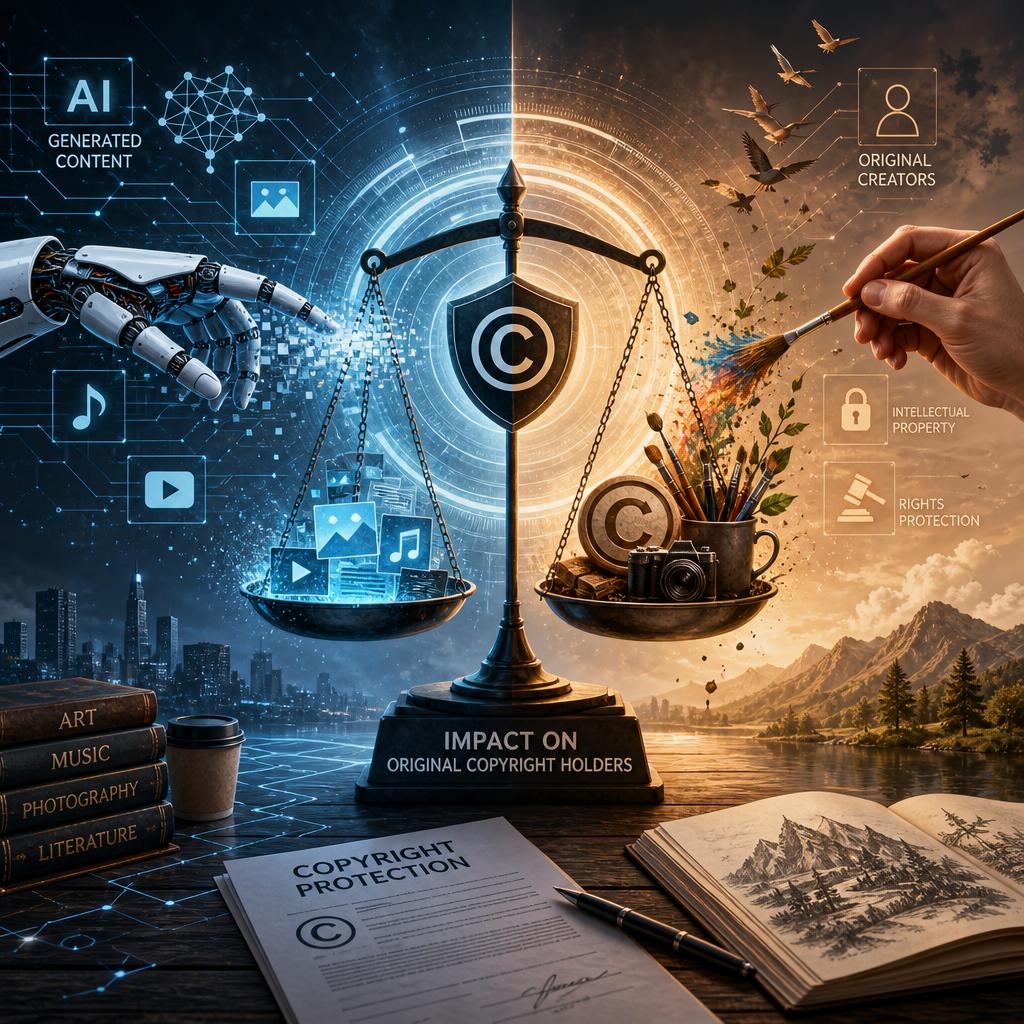
– Analyzing the Impact of AI-Generated Content on Original Copyright Holders
When AI-generated content replicates or is heavily inspired by copyrighted worksoriginal copyright holders face unprecedented challenges in asserting their rights. The core issue lies in the training datasets, where AI models ingest vast amounts of protected materials without explicit permission or compensation. This has raised significant concerns over unauthorized use, as the AI-produced content may closely mimic protected expressions, even if not verbatim. The resulting ambiguity complicates legal redress for creators, creating a legal gray area without clear precedents to identify infringement versus transformative use.
Key impacts on original copyright holders include:
- loss of Control: Creators may lose influence over how their works are utilized or altered within AI training processes.
- Market Dilution: AI-generated imitations flood the market, possibly undermining the commercial value of authentic original content.
- Legal Complexities: Courts must navigate uncharted territory in determining liability when AI outputs infringe copyrights.
| Impact Area | Challenge Faced | Potential Outcome |
|---|---|---|
| Training Data Usage | Unauthorized inclusion of copyrighted works | Possible misuse claims and demand for licensing |
| Output Similarity | Generation of near-identical protected content | disputes over originality and infringement |
| Monetization Rights | Profit from AI content without original creator compensation | Legal battles over revenue sharing |
- Navigating Fair Use and Licensing in AI Model Development
In the evolving landscape of AI development, the principles of fair use are increasingly scrutinized, particularly when training models on vast datasets containing copyrighted materials. Developers must carefully assess whether the use of copyrighted content falls within the allowable limits of fair use,balancing factors such as the purpose of use,the nature of the work,and the amount incorporated. However,the ambiguity surrounding these factors often leads to complex legal challenges and varying interpretations across jurisdictions. AI practitioners are advised to adopt rigorous documentation and clear policies to mitigate risks, ensuring that datasets are curated to respect intellectual property rights while facilitating innovation.
licensing emerges as an indispensable tool in this domain,offering a structured framework to legally incorporate copyrighted materials into AI training regimes. Many organizations now seek partnerships or acquire licenses that explicitly define the scope of usage, thus avoiding potential infringement claims. A strategic approach to licensing includes:
- Negotiating flexible terms that address both current and future AI applications
- Implementing clear attributions to original content creators
- Regularly updating agreements to reflect evolving AI capabilities and legal landscapes
| licensing Model | Key Benefit | Potential Limitation |
|---|---|---|
| Royalty-Free | cost-effective volume usage | May lack exclusivity |
| Direct Licensing | Tailored use cases | Higher negotiation complexity |
| Open-Source | Community-driven improvements | Varied legal enforceability |
Ultimately, navigating the labyrinth of fair use and licensing demands proactive legal consultation and a thorough understanding of both technology and intellectual property law, paving the way for lasting and compliant AI innovation.
– Strategic recommendations for Mitigating Copyright Risks in AI Deployment
To navigate the complex terrain of copyright challenges in AI developmentorganizations must adopt a multifaceted approach centered on compliance and clarity. First and foremost, securing appropriate licenses or permissions from original content creators when training AI models is essential. This proactive step not only respects intellectual property rights but also cushions against potential legal disputes. Additionally, maintaining rigorous documentation of data sources and usage terms solidifies an association’s position in cases of litigation. Implementing regular audits of training datasets ensures that unintended copyrighted materials are identified and addressed promptly, minimizing risk exposure.
Moreover, companies shoudl integrate technical safeguards to control and monitor AI outputs effectively. Measures include:
- Implementing watermarking or traceability features in AI-generated content to attribute origins and verify authenticity.
- establishing filters that detect and prevent direct replication of copyrighted works in outputs.
- Developing user agreements that clearly outline permissible uses of AI-generated content, shielding developers from downstream liabilities.
By fostering collaboration between legal, technical, and creative teams, businesses can craft policies that uphold copyrights while driving innovation responsibly.