

Choosing the Right AI Tool to Address Key Workflow Challenges
effectively integrating AI into your workflow begins with identifying the most critical bottleneck that hinders productivity and operational smoothness. Instead of attempting to overhaul multiple facets simultaneously, focusing on a single pressing challenge allows for targeted precision and measurable impact. Pinpointing this key area ensures the AI tool selected is perfectly suited to address the exact pain point, driving immediate improvements and creating a foundation for scalability.
Consider the following crucial criteria when evaluating AI solutions:
- Functionality alignment: Does the tool specialize in solving your specific workflow challenge?
- User friendliness: will your team quickly adapt to the technology without steep learning curves?
- Integration capability: Can it seamlessly mesh with your existing systems and software?
- Data security: are industry-standard safeguards in place to protect sensitive information?
| Workflow Challenge | Relevant AI Tool Type | Expected Time Savings |
|---|---|---|
| Manual Data Entry | Clever Automation Bots | 40-60% |
| Customer Support Volume | AI Chatbots with NLP | 30-50% |
| Content Generation | generative AI Assistants | 50-70% |
By strategically selecting an AI tool that solves one significant bottleneck, your organization gains a clear, quantifiable advantage - drastically reducing wasted time and refocusing efforts on higher-value tasks. This targeted approach not only builds confidence in AI adoption but also sets a replicable standard for addressing future workflow challenges.
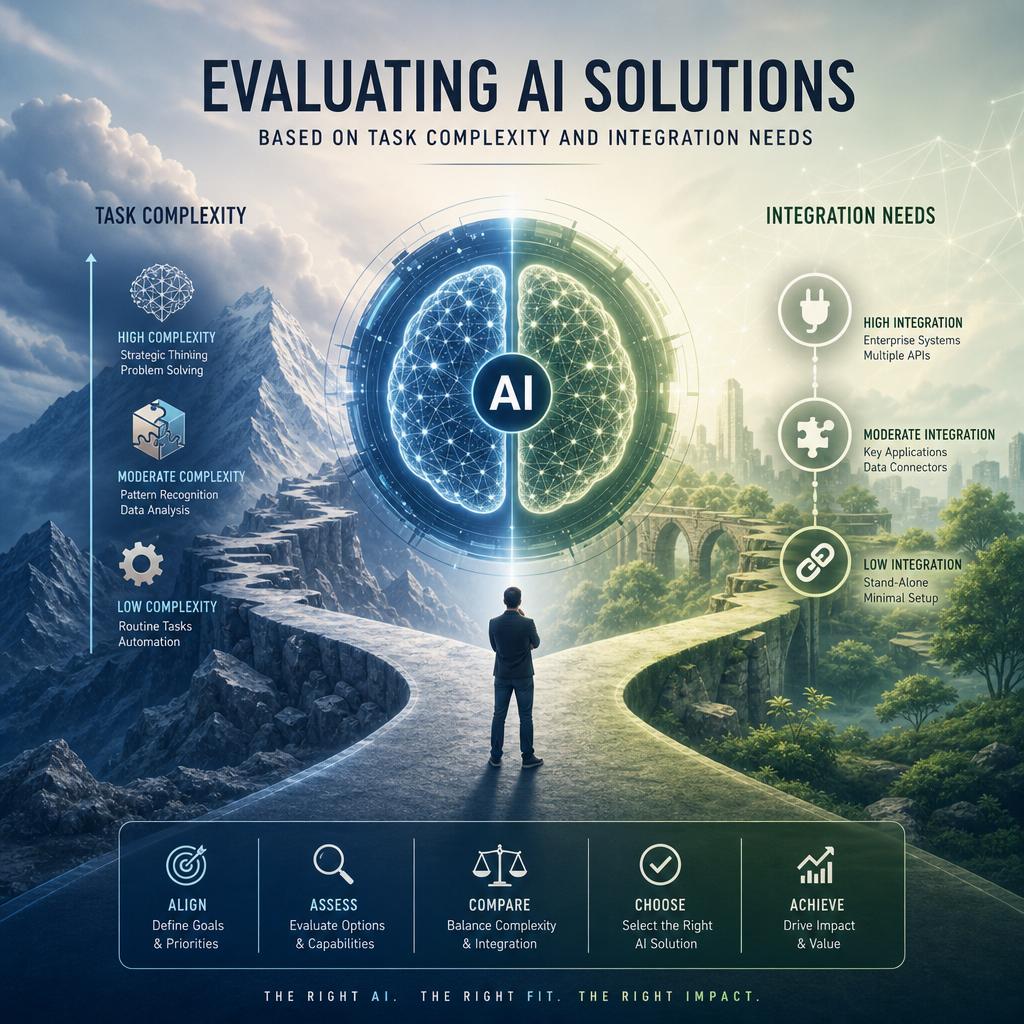
Evaluating AI Solutions Based on Task Complexity and Integration Needs
When selecting an AI solution, its crucial to assess the complexity of the task at hand alongside the integration requirements. Simple tasks, such as automating repetitive data entry or generating standard reports, can frequently enough be addressed with plug-and-play tools that require minimal customization. Conversely,more intricate processes-like predictive analytics involving large datasets or real-time decision-making-necessitate robust platforms capable of deep learning and flexible APIs. Prioritizing tools that precisely target a singular bottleneck ensures efficiency gains without the pitfalls of overengineering.
Key considerations when evaluating AI solutions include:
- Task specificity: Matching tool capabilities directly to the problem scope avoids wasted resources.
- Integration ease: Seamless connection with existing systems reduces deployment time and disruption.
- Scalability potential: Ensures that the solution can grow with emerging business demands.
- User experience: intuitive interfaces promote adoption by end-users and smooth operational flow.
| Task Complexity | Recommended AI Tool Type | Integration Requirement |
|---|---|---|
| Low | Pre-built automation scripts | Minimal API connection |
| Medium | A.I. platforms with configurable workflows | Standard API/Webhook integration |
| High | custom AI solutions with deep learning capabilities | Full-stack system integration |
Maximizing Efficiency Through Targeted AI implementation
When integrating artificial intelligence into your workflow, the key principle is to focus on a single, critical bottleneck that throttles productivity. Rather than deploying broad, unfocused AI solutions, a targeted approach allows you to address specific pain points efficiently, resulting in immediate and measurable time savings. As an example, automating data entry or streamlining customer inquiries can free up valuable human resources that were previously tied down by repetitive tasks. This laser-focused implementation ensures a high return on investment and paves the way for expanded AI use in other areas as confidence grows.
Successful AI adoption relies on selecting tools with clearly defined capabilities aligned to your bottleneck. Consider the following criteria when choosing a tool:
- Precision: Can it precisely resolve the identified issue without creating additional overhead?
- Integration: Does it seamlessly fit into your existing processes and software ecosystem?
- Scalability: Can the solution scale as the problem area grows or evolves?
| Focus Area | Example AI Tool | Time Saved |
|---|---|---|
| Customer Support | AI Chatbots | Up to 40% |
| Data Management | Automated Data Entry | Up to 60% |
| Marketing | Content Optimization | Up to 30% |
by adhering to this focused methodology, you are not just investing in technology, but in a strategic capability that systematically maximizes efficiency and creates a foundation for lasting growth.
Best Practices for Sustained Time Savings and Continuous Improvement
To ensure lasting benefits from AI integration, it’s crucial to maintain a disciplined approach focused on sustainable practices. Start by regularly evaluating the impact of the AI tool on your workflow to confirm it continues to address the key bottleneck effectively. Set measurable benchmarks tied to time savings and efficiency improvementsand review these metrics periodically. Additionally, empower your team with ongoing training and updates to fully leverage the tool’s capabilities, preventing skill gaps that could diminish gains.
- Document processes: Keep detailed records of workflows and how the AI tool is used, ensuring clarity and consistency.
- Encourage feedback: Create open channels for team members to report challenges or suggest enhancements to optimize usage.
- Iterative improvements: Use insights from performance reviews and feedback to refine tool settings or adopt complementary solutions.
| Practice | Benefit | Frequency |
|---|---|---|
| Performance Metrics Review | Identifies new bottlenecks early | Monthly |
| User Training Sessions | Boosts tool proficiency | Quarterly |
| Feedback Collection | Improves adoption and satisfaction | Continuous |