

legal Foundations for Accountability in AI-Related Harms
Companies can face legal liability for harms caused by artificial intelligence under existing frameworks that address negligence, product liabilityand data protection. Negligence claims may arise if a company fails to exercise reasonable care in the growth, deploymentor monitoring of AI systems, leading to foreseeable harm. Similarly, product liability laws can hold manufacturers or vendors accountable if an AI product malfunctions or causes injury due to design defects, inadequate warningsor failure to update software to prevent known risks. Moreover, data protection regulations such as the GDPR impose strict obligations on companies regarding the use of personal data by AI, with violations triggering administrative penalties and private claims.
- Negligence: Failure to exercise reasonable care in AI design or supervision.
- Product Liability: accountability for defective AI products causing harm.
- Data Protection Laws: Compliance with data use and privacy standards.
- Contractual Breaches: Liability stemming from violation of terms governing AI use.
| Legal basis | Potential Claim | Example Scenario |
|---|---|---|
| Negligence | Personal Injury | AI-driven vehicle crashes due to poor sensor calibration |
| Product Liability | Defective Product | Malfunctioning AI medical device causing misdiagnosis |
| Data Protection | Privacy Violation | Unauthorized AI profiling using sensitive personal data |
| Contract Law | Breach of Terms | AI service failing to meet agreed performance metrics |
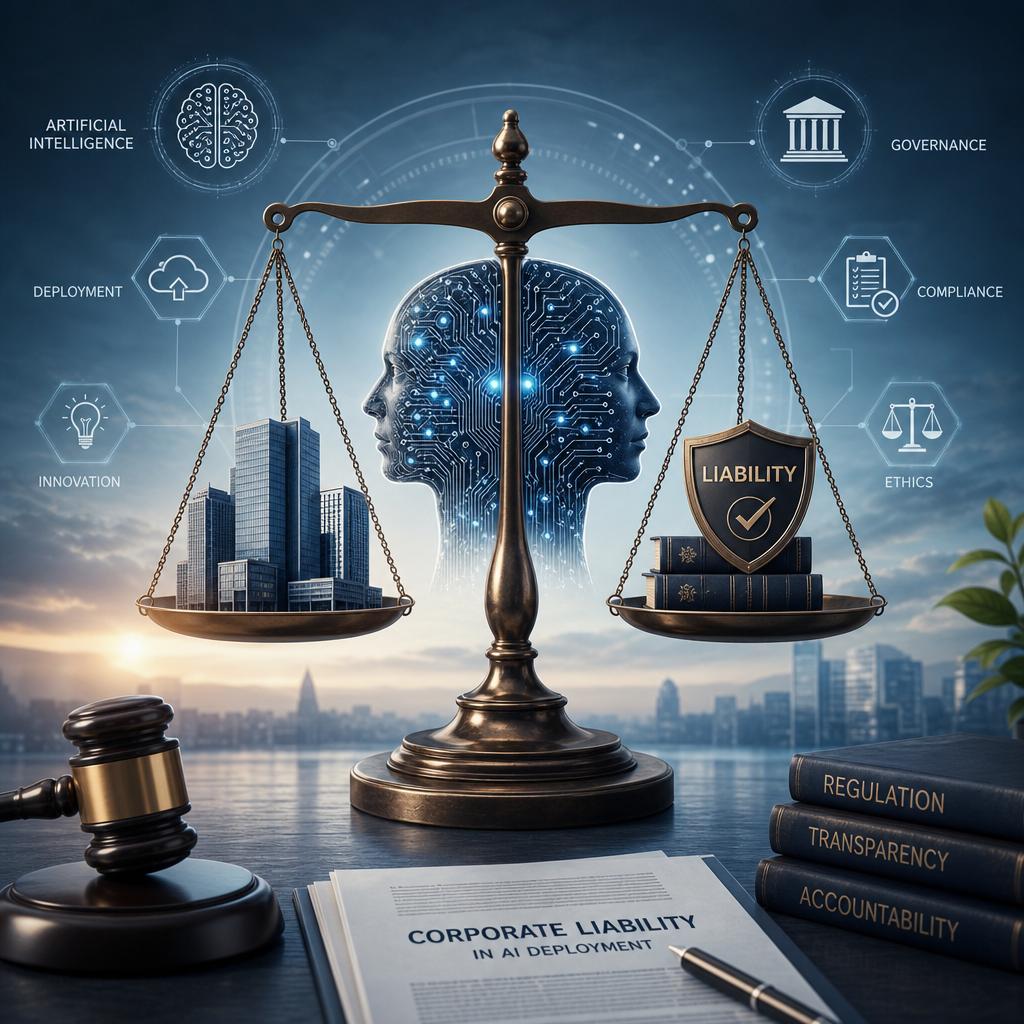
Analyzing Corporate Liability in Artificial Intelligence Deployment
When corporations deploy artificial intelligence systems,liability issues arise from the complex interplay between the technology’s autonomous decision-making and the traditional frameworks of responsibility. Legal accountability may hinge on several factors, including the degree of control the company exercises over the AI, the adequacy of risk assessments conducted beforehandand whether the deployment aligns with existing regulations. Courts increasingly consider whether the harm caused by AI could have been foreseen and mitigated through reasonable corporate governance practices.
Several key legal principles come into play when analyzing liability:
- Negligence: Failure to implement sufficient safeguards or to monitor AI behavior adequately.
- Strict liability: Holding companies responsible regardless of fault if AI causes inherently risky outcomes.
- Product liability: When AI is regarded as a product, manufacturers and deployers might potentially be liable for defects or malfunctions.
- Vicarious liability: Corporate responsibility for the acts of agents controlling or programming the AI system.
| Legal Basis | Submission to AI Deployment | Example Scenario |
|---|---|---|
| Negligence | Lack of proper AI testing | Unintended discrimination in hiring algorithms |
| Strict liability | AI causing physical harm | Autonomous vehicle accidents |
| Product Liability | Defective AI software | Security breach from software vulnerability |
Challenges in Proving Negligence and Causation in AI Cases
Establishing negligence in cases involving artificial intelligence introduces unique complexities unmatched in traditional litigation.A key difficulty lies in defining the standard of care: What exactly should a company have anticipated or prevented when deploying advanced algorithms capable of autonomous decision-making? Unlike human actors, AI systems operate based on data-driven models that evolve over time, making it challenging to pinpoint a clear breach of duty. Moreover, the distributed nature of AI development-often involving multiple contractors, open-source componentsand continuous updates-blurs lines of responsibility. This multifaceted habitat demands courts to innovate their legal frameworks and consider whether existing negligence principles adequately address the dynamic interaction between humans and machines.
Proving causation also presents formidable hurdles as it requires linking the AI’s actions directly to the harm suffered. Due to AI’s intricate and often opaque decision-making processes, identifying the exact moment and mechanism causing damage can border on the inscrutable. the presence of intervening factors such as data biases, algorithmic errorsor external environmental changes complicates establishing a straightforward causal chain. Litigation may need to rely heavily on expert testimony to unravel these complexities, but even then, the unpredictability of AI outputs and the latent impact of training datasets frequently enough weaken the evidentiary clarity necessary for prosperous claims.
- Ambiguous standard of care: Defining reasonable conduct in AI deployment.
- Diffuse responsibility: Multiple stakeholders complicate liability attribution.
- Opaque algorithms: Difficulties in tracing decision pathways.
- Intervening factors: Externalities that disrupt causal connections.
Strategic Recommendations for mitigating legal Risks in AI Use
To effectively manage the evolving legal landscape around AI, companies must adopt a proactive approach grounded in comprehensive risk assessment and transparent governance. Implementing robust compliance frameworks that align with current regulations and anticipate future policy shifts is crucial. Organizations should prioritize continuous audits of AI systems to detect biases, errorsor unintended consequences early. Embedding ethical standards into AI development processes-not merely as a checkbox but as a core operational pillar-can substantially mitigate exposure to liability claims. Additionally, cultivating a culture of accountability, where developers and management understand their legal obligations, enhances a company’s ability to respond swiftly and convincingly if legal challenges arise.
Moreover, clear communication and informed consent with consumers about AI usage are essential defensive tools. Companies should establish explicit policies for data handling, algorithmic openness, and user recourse mechanisms. Consider these strategic actions summarized in the table below:
| Strategic Action | Purpose | Legal Benefit |
|---|---|---|
| Regular AI Impact Assessments | Identify and mitigate risks before deployment | Demonstrates due diligence |
| Contractual Protections with Vendors | Clarify liability and responsibilities | Limits downstream litigation exposure |
| Transparent User Disclosures | enhance user trust and informed consent | Reduces claim of deception or harm |
| Continuous Regulatory Monitoring | Stay compliant with emerging laws | Prevents penalties and legal sanctions |
In essence, these well-rounded strategies do more than just protect against lawsuits-they foster innovation within safe and ethical boundaries, positioning companies as responsible leaders in AI deployment.