

The Role of AI in Translating Database Schemas into SQL Queries
Artificial Intelligence has revolutionized how database schemas are interpreted and transformed into executable SQL queries. By analyzing complex relationships and multiple tables within a schema, AI can generate precise query scripts that align perfectly with specified goals.This process leverages elegant natural language processing combined with schema understanding, allowing AI to not only write efficient queries but also reduce human errors and labour-intensive trial-and-error debugging. Moreover, AI’s capacity to learn from vast datasets enables it to optimize queries for performance, ensuring faster and more reliable data retrieval.
Key advantages of AI-generated SQL queries include:
- Automated query generation: Seamlessly converting schema structures into usable SQL without manual coding.
- Context-aware optimization: Tailoring queries based on the intent behind data goals for enhanced efficiency.
- Error detection and explanation: Identifying potential pitfalls and providing human-readable rationales behind query decisions.
| Feature | Benefit | Example |
|---|---|---|
| Schema Analysis | Identifies table relationships | Detects foreign key joins automatically |
| Intent Interpretation | Aligns queries with business goals | Generates sales reports based on timeframes |
| Query Explanation | Boosts user comprehension | Breaks down JOIN operations in natural language |
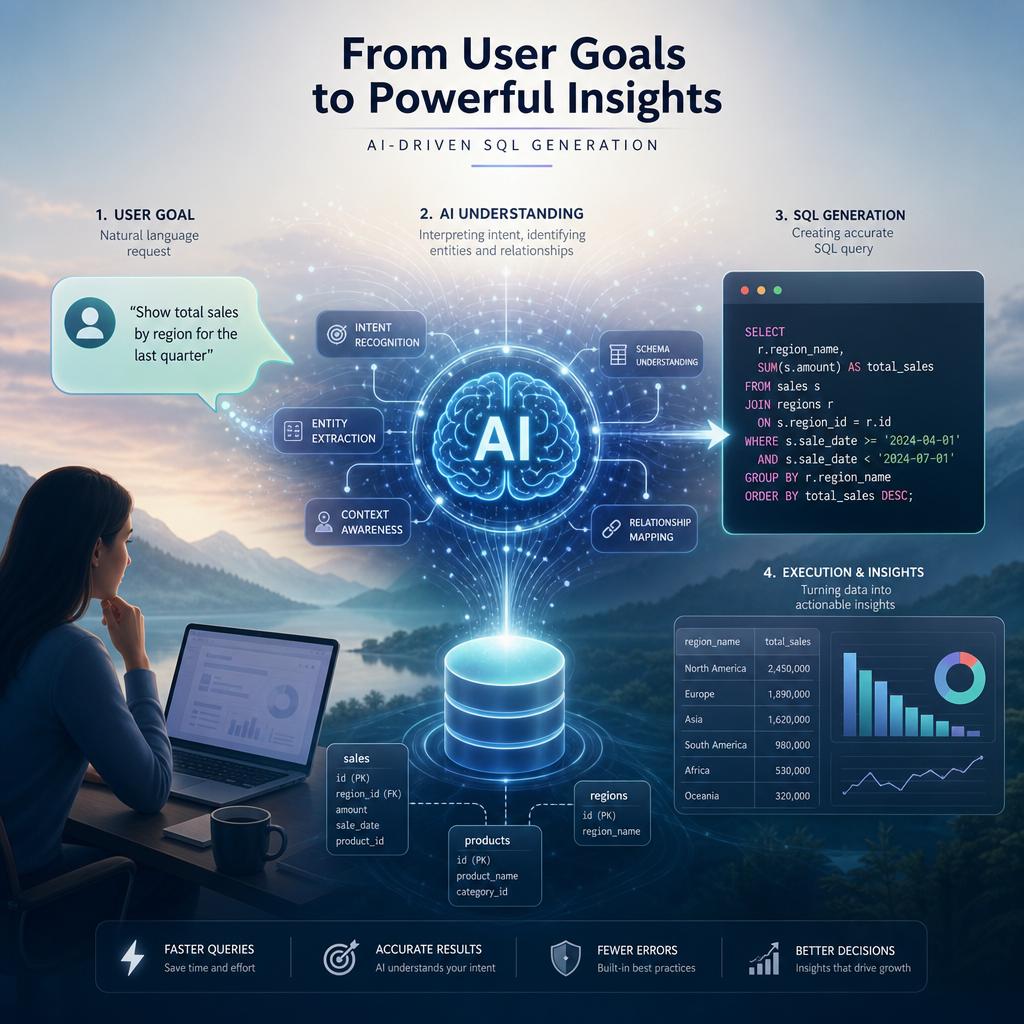
Understanding the Process of AI-Driven SQL Generation from User Goals
AI-driven SQL generation begins by deeply understanding the user’s goals through a combination of natural language processing and schema analysis. The system first decodes the user’s intent, extracting key metrics, relationshipsand constraints embedded in the request. This semantic comprehension allows the AI to map user objectives to the underlying database structure, ensuring that the generated queries are not only syntactically correct but also contextually relevant. The process is iterative, with the AI refining it’s interpretation by cross-referencing the schema’s tables, columnsand data types, thereby aligning the output precisely with what the user aims to achieve.
Key components involved in this process include:
- intent Extraction: Parsing user input to identify target outcomes.
- Schema Integration: Leveraging database metadata for accurate query construction.
- Query Generation: Synthesizing SQL code that aligns with standard practices and user goals.
- Explanation Module: Providing transparent reasoning about each step of the query formulation.
| Stage | Description | Example Output |
|---|---|---|
| Intent Extraction | Identify user goal like “total sales by region” | “Calculate SUM(sales) GROUP BY region” |
| Schema Mapping | Match terms to tables/columns | Table: sales_data; Columns: sales, region |
| SQL Synthesis | Generate executable SQL | SELECT region, SUM(sales) FROM sales_data GROUP BY region; |
| Explanation | Describe query logic step-by-step | Aggregates sales grouped by each region to deliver totals |
Evaluating the Accuracy and Reliability of AI-Generated SQL Code
When assessing the proficiency of AI in generating SQL queries, it’s crucial to focus on both accuracy and reliability. accuracy refers to the AI’s ability to produce syntactically correct and semantically meaningful SQL statements that align perfectly with the specified schema and business goals. Reliability, conversely, measures consistency-whether the AI can replicate this level of precision across diverse database structures and varied query complexities. Multiple rounds of testing using different schemas, query intentsand edge cases help in identifying not only how well the AI understands relational structures but also its adaptability in handling unexpected scenarios like missing data references or ambiguous instructions.
- Syntax Verification: Automated parsers and SQL execution engines quickly detect malformed queries.
- Semantic Validation: Checks if the generated query’s results match the intended data retrieval goals.
- Explainability: The AI’s ability to articulate the logic behind each query component increases trust and usability.
- Performance Testing: Evaluating response times and query optimization to ensure practical efficiency.
| Evaluation Criterion | Key indicator | Measurement Method |
|---|---|---|
| Accuracy | Correctness of generated SQL | Query execution results vs expected output |
| Reliability | Consistent performance on varied schemas | Repeated testing across datasets |
| Explainability | Clarity of AI’s rationale | Human evaluation of explanations |
Best Practices for Leveraging AI Tools in SQL Query Writing and Explanation
Maximizing the potential of AI tools in SQL query writing involves a balanced approach of clear input and strategic validation. AI systems thrive on precision; therefore, providing a well-defined schema alongside explicit goals ensures the generation of accurate and efficient queries. Additionally, it’s crucial to iteratively review AI-generated SQL code to confirm it meets the required business logic and performance standards. Validation should incorporate both automated testing and manual scrutiny, allowing developers to catch nuances that AI might overlook. This continual feedback loop not only enhances query quality but also trains AI models to better understand domain-specific intricacies over time.
Adopting these best practices can streamline the collaboration between human expertise and AI capabilities:
- Define Clear Schema and Objectives: Use detailed table structures with data types and constraints to guide AI effectively.
- Leverage Incremental Query Generation: Build queries step-by-step, allowing AI to generate and explain complex logic in manageable segments.
- Apply consistent Validation Techniques: Cross-check AI outputs with sample data and edge cases for robustness.
- Document AI Explanations: Maintain clear annotations and comments to enhance future maintainability and team understanding.
| Best Practice | Benefit |
|---|---|
| Detailed Schema Input | Reduces ambiguity in AI-generated queries |
| Incremental Logic Explanation | Improves understanding of complex SQL structures |
| Rigorous Validation | Ensures accuracy and performance |
| Thorough Documentation | Facilitates knowledge transfer and troubleshooting |