

The Evolution of AI in Information Retrieval and Its Impact on Traditional Search Engines
As artificial intelligence continues to reshape the landscape of information retrieval, traditional search engines face an evolving challenge that extends beyond algorithmic refinement.AI-powered systems leverage advanced natural language processing, machine learning, and deep semantic understanding to interpret user intent with unprecedented precision. This allows them to deliver highly personalized and contextually relevant results, often synthesizing information across various sources rather than relying solely on keyword matching. Yet,despite these advancements,search engines like Google remain indispensable due to their vast indexing infrastructure and the ability to aggregate real-time data from the entire web ecosystem.
Key factors highlighting the coexistence of AI with traditional search include:
- Robust Data Indexing: Traditional engines maintain immense, continuously updated indexes that AI models rely on for accurate retrieval.
- Efficiency & Speed: Search engines are optimized for rapid query processing and delivering concise results instantly.
- Explainability: Traditional engines provide clear ranking signals, whereas AI outputs can sometimes lack clear rationale.
- Domain-Specific Expertise: AI models excel in niche areas but often depend on search engines for wide-ranging data.
| Aspect | Traditional Search Engines | AI in information Retrieval |
|---|---|---|
| Data Scope | Extensive web crawling and indexing | focused on semantic understanding and contextual links |
| Response Style | Ranked list of web pages | Contextualized synthesized answers |
| User Experience | Fast, familiar interfaces | Conversational and interactive |
The intersection of AI capabilities and traditional search engine infrastructure is not merely competitive but complementary. As both continue to evolve, their integration promises to enhance the accuracy, relevanceand user friendliness of digital information discovery. Far from fully replacing Google Search, AI serves as a powerful extension, augmenting the foundational strengths of established engines to meet the growing complexity of user needs.
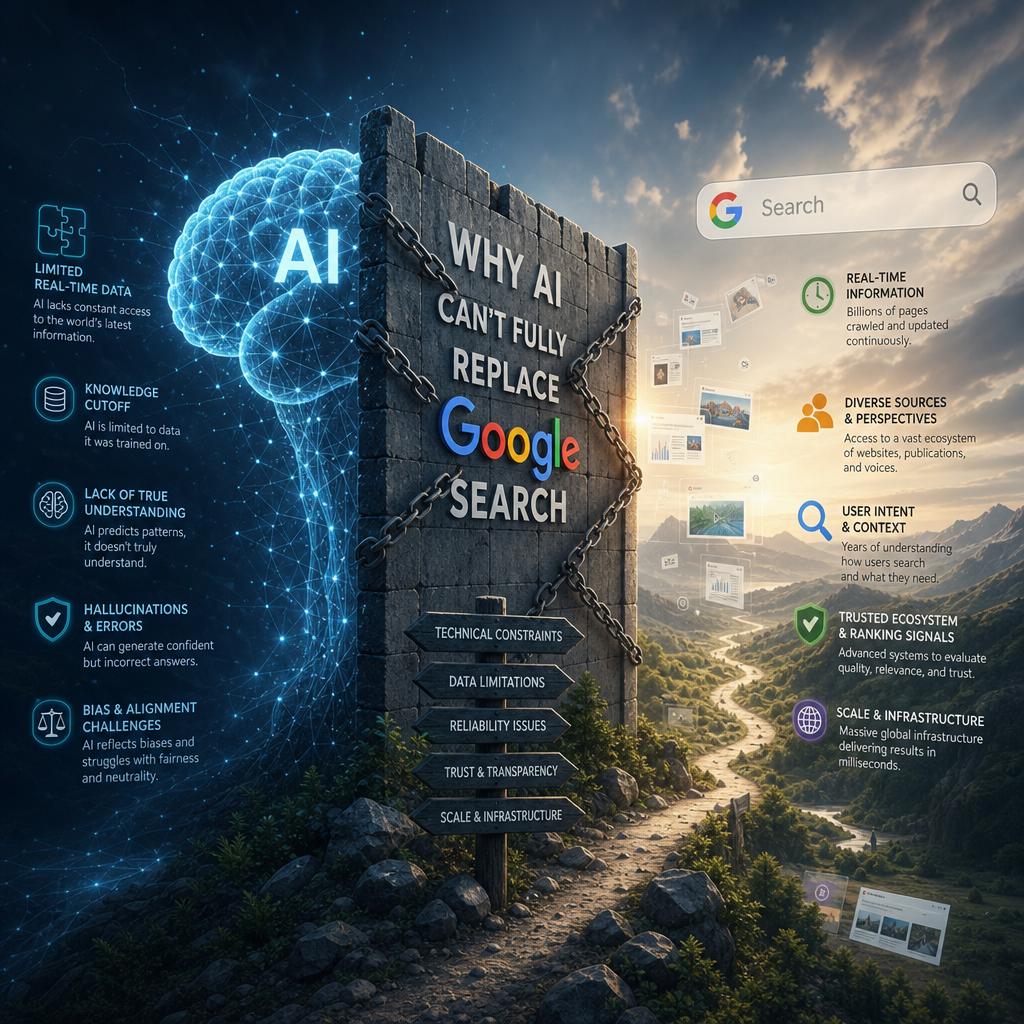
Analyzing the Technical Constraints That Prevent AI from Fully replacing Google Search
Despite the rapid advancements in artificial intelligence, several technical limitations currently hinder AI from fully supplanting Google Search as the primary tool for information retrieval.One core challenge lies in the AI’s dependence on pre-existing data and training sets, which can limit its ability to access the most current and dynamically changing information across the web.Unlike Google’s constantly crawling search engine algorithms, AI models face difficulties in real-time indexing, leading to potential delays or gaps in updated content.Moreover, AI struggles with understanding the nuanced context behind ambiguous or complex queries, which frequently enough require interpreting intent beyond keyword matching-a specialty where Google Search’s multifaceted ranking algorithms excel.
- Data Freshness: Google’s web crawlers update indexed content frequently, whereas AI relies on static training snapshots.
- Contextual Understanding: Traditional search algorithms leverage complex ranking signals to interpret user intent more effectively than AI language models alone.
- Scalability: Handling billions of unique queries daily with optimal response time remains a technical feat best handled by highly optimized search infrastructure.
- Bias and Accuracy: AI models can inherit biases from training data, sometimes producing less reliable or overly generalized answers compared to curated search results.
| Aspect | Google Search | AI-Driven Search |
|---|---|---|
| Content Update Cycle | Continuous real-time indexing | Periodic retraining required |
| Query Interpretation | Multi-layered ranking algorithms | Contextual prediction model |
| Bias Management | Algorithmic adjustments and transparency | Dependent on training dataset quality |
While AI contributes remarkable capabilities in natural language understanding and personalized responses, the inherent complexity of web-scale search demands more than sophisticated language processing. Integration of AI with existing search frameworks continues to enhance user experience but has yet to resolve critical constraints inherent to autonomous AI search tools. For these reasons, Google Search’s robust infrastructure and algorithmic diversity remain indispensable in delivering broad, accurate, and timely search results to users worldwide.
Critical Roles Google Search Continues to Play Amidst Advancements in AI Technology
Despite the rapid advancements in AI technology, Google Search maintains irreplaceable functions that anchor it firmly as the primary gateway to the web. Its unparalleled ability to index and continuously update billions of web pages ensures users receive the most current, diverseand authoritative information available. Unlike AI models that generate responses based on learned patterns, Google Search delivers direct access to original content sources, empowering users to verify facts and explore information in depth.Moreover, the platform’s sophisticated algorithms prioritize relevancy, user intent, and localization, providing a tailored experience that AI alone cannot yet replicate with the same nuance.
- Real-time updates and fresh content retrieval
- Thorough indexing across millions of domains
- Personalized search experience based on user behavior and geography
| Feature | Google search | AI Language Models |
|---|---|---|
| Content Source | Direct from Web | Trained on Web & Data |
| Update Frequency | Continuous | Periodic Retraining |
| User Interaction | Query Suggestion & Refinement | Conversational,Generative |
| Fact Verification | Via Original Links | Dependent on Training Data |
AI systems excel at synthesizing information and offering conversational responses,yet they operate within the boundaries of their training data and current capabilities.Google Search’s critical role in supporting transparency and user control remains unmatched, as it offers not just answers but the means to independently explore and cross-check information. This symbiotic relationship highlights that rather than replacing Google Search, AI technologies serve as complementary tools-enhancing information discovery without compromising the depth, reliability, and breadth that Google has cultivated over decades.
Strategic Recommendations for Integrating AI with Search Engines to Enhance User Experience
To effectively blend artificial intelligence with traditional search engines,businesses must prioritize transparency and contextual understanding. AI systems should be designed to clarify how results are generated, allowing users to trust the relevance and accuracy of responses. Emphasizing context means moving beyond keyword matching towards interpreting user intent more holistically, using natural language processing and behavior analysis. Additionally, integrating AI-powered semantic search capabilities can drastically reduce irrelevant results, ensuring a more precise and satisfying user journey.
Key strategic components include:
- Hybrid Models: Combine AI’s predictive capacities with classic crawl-and-index methods to retain comprehensive and timely data coverage.
- User Personalization: Leverage AI to tailor search experiences dynamically based on user preferences and previous interactions.
- Ethical Frameworks: Develop guidelines for AI deployment that protect privacy, reduce biasand promote fairness.
| Strategic Focus | Impact on Search Experience |
|---|---|
| Contextual Relevance | Reduces noise, surfaces meaningful content |
| Personalized Results | Increases engagement and satisfaction |
| Transparency in Algorithms | Builds user trust and confidence |